Canteen buyers planning 80-bag stock
An exact bag count makes it easier to plan orders and track how many tea bags are used, allowing separately for stronger brews or waste.


For an 80-bag workplace canteen box, choose a decaf black tea whose preparation fits lunch service: Tesco’s product listings give Tetley a 2–3 minute brew and Yorkshire Tea a 4–5 minute brew at 100°C. If organic and Fairtrade sourcing is a procurement requirement, consider Clipper’s 80-bag box; whichever tea you choose, check the delivered pack for ingredients and any residual-caffeine declaration that matters.
An 80-bag box can serve different canteen priorities, from a repeatable lunch-service routine to a specific sourcing requirement.
An exact bag count makes it easier to plan orders and track how many tea bags are used, allowing separately for stronger brews or waste.
If colleagues expect a conventional black tea to drink with or without milk, compare the selected tea’s brewing instructions with the time available during lunch service.
Organic or Fairtrade claims, or a stated decaffeination process, may be relevant when they form part of the workplace’s procurement criteria. Check the current pack for the claims you need.
Start with the exact pack format, then check the brew routine and any sourcing or caffeine specification your canteen needs.
| Priority | What to check | Your needs |
|---|---|---|
| Pack format | Confirm 80 tea bags on the selected pack. Allow separately for double-bagging and waste when planning stock. | I need a consistent 80-bag unit for canteen orders and stock counts. |
| Decaf status | Check that the ingredients describe decaffeinated black tea. Decaf does not necessarily mean caffeine-free; read the current declaration if a precise threshold matters. | Colleagues want a decaf black-tea option, and I need to distinguish it from a caffeine-free infusion. |
| Brewing routine | Tesco’s product information gives Tetley 2–3 minutes, Yorkshire Tea 4–5 minutes at 100°C and Tesco Decaff Original 3–5 minutes. Follow the instructions on the box you serve. | During lunch service, I want staff to be able to use a repeatable brewing routine with the canteen’s equipment. |
| Sourcing and process | Check the current product’s organic and Fairtrade statements. Clipper says it uses carbon dioxide to decaffeinate its tea; that process claim does not establish a taste advantage. | Our procurement criteria may call for stated sourcing credentials or a particular decaffeination process. |
Twinings explains that minor traces of caffeine can remain in decaffeinated tea. A decaf label alone therefore does not establish a precise residual-caffeine level.
If a particular threshold matters, check the declaration on the current pack rather than treating all decaf teas as interchangeable.
Product information can change, and Twinings’ online statements differ on residual caffeine. A website description may not settle which specification applies to the box in the canteen.
Before service, read the delivered pack’s ingredients, allergen information, brewing instructions, best-before date and any relevant caffeine statement.
Tesco’s checked decaf results included PG Tips packs of 70 and 160 bags. Neither meets an exact 80-bag stock requirement.
Keep the 80-bag requirement when comparing stock units, or change that requirement explicitly before considering other pack sizes.
These references concern the specified decaf packs and ranges, not every tea made by each brand.
Tesco Decaff Original is listed as an 80-bag, 250g decaf tea pack.
Tetley Decaffeinated is listed as an 80-teabag, 250g black-tea pack.
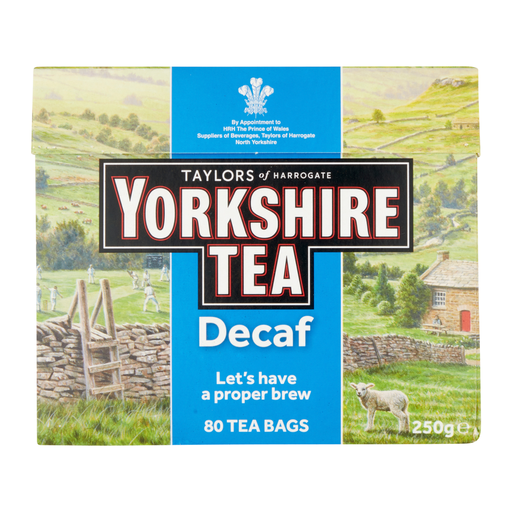
Yorkshire Tea Decaffeinated is listed as an 80-teabag, 250g black-tea pack.
Twinings Everyday Decaffeinated is an 80-bag, 250g tea described by Twinings as containing Kenyan teas.
Clipper describes its 80-bag Everyday Decaf as organic and Fairtrade black tea.
PG Tips is a decaf brand to consider if the canteen can use a different stock-unit size.
These options cover 80-bag decaf black teas for canteen lunch service, including everyday packs and an organic, Fairtrade-labelled choice.
 No image available
For an 80-bag decaf black-tea stock unit when staff can allow the stated 4–5 minute brew at 100°C. The corresponding Yorkshire Tea 250g product listing identifies 80 tea bags; check the delivered pack before service.
 No image available
An 80-bag decaffeinated black tea with a stated 2–3 minute brewing guide for staff planning a lunch-service routine. Decaf should not be treated as a guarantee of zero caffeine; check the current pack if a specific threshold matters.
 No image available
An 80-bag decaffeinated black tea for a canteen whose procurement criteria include the stated organic and Fairtrade attributes. Check the delivered pack for those claims and its tea-brewing instructions before service.
Not necessarily: Twinings explains that minor traces of caffeine can remain after decaffeination. Check the selected tea’s current pack declaration if a particular residual-caffeine threshold matters.
Use the instructions on the selected box and test the routine with the canteen’s kettle or urn. Tesco’s product information gives Tetley 2–3 minutes, Yorkshire Tea 4–5 minutes at 100°C and Tesco Decaff Original 3–5 minutes; the timings are not interchangeable instructions for every tea.
Check the physical pack being served. Tesco warns that food products can be reformulated, so website information should not replace the current label’s ingredient and allergen information.