Morning tea drinkers reducing caffeine
If you want to keep a conventional black-tea break, decaf is an option. Check the exact pack’s caffeine statement rather than treating decaf as a promise of zero caffeine.


For a familiar morning cuppa with less caffeine, start with an everyday or English Breakfast decaf black tea and choose the blend that suits how you drink it. Decaf does not necessarily mean caffeine-free, so check the statement on the exact pack; flavourings, brewing instructions and pack size can also change which tea fits your routine.
Decaf black tea suits different morning routines, but the pack’s caffeine wording and the blend’s flavour still matter.
If you want to keep a conventional black-tea break, decaf is an option. Check the exact pack’s caffeine statement rather than treating decaf as a promise of zero caffeine.
If you usually take tea with milk, compare everyday and English Breakfast decaf blends. Yorkshire Tea describes its Decaf as retaining the character of its tea, while Twinings describes distinct Everyday and English Breakfast blends.
If organic ingredients or Fairtrade sourcing affect your choice, look for statements about the specific tea. Clipper describes its Organic Everyday Decaf as organic black tea traded in compliance with Fairtrade standards.
Choose the kind of cup you want, then check its caffeine wording and brewing directions. Pack size and sourcing claims can help distinguish options that otherwise suit the same morning routine.
| Priority | What to check | Your needs |
|---|---|---|
| Residual caffeine | Read the exact tea’s caffeine statement. Check whether a figure refers to dry leaves, a teabag or a prepared cup before comparing it with another figure. | I’m reducing caffeine, so I want wording that helps me account for the tea I actually drink. I won’t assume that decaf means none. |
| Blend and flavour | Distinguish plain everyday black tea and English Breakfast from flavoured styles such as Earl Grey. Read the blend description if you have a particular taste in mind. | For a familiar tea with milk, I’d start with an everyday or English Breakfast decaf; I’d choose Earl Grey when I want its bergamot character. |
| Brewing | Follow the product’s directions rather than using one timing for every bag. Tesco’s PG Tips Decaf listing gives 1–2 minutes, while Twinings gives 2–3 minutes for its English Breakfast Decaffeinated. | A quick morning brew matters to me, so I’ll check the directions for the tea I buy. |
| Pack and sourcing | Check bag count and weight for the amount you keep at home. If sourcing or processing matters to you, read the specific organic, Fairtrade or decaffeination statement. | I may want a smaller pack to try a blend, or more bags for regular breaks. Sourcing claims matter to me only when they apply to the product I’m choosing. |
Residual caffeine matters when you are keeping track of your intake. Twinings says its decaf tea contains less than 0.1% caffeine in dry leaves and gives 3mg as a typical decaffeinated-teabag figure; Tesco’s PG Tips Decaf listing states less than 0.2% caffeine, on a different stated basis.
Read the exact pack’s statement, and do not treat figures with different measurement bases as directly comparable.
Plain everyday tea, English Breakfast and Earl Grey offer different flavour profiles. A familiar brand name alone does not tell you which style is in the pack.
Start with everyday or English Breakfast decaf for a conventional black-tea cup; choose Earl Grey if you want its characteristic flavouring.
Clipper says it uses carbon dioxide to decaffeinate its Organic Everyday Decaf. That process statement does not give you a caffeine amount for the cup.
Use sourcing and processing statements to assess those preferences, and check caffeine wording separately.
These references describe particular decaf lines and their stated features; they are not a ranking of the brands or a list of products available on Joybuy.
Its Decaf is a traditional black-tea option for a familiar morning cup.
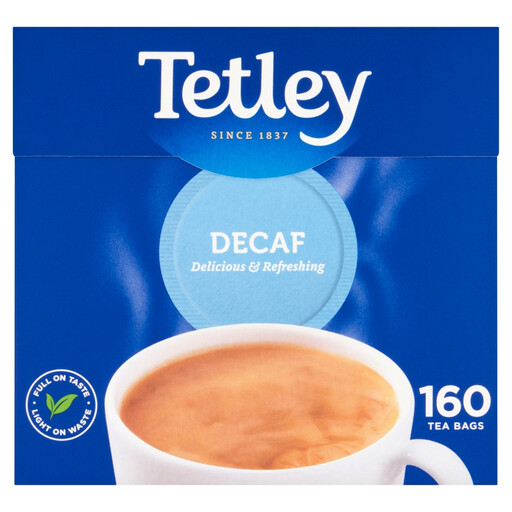
Tetley offers decaffeinated black tea in tea-bag packs, including an 80-bag pack and a 160-bag pack.
PG Tips Decaf is a black tea with a short brewing direction in Tesco’s product listing.
Its decaf range includes Everyday and English Breakfast black-tea blends with different stated profiles.
Organic Everyday Decaf is a black-tea option for shoppers who look for stated sourcing and processing details.
Tesco Decaff Original Tea is an own-label everyday decaf black-tea option.
These tea-bag options include everyday decaf black teas and a smaller Ceylon-style pack for a morning break. Choose by the blend and pack size you want, then check the individual tea’s caffeine wording.
 No image available
An 80-bag decaf pack for a regular morning tea break. If you are tracking caffeine intake or prefer tea with milk, check the pack’s caffeine and serving guidance.
 No image available
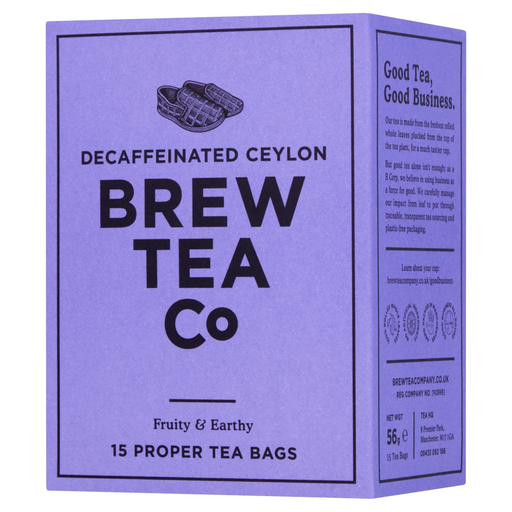
A smaller decaf tea-bag pack if you want to try a different black tea for your morning break. Check the pack for brewing directions and a caffeine statement before relying on a particular caffeine level.
 No image available
The 160-bag pack gives regular tea drinkers a larger supply than the listed Tetley 80-bag pack. Check its own caffeine statement rather than treating decaf wording as proof of zero caffeine.
 No image available
An everyday decaf tea-bag pack for shoppers interested in its stated organic and Fairtrade attributes. Clipper says it uses carbon dioxide to decaffeinate Organic Everyday Decaf; check caffeine wording separately.
 No image available
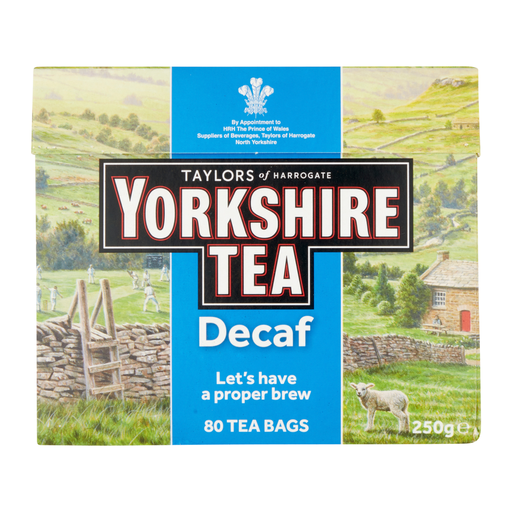
A decaf version of Yorkshire Tea’s traditional black-tea style in a 250g pack. Yorkshire Tea describes its Decaf as retaining the character of its blend; check this pack for bag count, brewing directions and caffeine wording if those affect your choice.
Not necessarily. Twinings says its decaf teas contain less than 0.1% caffeine in dry leaves and gives 3mg as a typical decaffeinated-teabag figure. Tesco’s PG Tips Decaf listing states less than 0.2% caffeine. Check the exact product’s wording, including what any measurement refers to.
Start with an everyday or English Breakfast decaf black tea if you want a conventional morning cup. Twinings describes its Everyday Decaffeinated as hearty and well-rounded and its English Breakfast Decaffeinated as a robust Assam, Kenyan and Ceylon blend; Yorkshire Tea describes its Decaf as retaining the character of its tea. Let your preferred flavour guide the choice.
Follow the directions for the tea you buy. Tesco’s PG Tips Decaf listing specifies 1–2 minutes, while Twinings recommends 2–3 minutes for English Breakfast Decaffeinated. One pack’s timing is not a rule for every decaf tea.
No. Those labels concern different product attributes. Clipper describes its Organic Everyday Decaf as organic black tea traded in compliance with Fairtrade standards and says it uses carbon dioxide in decaffeination. Check its caffeine wording separately if residual caffeine matters to you.