Managers stocking a shared tea point
Match a decaf black-tea pack to the kitchen’s turnover and storage space. Decide whether staff need sealed portions or can use bags from a shared pack.


For a shared office tea point, choose a decaf black-tea pack that fits how often it will be used and how the bags will be stored. Individually wrapped portions suit meeting rooms and visitor trays; a standard pack may be more practical where staff use the same dry, maintained kitchen. Check the exact pack if caffeine content, ingredients or sourcing marks matter to your workplace.
Match a decaf black-tea pack to the kitchen’s turnover and storage space. Decide whether staff need sealed portions or can use bags from a shared pack.
Individually wrapped bags can provide sealed portions for visitor trays, boardrooms and small catering settings.
Decaf black tea offers a familiar tea format, but decaf does not necessarily mean caffeine-free. Check the declaration on the particular pack if caffeine intake matters.
Start with where the bags will be served, then compare the pack’s caffeine statement, ingredients and brewing instructions.
| Priority | What to check | Your needs |
|---|---|---|
| Caffeine declaration | Read the exact pack’s decaf and caffeine wording. Do not assume that decaf means caffeine-free. | I want a black-tea option with less caffeine, and I need its label to be clear enough for anyone monitoring their intake. |
| Portion format | Check whether bags are individually wrapped, how many the pack contains and whether opened tea can be kept cool and dry. | For visitor trays, I want sealed portions; at a regularly used tea point, I can consider a shared pack that staff will store properly. |
| Ingredients and sourcing | Read the ingredients and look for any required organic or Fairtrade marks on the exact pack. Check its packaging instructions against local collection arrangements. | Our workplace may have an ingredient or sourcing requirement, so I need the product we order to show the relevant information. |
| Brewing guidance | Compare the selected tea’s stated infusion time and any instructions for making it in a mug. | I want staff to have the product’s brewing instructions before deciding whether its flavour suits the office. |
Decaffeinated tea can retain caffeine. Sainsbury’s listing for PG Tips Decaf 70 tea bags, for example, states less than 0.2% caffeine; that declaration does not describe every decaf product.
Check the chosen pack’s statement. Anyone following individual advice about caffeine should use that advice rather than treating all decaf teas as interchangeable.
Sealed bags serve a clear purpose in meetings and visitor areas, but staff using one shared kitchen may not need a separate envelope for each cup.
Choose the format for the place where tea is served, then compare pack count and dry storage needs.
Individual envelopes also leave a wrapper to handle for each portion.
Ingredients, sourcing marks and disposal instructions can differ between products and packaging formats.
Check the exact item and current pack before using any certification or disposal claim for workplace purchasing.
Instructions vary: Yorkshire Tea advises 4–5 minutes for its brew, while Twinings gives 2–3 minutes for Everyday Decaffeinated.
Keep the selected product’s instructions at the tea point so staff can prepare it as directed before judging the blend.
These examples show different decaf pack formats and label details; check the particular product rather than assuming every item from a brand is the same.
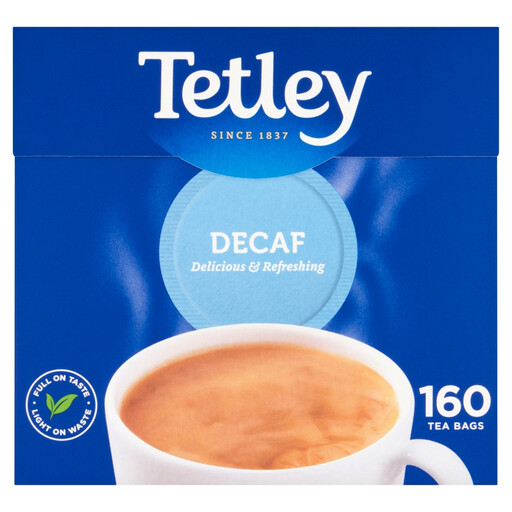
Joybuy lists a Tetley decaf black-tea pack containing 160 bags and 500g, a format to consider for a regularly used shared tea point.
UK retailer listings show PG Tips decaf black tea in 70- and 160-bag packs.
Joybuy lists Yorkshire Tea Decaf in a 500g pack described as approximately 160 bags, with a 4–5-minute brew instruction.
Twinings lists Everyday Decaffeinated in an 80-bag pack and All Day Decaf in distinct pyramid-bag formats.
Clipper identifies organically grown decaffeinated black tea and lists both 25-envelope and 250-envelope catering formats.
Typhoo describes an 80-bag decaf product made with Kenyan tea and gives a 1–5-minute brew range.
These decaf black-tea bag options are relevant to a shared office tea point. Compare their pack sizes and check the current pack if you need sealed portions or a particular caffeine declaration.
 No image available
An 80-bag decaf option for a shared tea point. The product guidance gives a 2–3-minute brew and cool, dry storage; check the pack if you need a numeric caffeine declaration or individually wrapped bags.
 No image available
A larger pack to consider where the shared tea point uses decaf regularly. It contains 160 bags of decaffeinated black tea and calls for cool, dry storage; check the pack for caffeine, brewing and wrapping details that matter to your office.
 No image available
An 80-bag decaf option for an office checking organic ingredients and Fairtrade sourcing. The product description identifies organically grown black tea and advises cool, dry storage; confirm the marks on the exact pack, along with any required caffeine or wrapping details.
It can. Sainsbury’s listing for PG Tips Decaf 70 tea bags states less than 0.2% caffeine; this is a declaration for that product, not a rule for every decaf tea. Check the exact pack when caffeine content affects the choice.
Choose individually wrapped bags when sealed portions are needed for visitors, meetings or desk-side service. For a regularly used shared tea point, a standard pack is another option if it can be kept dry and replenished to suit use.
Follow the chosen product’s instructions rather than applying one time to every blend. Yorkshire Tea advises 4–5 minutes for its brew, while Twinings recommends 2–3 minutes for Everyday Decaffeinated.
No. NHS pregnancy guidance sets a limit of 200mg of caffeine a day and identifies tea among caffeine sources. Decaf tea may still contain caffeine, so someone following that guidance should check the product declaration and account for other sources of caffeine.
Do not assume so. Bag, envelope and outer-pack instructions can differ between products and formats. Read the current pack and check which materials your workplace collection accepts.