What should you check first?
Decide which requirement changes your choice of tea, then check it on the exact product rather than relying on the word “decaf” alone.
Organic-labelled decaf
Choose when: Certified organic production is a firm requirement alongside decaf black tea.
Bear in mind: Organic certification does not establish that a decaffeinated tea is caffeine-free.
Decaf with a stated caffeine figure
Choose when: A product-specific amount per prepared cup helps you account for caffeine in your routine.
Bear in mind: A figure measured for one tea and brewing method cannot be transferred to another.
Everyday decaf black tea
Choose when: A familiar black-tea format and a convenient pack size matter more than an organic claim.
Bear in mind: A decaf label does not establish organic certification or a particular caffeine amount per cup.
| Priority |
What to check |
Your needs |
| Caffeine |
Look for an amount per prepared cup and its water volume and brew time. Yorkshire Tea states 1.5–2mg per 200ml cup brewed for five minutes; that figure is specific to its Decaf. |
I want to account for tea alongside other sources of caffeine, rather than assuming decaf means none. |
| Organic status |
Check the organic claim and certification or control information for the exact tea. Fairtrade and Rainforest Alliance claims address different requirements; Great Britain’s organic labelling rules do not make them substitutes for organic certification. |
Certified organic production matters to my household, so a general sourcing claim will not settle the choice. |
| Tea type and preparation |
Check whether the bags contain black or green tea and follow the pack’s brewing directions. A caffeine figure tied to one brew time should be read with that preparation basis. |
For our usual milk-tea routine, I would start with a decaf black tea; if I prefer green tea, I need to choose that type explicitly. |
| Pack size |
Compare the stated bag count and weight on the packs you are considering. The Clipper organic listing at Tesco describes 40 bags and 116g; the reviewed Tetley decaf black-tea listing describes 80 bags and 250g. |
A pack should last a practical length of time in our household without mistaking a larger bag count for a different tea type or certification. |
Brand and product-line references
These references concern the particular decaf teas described, not every product sold under each brand.
Clipper
Clipper describes Organic Everyday Decaf as decaffeinated organically grown black tea. Tesco’s listing for a 40-bag pack identifies it as organic and gives the control code GB-ORG-05.
- A product-specific organic claim makes this a relevant line to check when certification is the priority.
- The organic claim is not a claim of zero caffeine; check certification details on the particular pack you buy.
Yorkshire Tea
Yorkshire Tea states that its Decaf contains 1.5–2mg caffeine in an average 200ml cup brewed for five minutes.
- The stated preparation basis makes that product’s caffeine figure usable when accounting for a cup.
- The figure should not be applied to other teas or brewing methods; check the exact pack for an organic claim if that matters.
Twinings
Twinings describes a decaf range spanning black, green, English Breakfast and Earl Grey teas. It also explains that traces of caffeine can remain after decaffeination.
- Different tea styles give households a choice beyond everyday black tea.
- Check the particular blend for its caffeine information and any organic claim; a range description does not establish either for every pack.
Tetley
Tesco’s listing for Tetley Decaffeinated 80 Teabags 250g identifies the ingredient as decaffeinated black tea and separately lists Rainforest Alliance certification.
- The listed tea type and 80-bag format make the pack straightforward to compare with other everyday decaf black teas.
- Rainforest Alliance certification is not organic certification; check the exact pack if organic status is required.
Tesco
Tesco lists its own-brand Decaff Original Tea as an 80-bag, 250g option.
- The stated bag count and weight allow a direct pack-size comparison with other decaf teas.
- Tesco advises reading current food labels because product information can change; check the pack for any claim that affects your choice.
Decaf tea options on Joybuy
These options include decaf black and green tea in different pack sizes. If organic certification or a prepared-cup caffeine figure decides your choice, check those details for the exact pack.
 No image available
Taylors of Harrogate Yorkshire Tea Decaf 250g
For a black-tea routine where a stated caffeine amount helps with tracking, Yorkshire Tea gives 1.5–2mg per 200ml cup brewed for five minutes for its Decaf. This is a 250g pack; use the stated brew basis when interpreting the figure, and check the exact pack if organic status matters.
View on Joybuy
 No image available
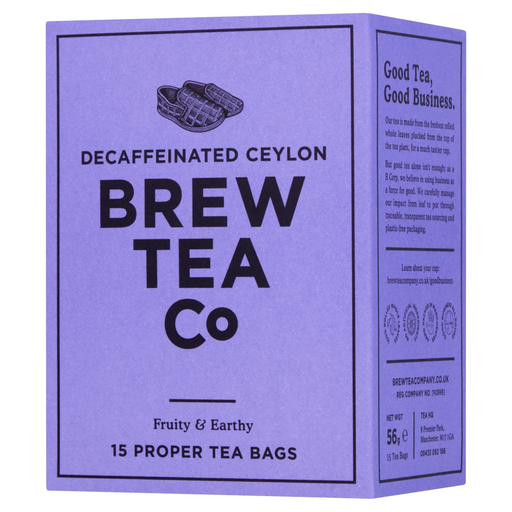
Brew Tea Co CO2 Decaffeinated Tea, 15 bags, 56g
This smaller 15-bag, 56g decaf pack may suit a household trying a different tea before choosing a larger supply. Its name identifies CO2 decaffeination; check the exact pack for organic certification or a per-cup caffeine figure if either is decisive.
View on Joybuy
 No image available
Tetley Decaffeinated Green Tea, 50 bags, 100g
Choose the green-tea format if you do not want a decaf black tea. This pack contains 50 bags and weighs 100g; check its current label for organic information or a prepared-cup caffeine amount if you need either detail.
View on Joybuy
 No image available
Clipper Organic Fairtrade Decaf Everyday, 80 bags, 277g
For a household seeking organic-labelled decaf in a larger tea-bag pack, this Clipper option contains 80 bags and weighs 277g. Organic and Fairtrade are stated in its name; check the certification information on this exact pack if organic status is essential, and do not treat decaf as caffeine-free.
View on Joybuy
 No image available
Tetley Decaffeinated Black Tea, 80 bags, 250g
This is an everyday decaf black-tea format for households that prefer that tea type to green tea. The pack contains 80 bags and weighs 250g; Tesco identifies the ingredient for this product as decaffeinated black tea. Check the exact pack if you need an organic claim or a caffeine amount per prepared cup.
View on Joybuy
Questions about decaf and organic tea
Does decaf tea contain no caffeine?
No. Twinings explains that traces can remain after tea is decaffeinated. For a product-specific example, Yorkshire Tea states 1.5–2mg caffeine per 200ml cup of its Decaf brewed for five minutes; do not use that figure for another tea.
How should I account for caffeine while breastfeeding?
Count tea alongside other caffeine sources rather than considering each drink on its own. NHS Best Start in Life advises breastfeeding parents who consume caffeine to try not to have more than 300mg a day; its guidance also identifies sources such as coffee, chocolate, energy drinks and soft drinks. Ask a GP, midwife or health visitor about individual concerns.
How can I check whether a decaf tea is organic?
Look for an organic claim and certification or control information on the exact pack. The Department for Environment, Food & Rural Affairs says food labelled organic in Great Britain must meet the applicable production rules and certification requirements for the product and its suppliers.
Does Fairtrade or Rainforest Alliance mean a tea is organic?
No. They are separate claims and do not replace the organic certification required for an organic food label in Great Britain. Check the specific tea’s organic wording and control information if organic production is your deciding requirement.
Can I use one brew time for every decaf tea?
Follow the directions for the tea you have chosen. Yorkshire Tea’s stated caffeine figure for its Decaf, for example, is based on 200ml of water and five minutes of brewing; a different preparation should not be assumed to give that stated per-cup figure.


