What should you check?
Choose the type of tea first, then test flavour and brewing in the way the shop will serve it. Pack format and sourcing preferences can help distinguish options that meet those requirements.
| Priority |
What to check |
Your needs |
| Black-tea flavour |
Look for descriptions of the exact blend, not a brand-wide strength claim. Twinings describes English Breakfast Decaffeinated as having body; Clipper calls Organic Everyday Decaf robust, rich and bright. |
I want a recognisable black-tea cup that still appeals when served with milk. A small-pack trial can show whether the flavour suits the intended drinkers. |
| Brewing time |
Follow the pack directions before changing blends. Twinings suggests two to three minutes for English Breakfast Decaffeinated, or four for more punch; Clipper gives two to five minutes for Organic Everyday Decaf. |
Our usual mug size and amount of milk may affect the cup we prefer. I would try the tea as it will actually be served before ordering a larger pack. |
| Residual caffeine |
Read the exact pack’s decaffeination statement. Twinings says minor traces can remain in decaf tea and describes its English Breakfast Decaffeinated as decaffeinated to 0.2%. |
I’m choosing between reducing caffeine and avoiding it altogether. If complete avoidance matters, I need to check the ingredients of a caffeine-free infusion instead. |
| Pack format |
Check the bag count, net weight and storage directions on the chosen pack. Tesco’s UK listings include decaf packs of 40, 70, 80 and 160 bags, though formats differ by product. |
A smaller pack would let us test a blend; for regular service, I need to know how many individual bags the pack contains. |
| Sourcing and materials |
Check claims on the exact product. Clipper describes its Organic Everyday Decaf tea as organic and Fairtrade; do not extend those claims to other blends or assume a particular tea-bag material. |
Organic or Fairtrade tea may matter to our customers, and I want to check the bag and disposal information on the pack we buy. |
Brand references for decaf black tea
These brand references describe particular blends or listed pack formats, not every decaf product a brand makes.
Twinings
Twinings English Breakfast Decaffeinated is worth considering when a traditional black-tea cup with milk is the goal.
- Twinings describes the blend as having body and suggests a four-minute brew for more punch.
- Twinings says it is decaffeinated to 0.2%; it should not be treated as caffeine-free.
Clipper
Clipper Organic Everyday Decaf combines a brand-described robust black-tea blend with organic and Fairtrade tea.
- Clipper gives an infusion range of two to five minutes for its 80-bag Organic Everyday Decaf.
- “Robust” is Clipper’s description; try the blend with the intended serving method to judge its flavour.
Yorkshire Tea
Yorkshire Tea Decaf is a familiar everyday black-tea option for a shop considering a flavour-focused decaf blend.
- Yorkshire Tea says the blend is designed to retain character after caffeine removal.
- That description does not establish how its strength compares with other decaf blends; try the exact pack before stocking up.
PG Tips
PG Tips offers an everyday decaf black-tea alternative in pack formats listed by Tesco, including 40, 70 and 160 bags.
- Several listed bag counts provide a choice between trying a pack and stocking for regular use.
- Check the flavour of the exact decaf product rather than assuming a particular strength from the brand name.
Tetley
Tetley Decaffeinated is another everyday black-tea option; Tesco lists an 80-bag format.
- An individually bagged format may suit regular shared tea service.
- The listed format alone does not establish a strong-tasting cup; check the exact blend and try it if strength is decisive.
Tesco
Tesco’s decaf tea listings include its own-label Tesco Decaff Original Tea alongside branded alternatives.
- Tesco lists an 80-pack of its own-label tea, giving shoppers another pack format to consider.
- An own-label listing does not establish a strong flavour; check the exact product and try it before choosing it for regular service.
Decaf black tea options on Joybuy
These options cover organic decaf black tea and familiar everyday blends that could be considered for a retirement shop. Their pack sizes and flavour descriptions differ, so check the details of the one you intend to serve.
 No image available
Clipper Organic Fairtrade Decaf Everyday 80 Tea Bags 277g
An 80-bag decaf black-tea pack for shared service. Clipper describes the matching Organic Everyday Decaf blend as robust, rich and bright and advises a two- to five-minute infusion. Its flavour description is not a guarantee of how an individual cup will taste; decaf should not be assumed caffeine-free.
View on Joybuy
 No image available
Taylors of Harrogate Yorkshire Tea Decaf 250g
A 250g decaf black-tea option for drinkers who favour a familiar everyday blend. The product description calls it bold and full-bodied, while Yorkshire Tea describes its decaf blend as retaining character; those descriptions are not independent taste results. Check the bag count on the exact pack when planning regular service.
View on Joybuy
 No image available
Tetley 80 Decaffeinated Tea Bags 250g
This 80-bag, 250g decaffeinated black tea is a format to consider for regular service. Its product description suggests a two- to three-minute brew, but the pack format does not establish that it will taste strong to every drinker. Check the exact pack if residual caffeine matters.
View on Joybuy
 No image available
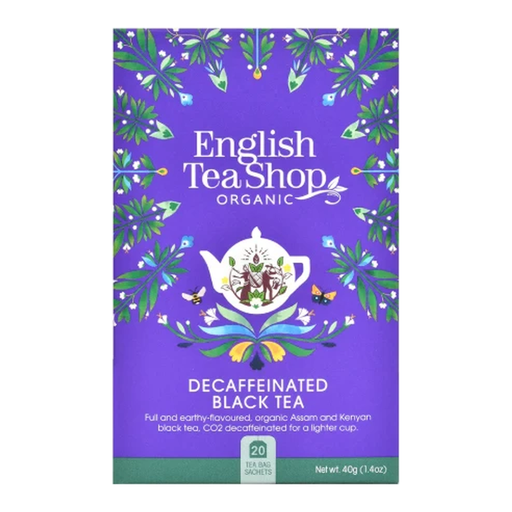
English Tea Shop Organic Decaffeinated Black Tea 20g
This organic decaffeinated black tea has a stated 20g box size, making the pack size worth checking for a small trial. Product descriptions differ between “smooth and mellow” and “rich and full-bodied”, so taste it before treating it as a strong option for regular service. Check the bag count and the basis of any caffeine figure on the exact pack.
View on Joybuy
Frequently asked questions
Does decaf black tea contain no caffeine?
No. Twinings says decaffeination removes nearly all the caffeine from tea, but minor traces can remain. If complete avoidance is the aim, choose an infusion labelled caffeine-free and check its ingredients rather than assuming any decaf black tea meets that need.
How can I try a stronger-tasting decaf cup?
Start with the exact blend’s brewing directions and try it using the mug and milk quantity you normally use. Twinings suggests two to three minutes for English Breakfast Decaffeinated, or four minutes for more punch; Clipper gives two to five minutes for Organic Everyday Decaf.
Which decaf tea should I try with milk?
A decaf black-tea blend described as having body or a robust profile is a starting point, but try it with your usual amount of milk. Twinings describes English Breakfast Decaffeinated as having body, while Clipper describes Organic Everyday Decaf as rich and robust; both are brand descriptions, not a direct taste comparison.
Should a retirement shop start with a large pack?
A small pack is useful when the shop needs to test flavour with its usual brewing and serving method. Before moving to a larger format, check the exact bag count and storage directions; UK retailer listings show that decaf pack counts vary by product.
What should the shop check on the pack it receives?
Check the ingredients, allergen information, best-before date, storage directions and bag count on the received pack. Also distinguish a request for reduced caffeine from one for complete avoidance: decaf black tea can retain traces of caffeine.


