What should you check before buying?
Choose the kind of black-tea blend you want, then check its caffeine wording, brewing directions and pack details for the time and frequency of your revision breaks.
| Priority | What to check | Your needs |
|---|
| Evening use |
Read the exact pack’s caffeine statement; do not interpret “decaf” as zero caffeine. Consider when you plan to drink it: Oxford Health NHS Foundation Trust CAMHS advises avoiding caffeinated drinks 5–6 hours before bed. |
I want a familiar cup during late revision, but the residual caffeine amount matters if I am trying to avoid caffeine near bedtime. |
| Blend and brewing |
Compare plain everyday black tea with origin-described blends. Twinings describes its English Breakfast Decaffeinated tea as a blend of Assam, Kenyan and Ceylon teas; follow the chosen pack’s brewing directions. |
If I normally drink breakfast tea, I may prefer a clearly described blend. For an everyday cup with snacks, I would start with a plain decaf and adjust the brew to taste. |
| Pack format |
Check the bag count, weight and best-before date on the exact pack. UK grocery listings identify 160-bag Yorkshire Tea and Tetley decaf formats, but pack size alone says nothing about flavour preference. |
A larger pack may fit repeated revision breaks; for occasional cups, I would check whether a smaller format suits how often I expect to use it. |
| Ingredients and sourcing |
Read the ingredient list if added flavouring matters. Check the exact product for organic or Fairtrade status and a stated decaffeination method; Tesco’s Clipper listing identifies organic and Fairtrade tea and CO2 decaffeination. |
I may want an unflavoured black tea, or I may care more about Clipper’s stated sourcing and process. Those are separate choices from pack size and brewing style. |
Brand and blend references
These descriptions help distinguish particular decaf products; they do not establish how every tea from each brand tastes or what is available on Joybuy.
Yorkshire Tea
An everyday decaffeinated black-tea blend, with a 160-bag, 500g format listed by Tesco.
- Yorkshire Tea describes its Decaf as blended to retain character after caffeine removal.
- That brand description is not a comparison of brewed flavour or a quantified caffeine amount per cup.
Tetley
Decaffeinated black tea listed by Tesco in 40-bag and 160-bag formats.
- The Tesco listings state that the tea is decaffeinated to 0.2%.
- “Decaffeinated to 0.2%” should not be read as a caffeine-free claim.
PG Tips
A decaf black-tea option listed in 70-bag and 160-bag formats by Sainsbury’s.
- Sainsbury’s describes the 70-bag product as rich and rounded and states that it contains less than 0.2% caffeine.
- The product information identifies natural flavouring; check the exact pack if you prefer tea without added flavouring.
Twinings
An English Breakfast Decaffeinated blend that Twinings describes as combining Assam, Kenyan and Ceylon teas.
- The brand recommends brewing for 2–3 minutes, or four minutes for a stronger cup.
- Twinings’ product information gives inconsistent caffeine figures; check the current pack or ask the manufacturer if the exact amount matters.
Clipper
An organic and Fairtrade everyday decaf black-tea option.
- Clipper describes an Assam-led blend, while Tesco’s product listing identifies CO2 decaffeination.
- Sourcing and process descriptions do not establish a preferred flavour or zero residual caffeine.
Tesco
An own-label Decaff Original tea listed in an 80-bag, 250g format.
- Tesco describes a smooth, rounded tea and gives a 3–5 minute brewing instruction.
- Tesco advises checking the pack because online food information can change.
Decaf tea options on Joybuy
These black-tea options cover smaller packs for occasional cups, larger packs for repeated revision breaks and products with stated sourcing or blend details. Compare each exact pack rather than assuming that its format determines its flavour or caffeine amount.
 No image available
Clipper Organic Fairtrade Decaf Everyday 80 Tea Bags 277g
An 80-bag decaffeinated black-tea option for repeated cups when organic and Fairtrade sourcing matters to you. Check the current pack for its caffeine wording and brewing directions.
View on Joybuy
 No image available
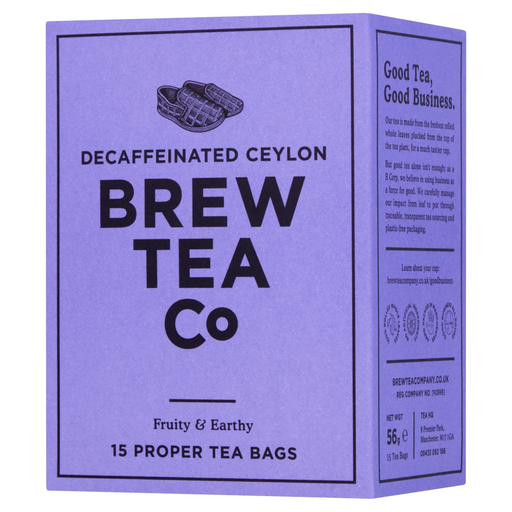
Brew Tea Co Decaffeinated Ceylon Tea, 15 Tea Bags, 56g
A smaller black-tea pack if you want to try an origin-described tea for occasional revision breaks. Its product description identifies Ceylon tea and CO2 decaffeination; follow the current pack for brewing and caffeine details.
View on Joybuy
 No image available
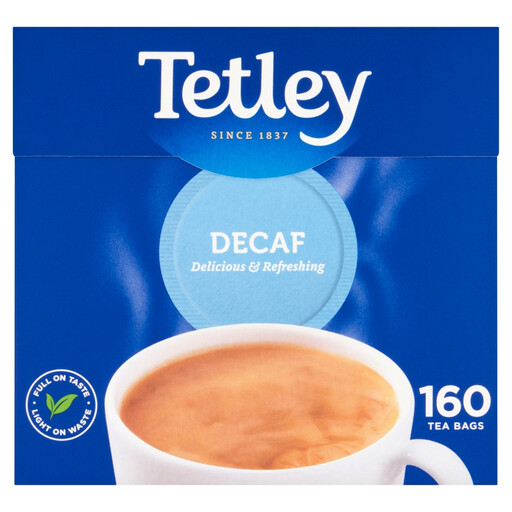
Tetley 160 Decaf Tea Bags 500g
A 160-bag decaffeinated black-tea format to consider for regular revision breaks. The product description identifies Rainforest Alliance-certified tea; check the pack’s caffeine statement and best-before date.
View on Joybuy
 No image available
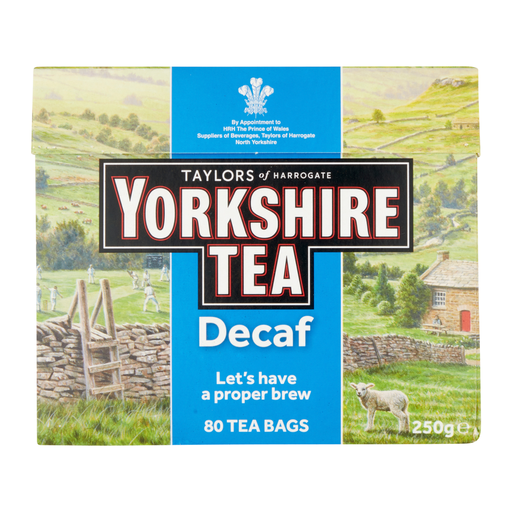
Taylors of Harrogate Yorkshire Tea Decaf 250g
A 250g decaffeinated black-tea blend for a familiar tea-style cup with snacks. Yorkshire Tea describes its blend as intended to retain character after decaffeination; check this exact pack’s bag count and caffeine wording before choosing a format.
View on Joybuy
 No image available
Tetley 80 Decaffeinated Tea Bags 250g
An 80-bag decaffeinated black-tea format if you want a stated brewing guide without choosing the 160-bag pack. Its product description recommends 2–3 minutes; check the current pack for caffeine wording and the best-before date.
View on Joybuy
Decaf tea questions
Is decaf tea caffeine-free?
Do not assume so. Tesco describes Tetley tea as decaffeinated to 0.2%, while a Sainsbury’s PG Tips listing states less than 0.2% caffeine; neither is a zero-caffeine statement. Check the exact current pack and ask the manufacturer if a specific caffeine limit matters.
Which blend should I choose with evening revision snacks?
Choose a decaffeinated black tea whose blend and ingredients match the cup you normally enjoy: an everyday blend for a straightforward tea, Twinings’ origin-described English Breakfast blend for that style, or Clipper if its stated organic and Fairtrade sourcing matters to you. Check residual-caffeine wording too: Oxford Health NHS Foundation Trust CAMHS advises avoiding caffeinated drinks 5–6 hours before bed.
How long should I brew a decaf tea bag?
Start with the directions for your exact product rather than using one time for every decaf. Twinings recommends 2–3 minutes for its English Breakfast Decaffeinated tea, or four minutes for a stronger cup; Tesco gives 3–5 minutes for Decaff Original.
What should I check on the pack before buying?
Check the bag count, weight, ingredients, allergen information, caffeine wording and best-before date where these affect your choice. Read the physical pack as well as the online description, since product information can change.
Does organic or Fairtrade decaf contain no caffeine?
No zero-caffeine conclusion follows from those sourcing descriptions. Clipper identifies organic and Fairtrade tea and a CO2 decaffeination process; check the exact product’s caffeine statement separately.


