Students stocking a shared kitchen
If the tea will be shared, a plain decaf black tea leaves the choice of milk and brewing strength to the person making each cup. Check the pack quantity against the space you have to store it.


For a first shared kitchen, an unflavoured decaf black tea is a flexible starting point if you do not know everyone’s flavour preferences. Choose English Breakfast decaf for a specifically robust breakfast-style blend, or Earl Grey decaf if you want bergamot flavour; whichever you choose, check the exact pack’s ingredients, quantity and caffeine wording, as decaf does not necessarily mean caffeine-free.
If the tea will be shared, a plain decaf black tea leaves the choice of milk and brewing strength to the person making each cup. Check the pack quantity against the space you have to store it.
Decaf tea offers a lower-caffeine option, but it is not necessarily caffeine-free. University Hospitals of Leicester NHS Trust notes that decaffeinated tea can still contain very low levels of caffeine.
English Breakfast decaf, plain everyday decaf and Earl Grey decaf are not interchangeable flavours. Decide whether you want a breakfast-style black-tea blend or Earl Grey’s bergamot character before buying a larger pack.
Choose the blend style first, then compare the exact packs for ingredients, quantity and preparation instructions.
| Priority | What to check | Your needs |
|---|---|---|
| Caffeine | Check that the exact tea is labelled decaffeinated. If you need a strict caffeine limit, check the product’s specific caffeine information rather than assuming decaf means zero caffeine. | I want a lower-caffeine cup later in the day. University Hospitals of Leicester NHS Trust says decaffeinated tea can still contain very low levels of caffeine. |
| Black-tea style | Compare a plain black tea with a named English Breakfast blend. Twinings describes its English Breakfast Decaffeinated as a blend of Assam, Kenyan and Ceylon teas. | For a first shared cupboard, I would start with a straightforward plain tea; if I specifically like a robust breakfast-style cup, I would choose that blend instead. |
| Added flavour | Read the ingredients rather than relying on the word decaf. Clipper lists black tea and natural flavour in its Decaf Earl Grey, while its Everyday Decaf is a plain black-tea option. | I only want Earl Grey if bergamot’s citrus character is a flavour I plan to drink regularly. |
| Pack and storage | Compare the tea-bag count, net weight and stated format. Follow the exact pack’s storage instructions; Tesco’s Tetley Decaffeinated listing specifies a cool, dry place. | A smaller pack lets me try an unfamiliar blend, while a larger one needs to fit my cupboard and expected use. |
| Brewing and disposal | Check the product’s brewing directions. For tea-bag disposal, check both the individual pack and your accommodation’s local food-waste collection rules. | I want a clear starting point for making a cup and a disposal route that applies where I live, rather than assuming every tea bag goes in food waste. |
University Hospitals of Leicester NHS Trust says decaffeinated tea can retain very low levels of caffeine. That distinction matters if your caffeine limit is strict.
Check the exact product information; seek appropriate professional advice if a medical limit applies.
Clipper lists natural flavour in its Decaf Earl Grey, whereas its Everyday Decaf is a plain black-tea blend. A stronger brew of plain tea will not turn it into Earl Grey.
Choose Earl Grey for its bergamot character, or an unflavoured decaf for a more neutral shared-kitchen option.
Tea-bag counts and pack weights differ, so the quantity that works for a shared cupboard may not suit someone trying a blend for the first time.
Check the bag count, net weight and format on the exact product. Consider a smaller pack when the flavour is unfamiliar.
Manufacturer information about industrial composting does not establish that a particular local food-waste service accepts the tea bags in your pack.
Follow the product’s disposal guidance and check the rules for your accommodation’s collection service.
These examples help distinguish blend styles and pack details; a brand’s inclusion does not describe every tea it makes.
Yorkshire Tea presents its Decaf as a black-tea blend intended to retain the character of its tea after decaffeination.
Tesco lists Tetley Decaffeinated as decaffeinated black tea in an 80-bag, 250g pack.
Tesco’s decaf-tea listings include PG Tips decaf black tea in several tea-bag quantities.
Twinings describes its English Breakfast Decaffeinated as a blend of Assam, Kenyan and Ceylon teas.
Clipper offers a plain Organic Everyday Decaf alongside a flavoured Decaf Earl Grey.
Tesco lists its own-label Decaff Original Tea as an 80-pack, 250g option.
These options cover plain decaf black teas in different pack quantities, including an organic everyday blend and a Ceylon tea. Choose by flavour and format before deciding how much to stock in a student kitchen.
 No image available
A plain decaf black-tea option for regular cups in a shared kitchen. The pack contains 80 tea bags and weighs 250g; the stated brewing starting point is two to three minutes. Store it in a cool, dry place.
 No image available
An unflavoured black-tea choice if organic sourcing matters to you. The stated pack contains 80 tea bags and weighs 277g. Check the current pack’s ingredient and brewing information before use.
 No image available
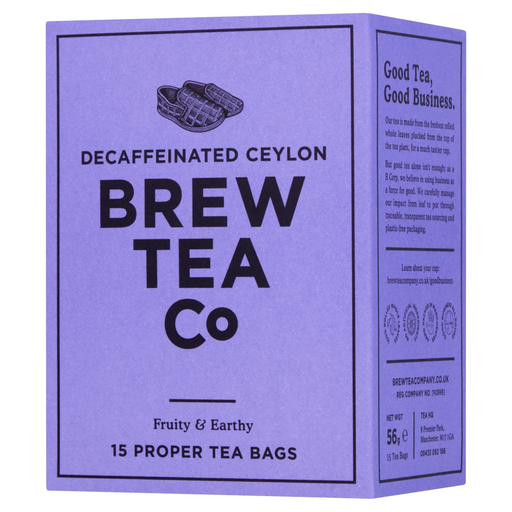
The 15-bag, 56g format offers a smaller quantity for trying a decaf tea before stocking a shared cupboard. The product description identifies Ceylon black tea and describes fruity notes. Check the exact pack’s decaf and ingredient wording if caffeine content is important to your choice.
 No image available
A plain decaf black tea in a 160-bag, 500g pack for a kitchen likely to use it regularly. Check that this quantity suits your cupboard space and expected use; the stated storage guidance is to keep it cool and dry.
 No image available
A decaffeinated black-tea option described by the product as bold and full-bodied; that is a product description, not an independent taste comparison. The stated net weight is 250g. Check the exact pack’s format and tea-bag count if individual bags are important for your kitchen.
Not necessarily. University Hospitals of Leicester NHS Trust says decaffeinated tea can still contain very low levels of caffeine. If you need to meet a strict limit, check the exact product’s information rather than treating the word decaf as a zero-caffeine guarantee.
An unflavoured decaf black tea is a flexible starting point when preferences are unknown. Choose an English Breakfast decaf if you specifically want a robust breakfast-style blend, or Earl Grey decaf if you want bergamot flavour; check the pack quantity before committing to regular use.
Follow the directions for the exact tea. The Tesco listing for Tetley Decaffeinated gives two to three minutes, while Twinings recommends two to three minutes for its English Breakfast Decaffeinated, or four minutes for a stronger cup.
Check both the pack and your local collection rules. Manufacturer information about industrially compostable tea bags applies where a suitable food-waste collection scheme is available; it is not a blanket instruction for every tea bag or accommodation.
Read the ingredient and allergen information on the exact pack, particularly when choosing a flavoured blend. For example, Clipper lists black tea and natural flavour in its Decaf Earl Grey, while its Everyday Decaf is presented as an unflavoured black tea.