What should you check?
Choose the kind of black-tea cup you want first, then check the exact blend’s brewing guidance, caffeine information and any sourcing or packaging claims that matter to you.
| Priority | What to check | Your needs |
|---|
| Blend style |
Compare the maker’s description of the exact tea: an everyday blend, an English Breakfast-style blend or an Assam-led blend. These descriptions are starting points, not an independent taste ranking. |
I want a black-tea cup with enough body for milk, rather than choosing solely because the box says decaf. |
| Residual caffeine |
Look for a product-specific amount and its cup size and brewing basis. Yorkshire Tea states 1.5–2mg per 200ml cup of its Decaf brewed for five minutes; that figure cannot be applied to other blends. |
For an evening cup, I want to reduce caffeine without assuming that decaf means none. University Hospitals of Leicester NHS Trust notes that decaf tea can still contain very low levels. |
| Brewing |
Follow the stated infusion time before changing how you prepare the tea. Twinings gives 2–3 minutes for its English Breakfast Decaffeinated, or four minutes for a stronger cup; the cited Tetley listing gives 2–3 minutes before milk. |
If my first mug tastes too light, I’d rather try the blend as directed before deciding whether its style suits me. |
| Sourcing and disposal |
Check certification claims on the exact pack. For tea bags, follow the maker’s instructions and check which materials your local collection accepts; plant-based does not automatically mean home-compostable. |
Organic or Fairtrade sourcing may influence my choice, but I still want to judge the tea’s flavour and caffeine information separately. |
Decaf tea options on Joybuy
These options cover everyday decaf black tea, a named Ceylon blend and organic decaf choices for a winter cup. Compare each exact pack and blend rather than treating their flavour descriptions or caffeine statements as interchangeable.
 No image available
Taylors of Harrogate Yorkshire Tea Decaf 250g
An everyday decaf black tea for a familiar cup; the product description calls it full-bodied. Yorkshire Tea states 1.5–2mg caffeine per 200ml cup of its Decaf brewed for five minutes. Check that the maker’s figure applies to this pack and your preparation if the amount matters to you.
View on Joybuy
 No image available
Tetley Decaffeinated Tea, 80 bags, 250g
A standard tea-bag format for an everyday decaf black-tea cup. For the corresponding 80-bag, 250g product, the ASDA Groceries listing gives Tetley’s guidance to brew for 2–3 minutes before adding milk. Decaf does not by itself mean caffeine-free.
View on Joybuy
 No image available
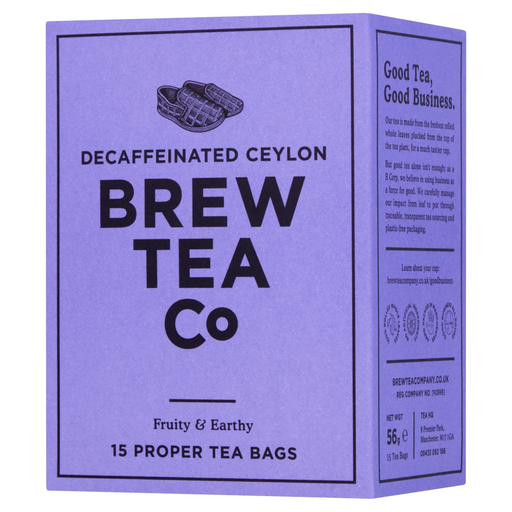
Brew Tea Co CO2 Decaffeinated Tea, 15 Proper Tea Bags, 56g
A Ceylon black-tea option if you prefer a named tea style. Its product description identifies organic black tea and a CO2 decaffeination method, and describes the cup as full-bodied. Check the basis of any caffeine statement on the current product information if residual caffeine affects your choice.
View on Joybuy
 No image available
Clipper Organic Fairtrade Decaf Everyday, 80 tea bags, 277g
An everyday decaf black tea to consider when organic and Fairtrade positioning matters. Clipper describes the matching Assam-blended tea as full and rich; the listed pack contains 80 tea bags. Those sourcing attributes do not establish its caffeine level or how it will taste to you.
View on Joybuy
 No image available
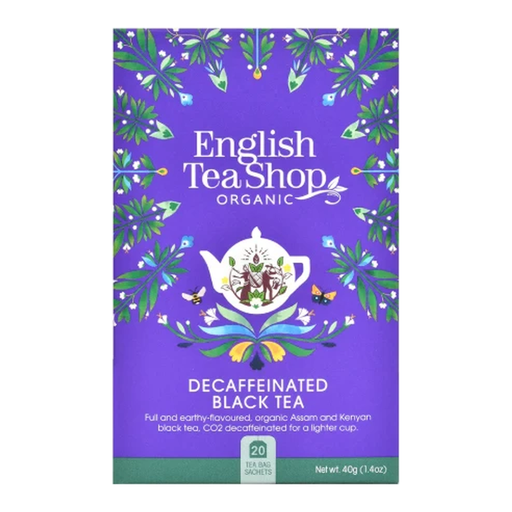
English Tea Shop Organic Decaffeinated Black Tea 20g
An organic decaf black tea whose product description calls the cup full-bodied. The title identifies a 20g pack. If a stated caffeine amount matters to you, check what serving and measurement it refers to before comparing it with another tea.
View on Joybuy
Questions about decaf tea
Is decaf tea completely caffeine-free?
Not necessarily. University Hospitals of Leicester NHS Trust says decaf tea can still contain very low levels of caffeine. Yorkshire Tea, for example, states 1.5–2mg per 200ml cup of its Decaf brewed for five minutes; do not apply that figure to another tea or preparation.
Which decaf blend should I consider for tea with milk?
Start with an everyday or English Breakfast-style black tea whose description matches the cup you want. Twinings describes Everyday Decaffeinated as hearty and well-rounded and English Breakfast Decaffeinated as having body and a light finish; Yorkshire Tea describes its Decaf as strong. These are the makers’ descriptions, so use the brewing instructions and your own taste to decide.
How long should I brew decaf black tea?
Start with the instructions for the exact blend. Twinings recommends 2–3 minutes for its English Breakfast Decaffeinated, or four minutes for a stronger cup; the cited Tetley guidance gives 2–3 minutes before milk, while Tesco gives 3–5 minutes for Decaff Original. No single time applies to every decaf tea.
Can every plant-based tea bag go in home compost?
No. Yorkshire Tea says its UK plant-based bags need suitable kerbside garden- or food-waste collection rather than home composting. Twinings describes its bags as industrially compostable. Check the instructions for your pack and what your local council collects.
What if I need to check ingredients or allergies?
Read the current pack for the exact tea you intend to use. Tesco and ASDA warn that food product information can change, so an older listing or a general brand description may not reflect the pack’s current ingredients or allergy information.


