Organic-first tea drinkers
You want decaffeinated black tea with an organic claim you can check on the pack. An everyday blend may suit you even if it is not named English Breakfast.


If certified organic decaf matters most, Clipper Fairtrade Organic Decaf is listed as decaffeinated organically grown black tea with an organic control-body code, but it is described as an everyday blend rather than English Breakfast. If a named breakfast blend to drink with milk matters more, Twinings describes its English Breakfast Decaffeinated as a robust Assam, Kenyan and Ceylon blend; check organic status separately rather than assuming the breakfast-style name establishes it.
You want decaffeinated black tea with an organic claim you can check on the pack. An everyday blend may suit you even if it is not named English Breakfast.
You want a decaf black tea with a robust blend description and clear brewing guidance for a cup alongside a full Scottish breakfast.
You want to distinguish bag counts and net weights before choosing between similarly named decaf teas.
Decide whether organic certification or a named breakfast blend is your firmer requirement, then check the exact pack for the other qualities you want.
Choose when: Organic status comes first. Tesco lists Clipper Fairtrade Organic Decaf as decaffeinated organically grown black tea and shows the control code GB-ORG-05.
Trade-off: This Clipper tea is described as an everyday blend, not a named English Breakfast blend.
Choose when: A robust blend to drink with milk comes first. Twinings describes its English Breakfast Decaffeinated as an Assam, Kenyan and Ceylon blend.
Trade-off: The Twinings product description does not establish an organic claim; check the exact pack if certification is essential.
| Priority | What to check | Your needs |
|---|---|---|
| Organic status | Check that the exact decaf tea is labelled organic and look for its control-body details. The UK Department for Environment, Food & Rural Affairs says an organic food claim requires applicable production rules and certification by an approved control body. | I want the tea itself to carry a regulated organic claim, not just organic products elsewhere in the brand's range. |
| Blend and milk | Read the blend description and the pack's brewing directions. Twinings suggests milk with its English Breakfast Decaffeinated and a longer brew for a stronger cup. | With a full Scottish breakfast, I would choose the blend description that matches the kind of tea I like with milk. |
| Caffeine | Check the current product information if a precise caffeine limit matters. Twinings explains that minor traces can remain after decaffeination. | Decaf does not have to mean caffeine-free. If I have a clinician-set limit, I need clarification for the exact tea rather than relying on the word 'decaf' alone. |
| Pack format | Compare tea-bag count and net weight on the exact listings; similarly named products can come in different pack sizes. | I want to know which size I am ordering rather than treating every listing for the same blend as an identical pack. |
Organic status and blend style answer different questions. Tesco describes Clipper's organic decaf as an everyday tea, while Twinings names its decaf English Breakfast.
If both matter, check that the exact pack is decaf, carries the organic claim and control-body details, and has the blend description you want.
Twinings says minor caffeine traces can remain in decaffeinated tea. Its English Breakfast Decaffeinated product information also gives inconsistent residual-caffeine figures.
For a clinician-set limit, check the current pack and ask the manufacturer about the exact product rather than choosing by a general decaf claim.
Tesco lists a 40-bag, 116g Clipper organic decaf pack, while the Joybuy Clipper listing names an 80-bag, 277g pack. One listing cannot establish the other pack's particulars.
Confirm the bag count, net weight, ingredients and organic control-body details for the pack you intend to order.
These descriptions concern the named teas, not every product made by each brand.
Tesco lists Clipper Fairtrade Organic Decaf as decaffeinated organically grown black tea with control code GB-ORG-05.
Twinings describes its English Breakfast Decaffeinated as a robust Assam, Kenyan and Ceylon blend and suggests serving it with milk.
Yorkshire Tea describes its Decaf as a blend developed to retain character after caffeine removal.
These are decaf black-tea options for the breakfast decision, including teas named organic and an option with milk-serving guidance. Check the exact pack when certification or a particular blend style matters.
 No image available
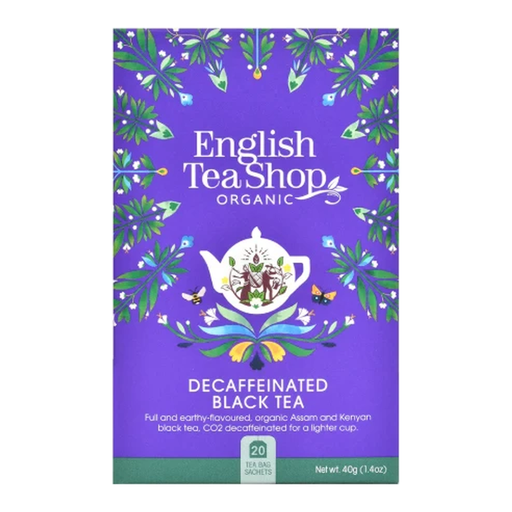
This decaffeinated black tea is named organic and described by the seller as full-bodied. If certified status or a cup with milk is important to you, check the control-body details and brewing guidance on the exact pack.
 No image available
A decaf black-tea option for a breakfast cup with milk: the product description suggests brewing for 2–3 minutes before adding milk. Check the exact pack for an organic claim if that is a requirement.
 No image available
An everyday decaf black tea named organic and Fairtrade in this 80-bag listing. Check the exact pack's control-body details and brewing directions if certification and a cup with milk are decisive for you; do not substitute details from a different Clipper pack size.
Check that the exact decaf product carries the organic claim and applicable control-body information. The UK Department for Environment, Food & Rural Affairs says food labelled organic must meet applicable production rules and certification requirements; Tesco's Clipper Fairtrade Organic Decaf listing, for example, identifies organically grown black tea and shows GB-ORG-05.
Organic status does not establish a particular blend style. Tesco describes Clipper's organic decaf as a robust everyday tea, while Twinings describes its English Breakfast Decaffeinated as a robust blend to serve with milk. Choose according to which attribute matters more, and check both on the pack if you require both.
Not necessarily: Twinings says minor traces of caffeine can remain after decaffeination. If you have a clinician-set caffeine limit, check the current pack and ask the manufacturer to clarify the exact product; Twinings' English Breakfast Decaffeinated information gives inconsistent figures.
Follow the directions for the tea you choose. Twinings advises brewing its English Breakfast Decaffeinated for 2–3 minutes, or four minutes for a stronger cup, and suggests a splash of milk; another blend may have different directions.