
24/7 Customer Support

Free returns

Same-day & Next-day Delivery

Quality Guaranteed

Unlock Your Welcome Offers: FREE Delivery | Up to 80% OFF | Free 30-day JoyPlus trial
Download the APP
A deep fat fryer can make chips, battered fish, chicken, spring rolls and doughnuts convenient to prepare at home. However, choosing the wrong model may leave you with uneven cooking, difficult cleaning and an appliance that occupies valuable worktop space.
The most useful comparison is not simply the price. UK shoppers should look closely at capacity, temperature control, safety features, cleaning design and hob compatibility. These factors determine whether a fryer suits occasional cooking, family meals or regular batch frying.
A fryer advertised as holding 3 litres of oil will not necessarily cook 3 litres of food. The basket’s safe food capacity is usually lower, and overfilling can cause oil temperature to drop or hot oil to splash.
Check both figures where available. For example, a 2-litre fryer may be designed for approximately 0.8kg of food, while a 3.5-litre model may handle up to 1kg in one batch. Smaller households may prefer a compact deep fryer UK model, whereas families may benefit from a family-sized deep fryer with a larger basket.
A high wattage can support quicker heating and temperature recovery, but it does not guarantee even cooking. The heating system, thermostat and basket design also matter.
An electric deep fat fryer with an adjustable thermostat is generally easier to use for different foods. Chips, fish, chicken and doughnuts each require different temperature settings. A model with only one preset may be less flexible, even if its wattage looks impressive.
Many products include removable parts, but the heating element and control panel generally should not be immersed in water. Check which components can go in the dishwasher and whether the manufacturer recommends hand washing for stainless steel surfaces.
An oil drain, removable tank or oil filtration system can be more useful than a non-stick coating alone. Used oil should be allowed to cool fully before draining, filtering or disposing of it.
Measure your available worktop and storage space before choosing a fryer. A larger oil capacity may reduce the number of batches needed, but it also increases the appliance’s footprint and the amount of oil required.
For occasional chips or snacks, a 2-litre or 3-litre fryer may be practical. A 3.5-litre model can be more suitable for family portions, provided you have enough ventilation and storage space.
Look for a variable or adjustable thermostat with a clearly marked temperature range. A deep fryer with adjustable thermostat settings gives you more control when switching between frozen chips, fresh potatoes, battered fish and pastries.
A viewing window can help you monitor browning without lifting the lid. However, it should complement—not replace—careful timing and temperature control. For hob-based cooking, a stainless steel deep fryer with a built-in Celsius thermometer provides a direct oil temperature reading.
Important features include a secure lid, cool-touch handles or exterior panels, non-slip feet, a magnetic plug or safety cut-out and an overheat protection system. Always follow the instructions, avoid overfilling, keep water away from hot oil and never leave frying unattended.
For easier maintenance, consider a dishwasher-safe deep fryer with a removable basket and oil tank. If you reuse oil, a deep fryer with oil filtration can help separate crumbs before storage, reducing unnecessary waste. Oil should still be checked for smell, colour and quality before reuse.
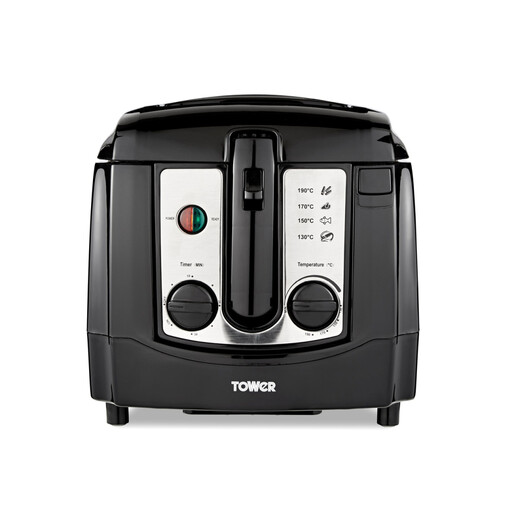
Why This Fits Their Persona: A practical choice for households wanting an electric home chip fryer with a moderate capacity and straightforward controls.
The 3-litre oil capacity is paired with a removable basket, adjustable thermostat and oil drainage spout, making capacity and cleaning details clearer than relying on wattage alone.
2300W heating element, viewing window, cool-touch exterior and magnetic plug. The basket is described as dishwasher-safe.
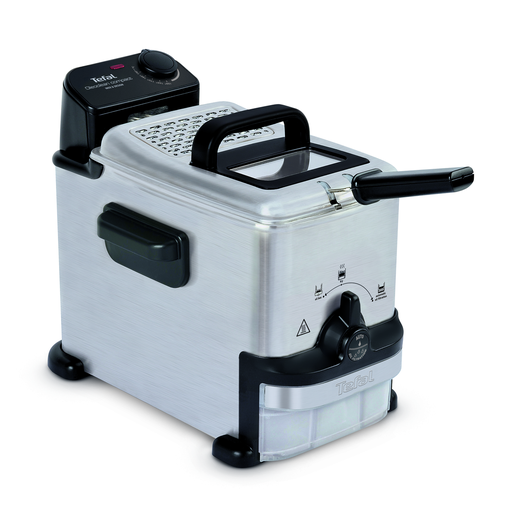
Why This Fits Their Persona: Suits regular home cooks who value oil management, compact storage and a more structured cleaning routine.
Its automatic filtration system drains and stores oil through a dial control, while removable dishwasher-safe parts address the common “easy clean” limitation.
2-litre oil capacity, approximately 0.8kg food capacity, 150°C–190°C thermostat range, viewing window and odour filter.
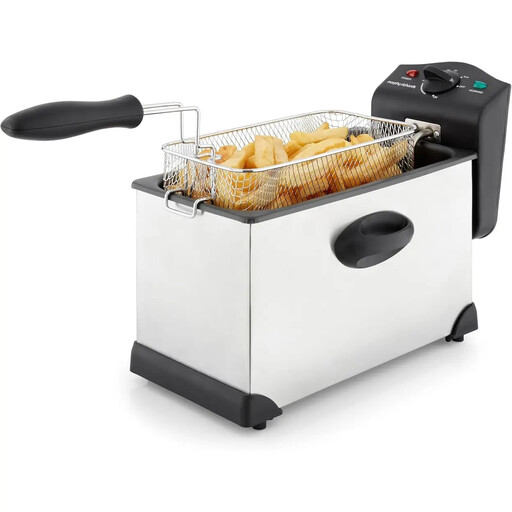
Why This Fits Their Persona: Designed for family meals and entertaining where larger batches of chips, chicken or breaded food are regularly prepared.
It states both 3.5-litre oil capacity and up to 1kg food capacity, reducing the risk of confusing oil volume with serving size.
2000W power, variable temperature control, viewing window, removable oil pan and dishwasher-safe oil pan.
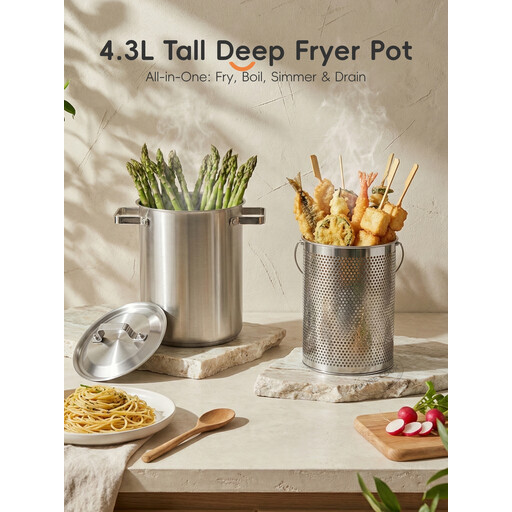
Why This Fits Their Persona: A flexible option for cooks who want an induction-compatible deep frying pot that can also boil, blanch, make soup or prepare hot pot dishes.
The 4.3-litre pot has a deep design, removable draining basket and three-layer magnetic base. It is specified for gas, induction and electric ceramic hobs.
304 stainless steel construction, multi-purpose use and dishwasher-safe design, subject to the manufacturer’s care guidance.
We have compiled a complete, real-time list of products that fully satisfy these strict selection criteria and UK safety regulations.
Running cost depends on the fryer’s wattage, cooking time and your electricity tariff. A 2000W appliance uses 2kWh if operated continuously for one hour, although normal frying takes considerably less time. Heating oil, cooking in batches and keeping the fryer warm all affect consumption. Choosing the correct capacity can help avoid repeated batches.
There is no universal timetable because oil quality depends on the food cooked, temperature and storage conditions. Filter cooled oil where the appliance allows it, store it in a sealed container and discard it if it becomes unusually dark, smells unpleasant or starts smoking at a lower temperature.
Both require careful handling because hot oil presents a fire and burn hazard. An electric fryer may offer features such as a thermostat, lid lock, cool-touch exterior and automatic cut-out. A deep frying pot offers hob flexibility but requires closer manual monitoring, particularly when checking temperature and oil levels. Always follow the supplied instructions and keep a suitable pan lid nearby for emergencies; never use water on an oil fire.