
24/7 Customer Support

Free returns

Same-day & Next-day Delivery

Quality Guaranteed

Unlock Your Welcome Offers: FREE Delivery | Up to 80% OFF | Free 30-day JoyPlus trial
Download the APP
For many of us, nothing quite compares to the authentic taste and texture of properly fried food. The perfect golden chip, crispy battered fish or light, fluffy doughnut is a simple pleasure that low-fat cooking methods often struggle to replicate. However, choosing a deep fat fryer for your home can be a confusing process, filled with marketing claims that don't always match reality.
As a Joybuy Product Recommendation Officer, my role is to help you navigate these choices. Many buyers find themselves disappointed with appliances that are difficult to clean, fail to reach the right temperature or are simply impractical for regular use. Before you invest, let's look at the common pitfalls to avoid.
To ensure you get an appliance that delivers great results and doesn't become a kitchen headache, focus on these core parameters.
Capacity is often advertised in litres, which refers to the oil capacity. For a typical family of four, a 3l deep fat fryer is a good starting point. This generally allows you to cook around 1kg of food, like chips, in a single batch. Pay attention to both the oil capacity (litres) and the food capacity (kg). A larger oil capacity helps the fryer maintain its temperature when you add food, which is crucial for achieving a crispy exterior.
A truly easy clean deep fat fryer is one that can be fully dismantled. Look for models with a removable oil bowl or tank. Ideally, this bowl, along with the frying basket and lid, should be dishwasher-safe. This feature transforms the cleaning process from a dreaded task into a simple one. Models constructed with a stainless steel deep fryer body and bowl are also durable and less prone to retaining odours.
Precise temperature control is non-negotiable for good frying. Look for a fryer with a clear, adjustable thermostat, typically ranging from 150°C to 190°C. This allows you to cook different foods at their optimal temperature. Other valuable features include:
To help you find the right fit, here are a few recommendations matched to different household needs.
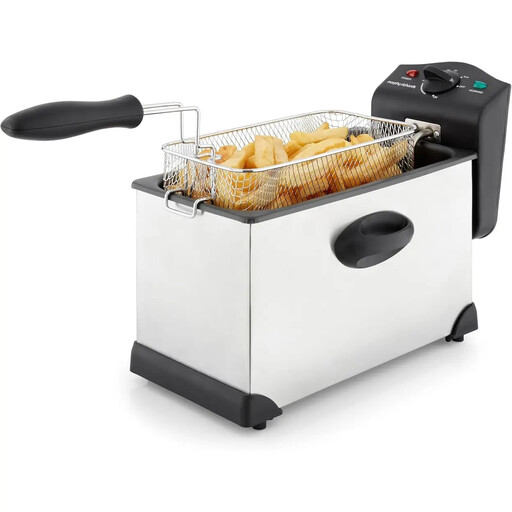
Why This Fits Their Persona: This fryer is well-suited for preparing family-sized meals. Its 3.5-litre oil capacity and 1kg food capacity mean you can cook enough chips for everyone in one go, avoiding the need for multiple batches.
It directly counters the "easy clean" myth with a removable oil pan that is dishwasher-safe, making cleanup straightforward. The variable temperature control also avoids the pitfall of inaccurate heating.
A large viewing window lets you check on food without losing heat. The powerful 2000W element ensures fast heat-up and recovery.
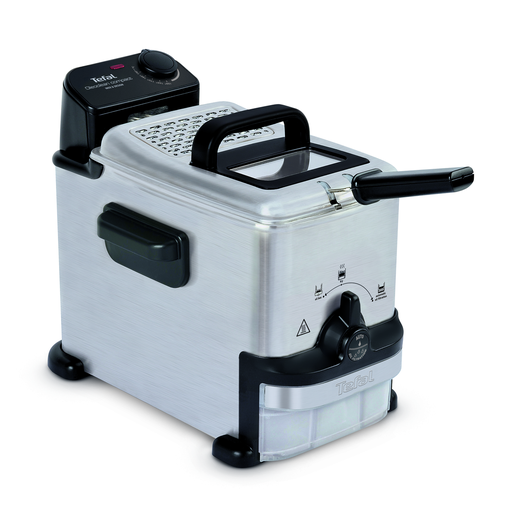
Why This Fits Their Persona: For anyone who loves fried food but detests the cleanup and oil waste, this model is a standout. It's designed for maximum convenience and minimal mess, making frequent frying a practical option.
It solves the oil management pitfall with its patented automatic oil filtration system. At the turn of a dial, it drains, filters and stores the oil in a separate container, ready for the next use. It is also fully dismantlable for easy cleaning.
The immersed heating element and 'Cool Zone' technology deliver professional-style results and keep oil fresher for longer. All removable parts are dishwasher-safe.
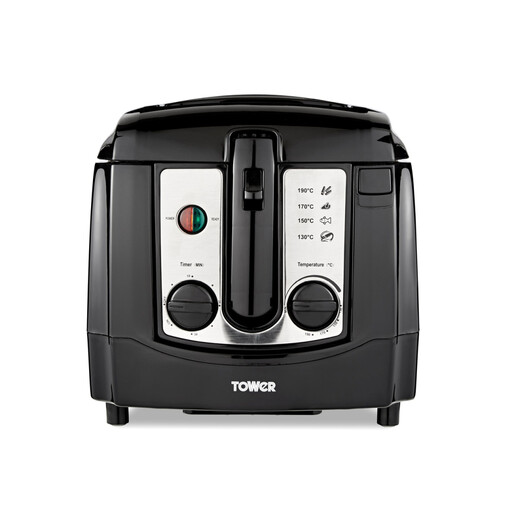
Why This Fits Their Persona: This is a solid, reliable electric fryer for chips that focuses on doing the basics exceptionally well. It's ideal for those who want a straightforward appliance for making traditional fried favourites without unnecessary complexity.
Its powerful 2300W heating element and adjustable thermostat provide the consistent heat needed for crispy results, avoiding the soggy food pitfall. The removable inner pot and non-stick basket also make it far easier to clean than fixed-tank models.
The 3-litre capacity is great for family portions, and the viewing window allows for safe monitoring. It combines robust power and essential features in a compact unit.
We have compiled a complete, real-time list of products that fully satisfy these strict selection criteria and UK safety regulations.
For light use (e.g., frying chips once or twice a week), you can typically reuse the oil 3-4 times. If you are cooking heavily battered items like fish or chicken, the oil will degrade faster and may need changing after 1-2 uses. Always filter the oil after it has cooled to remove food particles, which will extend its life. If the oil becomes dark, smells rancid or starts to smoke at normal temperatures, it's time to replace it.
The running cost depends on the fryer's power (wattage) and how long you use it. A typical 2000W (2kW) fryer used for 30 minutes would consume 1 kWh of electricity. Check your current electricity tariff for the price per kWh to calculate the exact cost. While they use more power than an air fryer for a short period, they are generally more energy-efficient than heating a large conventional oven for the same task.
It depends on the material. A stainless steel deep fryer with a flat, magnetic base is usually compatible with induction hobs. Look for models that specify "induction compatible" or have a multi-layer composite base designed for all hob types, including induction, gas and electric ceramic. Always check the product specifications before purchasing if you have an induction hob.