What matters when choosing?
Choose for the temperature of the room where the unit will run, then check how it will fit, operate and dispose of collected water.
Compact compressor model
Consider when: The affected bedroom or living area is normally heated.
Trade-off: Electrical Safety First says compressor units work best in warmer conditions; maximum extraction figures also depend on operating conditions.
Desiccant model
Consider when: The unit needs to work in a cool or unheated room near clothes storage.
Trade-off: Desiccant units suit cooler conditions, but Electrical Safety First notes that they may use more energy overall.
| Concern |
What to check |
Who this matters to |
| Humidity around stored clothes |
Look for target-humidity control and a place to run the unit with clear airflow near, rather than inside, the affected storage area. |
If clothes sit near a cold wall or in a poorly ventilated corner, I want to manage room moisture without overlooking the cause of condensation; around 31% of consumers put clothes-storage humidity first. |
| Indoor laundry |
Check for a laundry mode and compare stated room coverage with the room where clothes dry. |
When I dry clothes indoors regularly, I need to handle the added moisture without choosing solely by the maximum extraction figure. Roughly 31% of consumers make laundry moisture their primary concern. |
| Space and noise |
Compare the exact model's dimensions, operating-noise figure and tank size with the space available. |
If the unit will run near where I sleep or work, it needs to fit without becoming too intrusive; around 23% of consumers prioritise space and noise. |
| Cool-room operation |
Check the operating-temperature range and whether a compressor or desiccant model suits the room's conditions. |
For an unheated area beside clothes storage, I care about operation at that room's temperature more than a headline daily rate. About 15% of consumers put cool-room suitability first. |
Brands to consider
These brands have relevant dehumidifier ranges, but suitability depends on the exact model and the room where it will run.
Meaco
Its Arete 10L models are positioned for smaller rooms and flats.
- Meaco specifies the Arete One 10L for spaces up to 42m² and quotes 35 dB operating noise.
- Check the chosen model's dimensions, features and current availability rather than treating the Arete One and Arete Two as identical.
Pro Breeze
Its 12L humidistat model offers a compressor option with stated room coverage and water-disposal choices.
- Pro Breeze specifies coverage up to 20m², a 1.8L tank and continuous drainage for this model.
- If moisture collection is frequent, consider whether emptying a 1.8L tank or arranging drainage is practical.
EcoAir
The DD3 Slimline is a desiccant option to consider for a cool room near clothes storage.
- EcoAir specifies operation from 1°C to 40°C, a 3L tank, a laundry function and optional continuous drainage for the DD3 Slimline.
- Electrical Safety First notes that desiccant dehumidifiers may use more energy overall.
Ebac
Its domestic range includes 12L Smart AI Control models with laundry mode.
- Ebac lists four- or five-year warranty coverage depending on the series.
- Check dimensions and noise for the exact model before assuming it will fit a small flat.
Joybuy product options
These options include a desiccant model for a cooler room and models with laundry and drainage features. Check each unit's fit and operating conditions against the room where you plan to use it.
 No image available
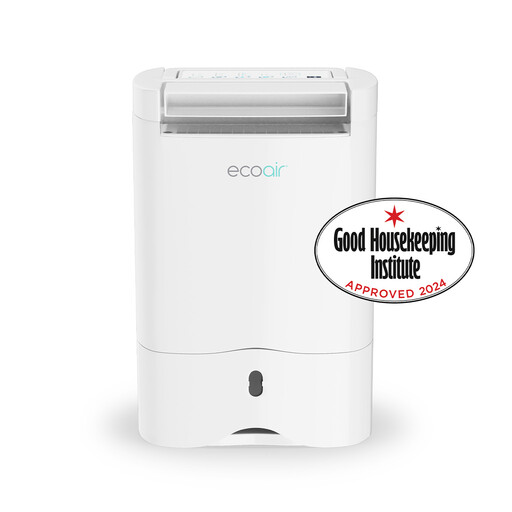
EcoAir DD3 Slimline Desiccant Dehumidifier, White
Consider this desiccant model if the room beside your clothes storage is cool or unheated.
- EcoAir specifies a 1°C to 40°C operating range for the DD3 Slimline.
- The listing gives a maximum extraction rate of 10L/day, a 3L tank, laundry mode and an optional continuous-drain arrangement.
- Check its exact dimensions and operating noise if it will sit in a tight space or near a bedroom; desiccant units may use more energy overall.
View on Joybuy
 No image available
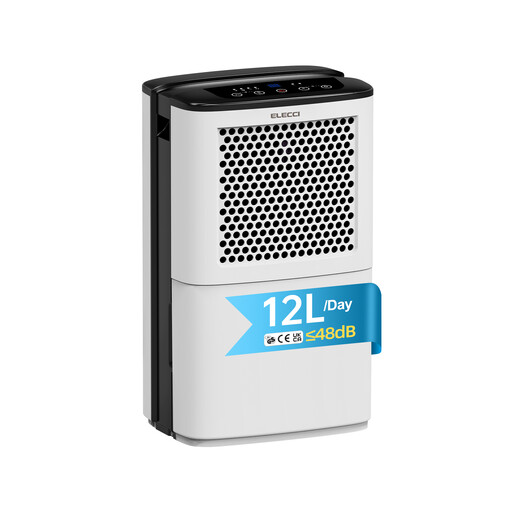
ELECCI 12L/D Dehumidifier with Drain Hose and 3.8L Tank
Consider this model for indoor laundry in a room within its stated 25m² coverage, provided you have space for the required airflow clearance.
- The listing specifies a drying mode, 3.8L tank, continuous drainage and a 24-hour timer.
- Its maximum 12L/day extraction figure is stated at 86°F and 90% relative humidity, not as a fixed rate in other conditions.
- Check its dimensions, noise and operating-temperature range for your room; the listing calls for at least 10 inches of clearance around the unit.
View on Joybuy
 No image available
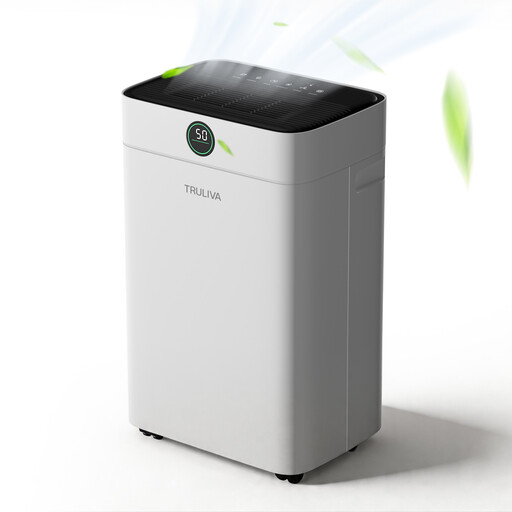
TRULIVA 25 L/Day Dehumidifier with Laundry Drying and 2.8L Tank
Consider this model if indoor laundry and a continuous-drain option matter, after checking whether the unit and its clearance will fit your flat.
- The listing specifies a laundry-drying mode, 2.8L tank and continuous-drain hose.
- Its maximum 25L/day extraction figure is stated at 90% relative humidity and 95°F; it should not be assumed under other room conditions.
- Allow for the listed 10 inches of clearance and check ordinary-mode noise if the unit will run near sleeping or working space.
View on Joybuy
Common questions
Will a dehumidifier fix damp behind my wardrobe?
A dehumidifier may help manage room moisture, but it will not by itself fix a leak or poor ventilation. Ceredigion County Council notes that condensation can form on cold surfaces with little air movement, so check the space behind the wardrobe and investigate persistent damp or mould.
Should I choose a compressor or desiccant model for a small flat?
A compressor model is a starting point for a normally heated room, while a desiccant model is worth considering for a cool or unheated room. Electrical Safety First says compressor units work best in warmer conditions and desiccant units suit cooler conditions, though the latter may use more energy overall. Check the temperature where the appliance will actually run.
How can I use a dehumidifier safely around stored clothes?
Run it with the clearance and airflow specified in its manual, rather than crowding it against clothes or furniture. Electrical Safety First advises keeping vents clear and following the manufacturer's instructions for cleaning and unattended use; check the plug and product markings when buying a unit for use in the UK.
If I rent in England, must I deal with serious damp by buying a dehumidifier?
No. Report persistent damp, mould or suspected building defects to your landlord in writing. GOV.UK identifies damp and mould as a housing hazard and states that, in England, local authorities have a duty to act on category 1 hazards and a power to act on category 2 hazards. Housing routes elsewhere in the UK differ.


