
24/7 Customer Support

Free returns

Same-day & Next-day Delivery

Quality Guaranteed

Unlock Your Welcome Offers: FREE Delivery | Up to 80% OFF | Free 30-day JoyPlus trial
Download the APP
Living in the UK means dealing with our fair share of damp, grey weather. While we can't change the forecast, we can control the climate inside our homes. Persistent condensation on windows, a lingering musty smell or the slow, frustrating process of drying laundry indoors are common signs of excess humidity. Left unchecked, this moisture can lead to issues with damp and mould, which can affect both your property and your comfort.
A quality dehumidifier for home use is a practical tool for managing indoor air moisture. It works by drawing in damp air, removing the water and releasing drier air back into the room. This guide is designed to help you understand the key features to look for and to present some carefully selected options that address common household needs.
Navigating the specifications can feel overwhelming. To simplify your choice, focus on these three key areas.
A dehumidifier's primary specification is its extraction rate, measured in litres per day (L/day). This indicates how much moisture it can remove from the air in 24 hours under specific test conditions.
Modern dehumidifiers come with functions designed for convenience and specific tasks.
An energy efficient dehumidifier can help manage running costs. Many modern units use R290 refrigerant, a hydrocarbon that has a much lower global warming potential than older refrigerants and contributes to the unit's overall efficiency. Features like a 24-hour timer and an adjustable humidistat, which automatically turns the unit off when the desired humidity is reached, also help to conserve energy.
Here are our recommendations, selected to cover a range of common household requirements in the UK.
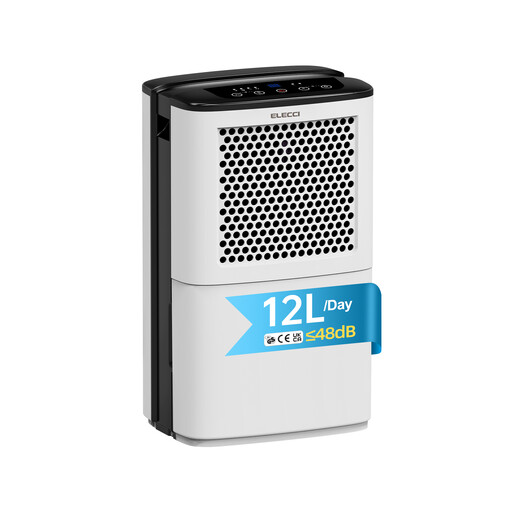
ELECCI 12L/D Dehumidifier with Drain Hose
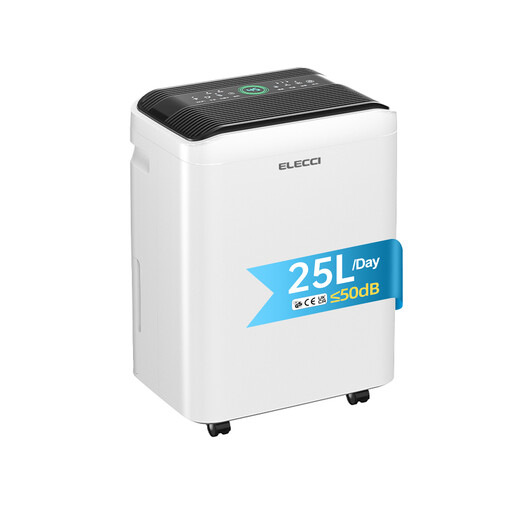
ELECCI 25L/D Dehumidifier with 4.8L Water Tank
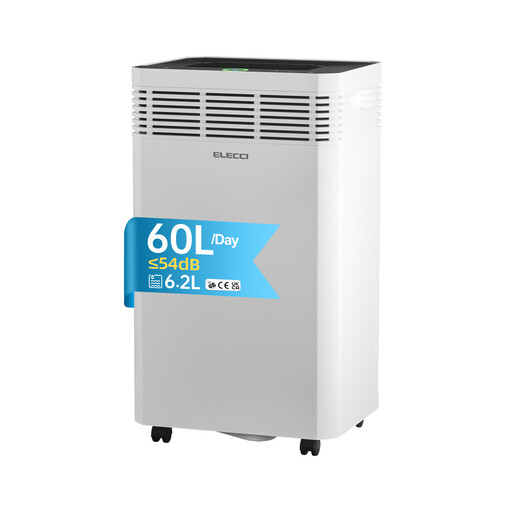
ELECCI 60L/D Dehumidifier with Purification
If the models above don't quite match your specific needs or if you're interested in exploring more energy-efficient models, you can find a wider selection to compare.
Explore our full range of R290 Dehumidifier models here.
1. Can a dehumidifier really help with damp and mould? A dehumidifier addresses the root cause of many common types of damp and mould: excess airborne moisture. By maintaining an indoor relative humidity level between 40% and 60%, you create an environment where mould struggles to grow. It is a preventative tool that helps manage the conditions that allow mould to thrive.
2. Are dehumidifiers expensive to run? Running costs depend on the unit's power consumption, how often you use it and your electricity tariff. To manage costs, choose an energy efficient dehumidifier, particularly one using modern R290 refrigerant. Using features like the built-in humidistat to automatically switch the unit off or a timer to run it during off-peak hours, can also significantly reduce energy usage.
3. How do I know what size dehumidifier I need? The right size depends on the area of the space you need to treat and the severity of the damp. As a general rule, use the room size guides: 10-12L models for single rooms up to 25m?, 20-25L models for larger rooms or small flats up to 50m? and 30L+ models for very large, open-plan spaces or basements. If in doubt, choosing a slightly larger capacity is often more effective than running a small unit constantly.