Who needs this advice?
The right appliance depends on where shower moisture travels, where the unit can stand and how warm that space stays.
People managing shower moisture in a small flat
If condensation appears after bathing in a studio or one- or two-bedroom flat, you may want portable humidity control without giving up much floor space. Check ventilation first, then look at the room where the appliance would actually run.
People short on space or sensitive to noise
When the unit will run near a bedroom or living area, its dimensions, placement requirements and stated noise level may matter as much as its extraction rating. Compare those details for the exact model rather than relying on a broad room-size claim.
People using a cold or poorly heated area
If the appliance will operate in an unusually cold space adjoining the flat, check its operating-temperature range. Desiccant models are an option to consider for lower temperatures, but their power use and water-handling arrangements still need checking.
What matters when choosing?
Check that the extractor works and that moisture is linked to showering rather than a leak. Then choose for the temperature and size of the space where the dehumidifier will run, followed by noise and tank-emptying needs.
| Concern |
What to check |
Who this matters to |
| Ventilation and the cause of damp |
Test the extractor and check vents and visible leaks before relying on an appliance. GOV.UK guidance explains that moisture can become trapped without effective ventilation. |
If damp patches persist even when nobody has showered, I need to know whether a fan, vent or leak needs attention before buying more extraction capacity; around 33% of consumers put the underlying cause first. |
| Space, capacity and noise |
Compare the exact model’s dimensions and stated noise with its room-size guidance. Read the conditions behind a litres-per-day extraction rating. |
If the unit must stand near my living or sleeping space, I need it to fit and to run at an acceptable noise level; roughly 27% of consumers make compact, quiet operation their primary concern. |
| Water handling |
Compare tank capacity and shut-off arrangements. For continuous drainage, check the hose connection and whether the route can slope towards a suitable drain. |
When showers create a recurring emptying task, I would rather have a workable drainage route or a tank I can manage; about 20% of consumers prioritise water-handling convenience. |
| Cold-room operation |
Check the operating-temperature range and rated power of the exact model. Compare compressor and desiccant options for the temperature where the unit will stand. |
If the only practical position is in a poorly heated area, I need an appliance suited to that temperature; around 20% of consumers place cold-space suitability first. |
Brands to consider
These brands provide examples of different small-home and cold-space specifications; compare the particular model and its instructions rather than treating a brand name as a performance guarantee.
Meaco
Meaco markets compact compressor dehumidifiers for flats and smaller homes.
- Meaco states 36 dB for the MeacoDry ABC 10L and 35 dB for the Arete One 10L, both positioned for smaller homes.
- Those are model-specific manufacturer figures, not a like-for-like noise comparison with other brands. Check the dimensions and availability of the variant you want.
Ebac
Ebac offers domestic dehumidifiers with straightforward humidity controls.
- Ebac positions its Ebac 12 with a dial humidistat for flats and small homes of up to two bedrooms.
- Confirm the exact model designation and specification sheet before ordering, particularly when comparing listings with similar names.
EcoAir
EcoAir provides desiccant options worth examining when an appliance must work in a colder area.
- EcoAir specifies a 1°C to 35°C operating range and continuous drainage for its DD1 Simple MK3.
- EcoAir lists 300 W in low mode and 580 W in high mode for that model. Compare its expected run time and power use; these figures must not be applied to a different EcoAir model.
Pro Breeze
Pro Breeze offers compressor models with humidity controls and drainage options.
- For its cited 12L model, Pro Breeze states a humidistat, continuous drainage, 38 dB noise and room guidance up to 20 m².
- Those specifications belong to that model, not every Pro Breeze unit. Compare its tank and room guidance with your intended placement.
Joybuy product choices
These choices include models with stated room guidance from 25 m² to 50 m², plus a desiccant option to consider for a colder area. For a compact occupied flat, check where each unit can stand and whether its noise and water-handling arrangements suit you; the wider room guidance of a larger model is not, by itself, a reason to choose it.
 No image available
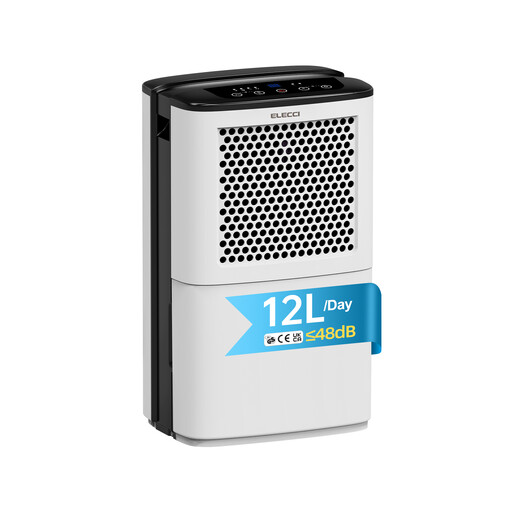
ELECCI 12L/D dehumidifier with 3.8L tank and drain hose
Consider this model if its stated guidance for rooms up to 25 m² fits the space where shower moisture spreads.
The product name specifies continuous drainage, auto defrost, a 24-hour timer and R290. Compare the exact model’s noise and dimensions with your intended position, and follow its bathroom-placement instructions.
Joybuy
 No image available
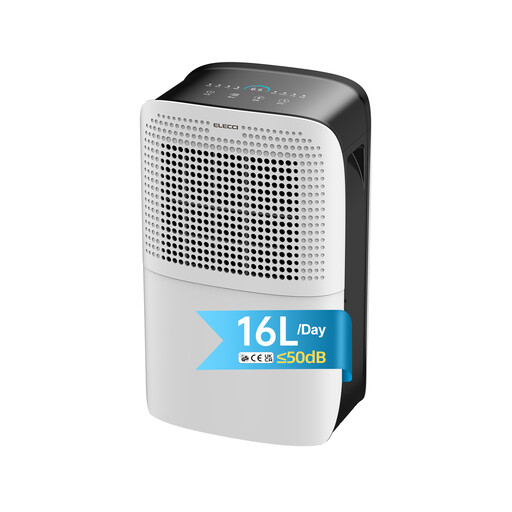
ELECCI 16L/D dehumidifier with 3.1L tank and drain hose
Consider its stated guidance for rooms up to 32 m² against the space available in your flat; the larger daily extraction figure alone does not establish a better fit.
The product name lists continuous drainage, four modes, auto defrost, a 24-hour timer and R290. Check noise, dimensions and the exact placement instructions before choosing a position near a living area or bathroom.
Joybuy
 No image available
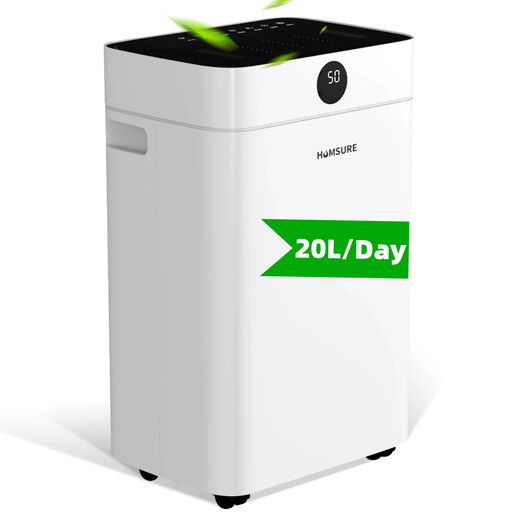
HUMSURE 20L/Day dehumidifier with 2.8L tank
This model is named for rooms up to 50 m², so check its physical fit and your moisture-control needs before choosing it for a small flat.
The product name lists continuous drainage, auto defrost, a 24-hour timer and R290. If you plan to use a drain hose, confirm the route and the exact model’s drainage instructions; check noise and dimensions for its intended position.
Joybuy
 No image available
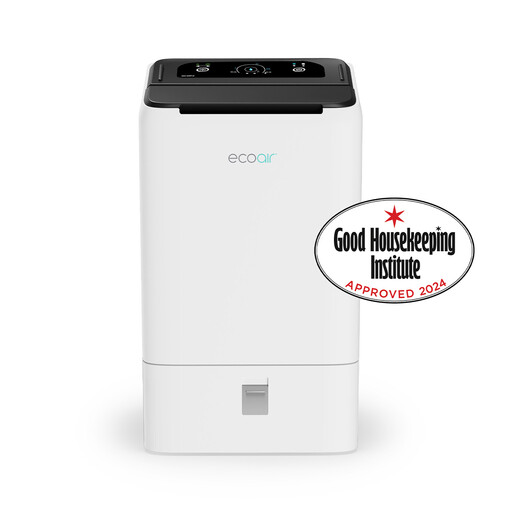
EcoAir DD2 Simple desiccant dehumidifier, 9 Litres/Day, white
Consider this desiccant model if the intended operating area is notably cold, while checking the DD2 Simple’s own temperature range and power use before deciding.
The product name lists a lightweight design and laundry mode. Check its measured noise, dimensions, drainage arrangements and bathroom-placement instructions against where you plan to use it.
Joybuy
Common questions
Can I put a portable dehumidifier inside the bathroom while I shower?
Only if the exact appliance instructions explicitly permit bathroom use. A Meaco manual for one of its units says to place it outside the bathroom with the door open instead. Keep portable electrical equipment away from standing water and follow the instructions for your model.
Can a dehumidifier replace the extractor fan after showers?
No: use a dehumidifier as support for, not a replacement for, working ventilation. GOV.UK guidance explains that moisture can become trapped without effective ventilation, so check the extractor and use it as intended.
What dehumidifier capacity should I consider for a small flat?
A compact 10L-class model is a starting point for comparison, not a universal requirement. Meaco recommends 10L for a one- to two-bedroom flat and sometimes 12L for a more serious moisture problem or more than two occupants. Compare the exact model’s stated test conditions, dimensions and noise with your flat and showering pattern.
When should I consider a desiccant rather than a compressor dehumidifier?
Consider a desiccant model when the unit must run in a cold or unheated space. Pro Breeze recommends desiccant technology for colder environments; EcoAir specifies a 1°C to 35°C range for its DD1 Simple MK3, which must not be assumed for other models. In a normally heated flat, compare exact-model noise, power use and water handling as well as technology.
I rent in England and have persistent bathroom damp. Is a dehumidifier my only option?
No: report persistent damp or mould to your landlord rather than treating an appliance as a repair. GOV.UK guidance for rented homes in England addresses landlords’ damp- and mould-related obligations. Record affected areas and check whether the problem persists independently of showering, particularly if you suspect a leak or faulty ventilation; rules elsewhere in the UK may differ.


