Choose a desiccant dehumidifier for a regularly cool or unheated room, where Electrical Safety First says this type performs better than a refrigerant model. In a normally heated room, compare electricity use with a refrigerant alternative before deciding. Neither type repairs leaks or other building defects that may be causing the damp.
Who might need one?
People managing moisture in cold rooms
If condensation or mustiness affects an unheated garage, cellar, conservatory or utility room, look for an operating-temperature range that covers the room at its coldest. Electrical Safety First identifies cooler and unheated spaces as a reason to consider a desiccant model.
Households drying laundry indoors
If washing regularly dries on an indoor airer, a laundry mode and directional airflow may help you manage the added moisture. A dehumidifier is not necessarily the fastest drying method: Which? identifies tumble dryers as faster for indoor drying.
People managing everyday condensation
For routine use in a flat or house, consider how often you can empty the tank, whether drainage is practical and whether you need to move the appliance. If damp follows rain or a plumbing leak, investigate that cause rather than relying on humidity control alone.
What matters when choosing?
Desiccant dehumidifier
Consider it when: The room is cool or unheated; Electrical Safety First says desiccant types perform better in those conditions.
Trade-off: Desiccant units may use more energy overall, so compare power use for the modes you expect to run.
Refrigerant dehumidifier
Consider it when: The room is normally heated and electricity use matters more than cold-room operation; Electrical Safety First says refrigerant types work best in warmer conditions.
Trade-off: A cold or unheated room may be less suitable for this type.
For consumers choosing a desiccant dehumidifier to manage damp indoor air, start with the room’s temperature. Then decide which day-to-day need matters most.
| Concern |
What to check |
Who this matters to |
| Cold-room operation |
Compare the stated operating range with the room’s lowest expected temperature, and check for an adjustable humidistat. |
If my utility room becomes cold in winter, I need a unit rated for that temperature rather than one chosen only by its extraction figure; around 36% of consumers put cold-room operation first. |
| Indoor laundry |
Look for a laundry mode and controllable airflow; consider the room temperature and amount of washing. |
When washing dries on an airer, I want to manage the moisture it adds without assuming the appliance will dry every load quickly; indoor laundry is the main concern for around 29% of consumers. |
| Routine maintenance |
Check tank capacity, full-tank shut-off and whether a compatible hose can reach a suitable drain. |
If I cannot empty a tank frequently, I need a practical way to keep the unit running; roughly 21% of consumers prioritise manageable emptying or drainage. |
| Noise and electricity use |
Check noise and power figures for the intended mode, plus how the humidity control stops or adjusts operation. |
For a room I use regularly, I need sound and electricity use I can live with; around 14% of consumers make those running considerations their primary concern. |
What can go wrong?
-
Assuming all damp is condensation
A dehumidifier reduces airborne moisture but cannot repair a leak or water entering through a building defect. Perth & Kinross Council advises identifying and repairing the source of water ingress.
Check whether staining worsens after rain, inspect accessible plumbing and seek repair advice for suspected building defects.
Leaving the source untreated can mean repeated mould treatment and further building damage.
-
Choosing by litres per day alone
An extraction figure does not tell you how a unit will suit a cold room or what it will use in your chosen mode. Electrical Safety First notes that desiccant types suit cooler spaces but may use more energy overall.
Check the room’s winter temperature first, then compare the stated operating range, power use, controls and drainage arrangement.
-
Overlooking the tank and drain route
A full tank can interrupt operation. Continuous drainage is useful only if the hose is compatible and can be routed safely to a suitable drain.
Check tank capacity, shut-off behaviour, hose requirements and the proposed drain route before buying; maintain the arrangement as instructed.
Without workable drainage, allow for regular manual emptying.
-
Blocking airflow or overlooking electrical details
Poor placement can restrict the airflow the appliance needs during operation.
Check the appliance’s marking and plug for your location, follow its placement instructions, and keep vents and filters clear.
Brands to consider
Meaco
Meaco’s DD8L Pro is a desiccant model with humidity-responsive control, app control and an automatic louvre for directing airflow.
- Meaco describes the DD8L Pro as operating in spaces below 10°C.
- Check the electricity use of your intended mode and current availability rather than treating the brand’s efficiency claims as an independent comparison.
EcoAir
EcoAir’s DD1 Simple MK3 pairs rotary controls and a laundry mode with a stated 1–35°C operating range.
- EcoAir specifies a 2-litre tank and continuous-drain compatibility for the DD1 Simple MK3.
- If a suitable drain is unavailable, consider whether regularly emptying a 2-litre tank fits your routine.
Pro Breeze
Pro Breeze specifies its 10L desiccant model for operation from 1–40°C, with a humidistat, 3-litre tank and continuous-drain option.
- The stated operating range and drainage option are relevant checks for a cool room where a drain route is available.
- Check the noise and electricity figures against the intended mode and room conditions before comparing them with another model.
Desiccant models on Joybuy
These EcoAir desiccant models offer laundry settings for indoor drying. Compare their stated extraction figures and check each model’s operating range before choosing one for a particularly cold room.
 No image available
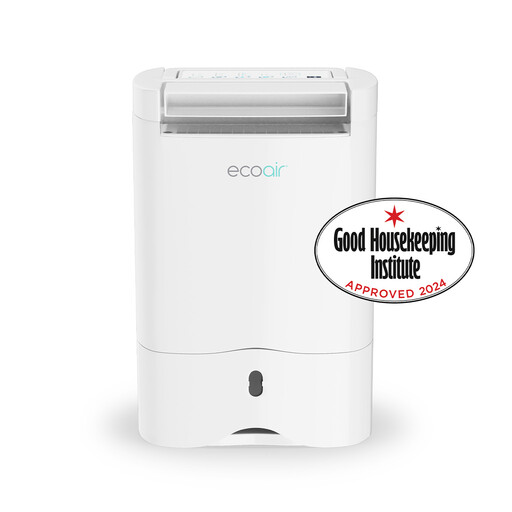
EcoAir DD3 Slimline desiccant dehumidifier, 3L tank, white
For indoor laundry where tank capacity matters, this model has a laundry mode and a stated 3L tank. Its listed extraction is up to 10 litres/day; check the operating-temperature range against your room’s coldest temperature, as well as noise and power use for occupied-room operation.
View on Joybuy
 No image available
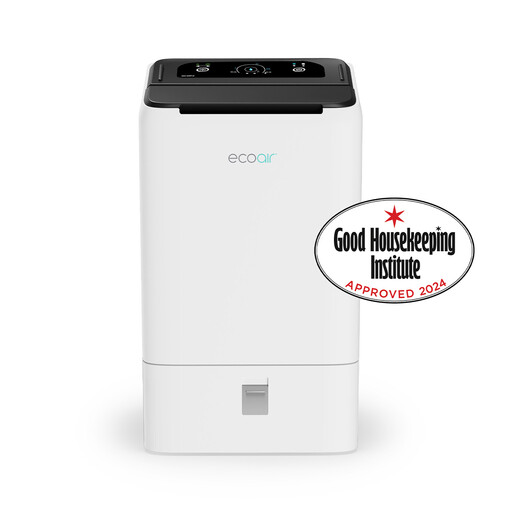
EcoAir DD2 Simple desiccant dehumidifier, white
For indoor laundry when you may move the appliance between rooms, this model lists a laundry mode and lightweight design. Its stated extraction is up to 9 litres/day; check the minimum operating temperature, tank capacity, noise and power use for your intended setup.
View on Joybuy
Frequently asked questions
Will a desiccant dehumidifier fix damp caused by a leak?
No. It can reduce airborne moisture, but it cannot repair water ingress or a building defect. Identify and address the source; Perth & Kinross Council warns that repairing water ingress matters for preventing further damage.
Should I stop ventilating the room while using a dehumidifier?
No: a dehumidifier does not replace effective home ventilation. GOV.UK explains that moisture from daily activities can become trapped without it; follow the appliance instructions on doors and windows during a drying cycle.
What should I check before using a dehumidifier at home?
Check that the plug and product marking are appropriate for where you will use it, and follow the manufacturer’s placement and drainage instructions. Keep airflow clear, maintain vents and filters, and empty the tank before moving the unit.


