Consider a desiccant dehumidifier when window condensation affects a cold or unheated room, or when drying clothes indoors adds to the moisture load. Check the exact model’s operating-temperature range, controls and water-emptying arrangements before choosing. A dehumidifier does not replace working ventilation: GOV.UK’s existing-home guidance for England explains that moisture can become trapped and condense without effective ventilation.
Who is it for?
Households with cold rooms
If condensation appears in a lightly heated or unheated room, the model’s stated minimum operating temperature matters. Meaco and Wood’s describe low-temperature operation for specific desiccant models; check the rating of the one you intend to buy.
People drying clothes indoors
Indoor drying adds moisture that can contribute to condensation. A laundry mode or directed airflow may be useful alongside working ventilation; Meaco lists both features for its DD8L Pro.
People running a unit near living spaces
For regular use in a bedroom or living room, consider the available humidity controls, stated noise level and effort involved in emptying the tank. Check these details for the exact model and setting you would use.
What matters when choosing?
Start with the temperature of the room where condensation occurs, then consider regular-use controls, indoor laundry and how you will manage collected water.
| Concern |
What to check |
Who this matters to |
| Cold-room operation |
Check the stated minimum operating temperature against the affected room’s temperature; check the conditions behind extraction figures. |
If my windows get wet in a cold or unheated room, I need a model rated to operate there. Around 29% of consumers put cold-room suitability first. |
| Regular-use controls |
Look for a humidistat or selectable target, and check the stated noise level and available modes. |
When the unit runs near a room I use every day, I want to manage humidity without constant adjustment or excessive disturbance. Regular-use control is the primary need for around 29% of consumers. |
| Indoor laundry |
Check for a laundry mode or directed airflow, and follow the model’s placement instructions. |
Drying clothes indoors adds moisture, so I want the unit to help manage that load as well as window condensation. Around 21% of consumers put laundry moisture control first. |
| Tank and drainage |
Check tank capacity and, if needed, hose compatibility and whether a suitable drain route is available. |
If I expect to use the appliance for long periods, frequent tank emptying could be inconvenient. Reducing that task comes first for around 21% of consumers. |
Mistakes to avoid
-
Treating the appliance as a replacement for ventilation
GOV.UK’s existing-home guidance for England explains that moisture from everyday activities can remain trapped and turn into condensation without effective ventilation.
Keep installed ventilation functioning and use extraction where fitted. Investigate persistent damp rather than relying on the dehumidifier alone.
-
Choosing by litres per day alone
A headline extraction figure does not, by itself, show how a model will suit a cold room. Figures measured under different conditions should not be treated as a like-for-like comparison.
Check the exact model’s operating-temperature range and the conditions attached to its extraction figure before comparing models.
-
Overlooking tank emptying
Regular operation may make manual emptying inconvenient. A continuous-drain option is useful only where the model and the available drain route allow it.
Check tank capacity, hose requirements and positioning instructions before choosing a drainage arrangement.
-
Skipping the model’s safety instructions
A damaged power cord presents an electrical or fire hazard; Meaco’s DD8L Pro manual warns against operating the unit in that condition.
Read the exact model’s instructions for electrical connection and placement, and do not use it with a damaged cord.
Brands to consider for specific needs
Meaco
Its DD8L and DD8L Pro illustrate options for cold-room condensation and indoor laundry.
- Meaco states that the DD8L maintains high extraction down to 1°C and lists a laundry mode and automatic louvre for the DD8L Pro.
- Check noise, drainage and power details for the exact model; these model descriptions are not a comparison under shared test conditions.
EcoAir
The DD1 Simple MK3 illustrates a desiccant option for domestic rooms and unheated spaces.
- EcoAir lists energy-saving and turbo modes and extraction of up to 7.5 L/day for the DD1 Simple MK3.
- Its manual’s 40%–60% relative humidity range is product comfort guidance, not a universal target for every home.
Pro Breeze
Its cited 10L desiccant model illustrates an option with humidity control and continuous drainage.
- Pro Breeze lists a 1°C–40°C working range, built-in humidistat and 3 L tank for that model.
- Its stated 44 dB noise level applies to the cited model; check the relevant operating conditions before comparing it with another unit.
Wood’s
The WDD80 is presented by Wood’s for cold spaces such as holiday homes, boats and caravans.
- Wood’s states that the WDD80 operates down to 0°C and has three fan speeds, a 2 L tank and a hose connection.
- Confirm that the exact model’s plug, instructions and drainage arrangement suit where you plan to use it.
Joybuy product choices
These desiccant models are relevant to window condensation when indoor laundry also adds moisture. For a cold room, confirm each model’s stated minimum operating temperature before choosing.
 No image available
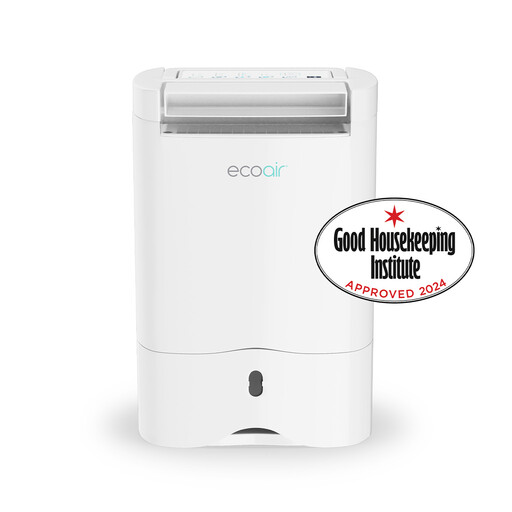
EcoAir DD3 Slimline Desiccant Dehumidifier, 10 Litres/Day, 3L tank
For window condensation alongside indoor clothes drying, this model lists a laundry mode. Its stated extraction is 10 Litres/Day and its tank is 3L; check the extraction test conditions and the minimum operating temperature for your room before buying.
View on Joybuy
 No image available
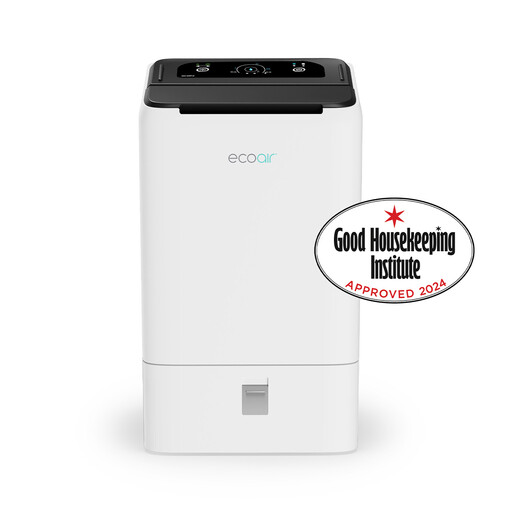
EcoAir DD2 Simple Desiccant Dehumidifier, 9 Litres/Day
This model lists a laundry mode for homes where indoor drying adds to window condensation. Its stated extraction is 9 Litres/Day; check the test conditions, minimum operating temperature and tank capacity if it will run regularly.
View on Joybuy
Questions and answers
Will a desiccant dehumidifier replace ventilation when my windows are wet?
No. GOV.UK’s existing-home guidance for England explains that moisture can become trapped and turn into condensation without effective ventilation. Keep installed ventilation functioning while using the dehumidifier.
Can I use a desiccant dehumidifier while drying clothes indoors?
Yes, if the model is suitable for that use and you follow its placement instructions. Meaco describes a laundry mode and automatic louvre on the DD8L Pro; keep ventilation working because drying clothes also adds moisture to the home.
What humidity setting should I use?
Start with the guidance for your appliance and the conditions in your room. EcoAir’s DD1 Simple MK3 manual describes 40%–60% relative humidity as a comfort range, not a universal setting that every home must use.
What should I check before plugging in a desiccant dehumidifier?
Follow the exact model’s electrical and placement instructions, and do not operate it with a damaged power cord. Meaco’s DD8L Pro manual warns that a damaged cord can create electrical or fire hazards.


