Choose a desiccant dehumidifier if your spare-room office becomes cool or is heated only intermittently, but check that the particular model is rated for the room’s temperature and will not disrupt work. If the room stays warm and electricity use is your main concern, compare a compressor model too; whichever you choose, ventilation and the cause of persistent damp still need attention.
Who this is for
People working in a cool spare room
If the room is only partly heated or cools between working hours, check a dehumidifier’s stated operating-temperature range. EcoAir and Meaco describe desiccant models intended for cooler conditions, but the range depends on the model.
Home-office users concerned about noise
For calls and focused work, compare the stated noise level at the fan setting you would use. Fan speeds and automatic controls may also affect when the unit needs to run near your desk.
People managing recurring condensation
Tank emptying, drainage and filter care matter when a unit will be used regularly. GOV.UK guidance also points to effective ventilation: an appliance should not be the only response when damp keeps returning.
What matters when choosing
Start with the spare room’s usual temperature: a cool room makes low-temperature operation important, while a consistently warm room gives you more reason to compare a compressor model’s electricity use. Then consider what running the unit during work and maintaining it would involve.
| Concern |
What to check |
Who this matters to |
| Cool-room extraction |
Check the model’s operating-temperature range and the conditions attached to its litres-per-day rating. |
If my spare room cools down between working hours, I need a unit rated to operate at those temperatures. Around 31% of consumers put cool-room extraction first. |
| Noise during work |
Compare stated dB(A) levels at the intended setting, plus fan-speed and timer options. |
When I am taking calls, I want moisture control without a distracting fan beside my desk. For around 25% of consumers, quiet working is the primary concern. |
| Electricity use |
Compare power consumption by mode and humidity controls; if the room stays warm, consider a compressor model as well. |
If the unit will run regularly, I want to understand its electricity use before choosing it for a warm office. Keeping that use down comes first for around 25% of consumers. |
| Emptying and upkeep |
Check tank capacity, full-tank shut-off, hose compatibility and filter-care instructions. |
With recurring condensation, I would rather not interrupt work to empty a tank frequently, but a drain hose also needs a suitable route. Around 19% of consumers prioritise easier routine upkeep. |
Buying pitfalls
-
Choosing by litres per day alone
Extraction ratings apply under stated temperature and humidity conditions; they do not promise that amount of water removal in your spare room. A headline rating also says nothing by itself about noise or electricity use.
Compare the rating’s test conditions with the room’s likely temperature, then check operating power, controls and drainage on the exact model.
-
Overlooking power draw in a warm office
Electrical Safety First notes that desiccant units may use more energy overall, while compressor units are generally more energy-efficient in warmer conditions. Consumption also varies by model and setting.
If the office is reliably heated, compare suitable compressor and desiccant models using their stated power consumption at the settings you expect to use.
-
Relying on the appliance to resolve recurring damp
GOV.UK guidance explains that moisture can become trapped without effective ventilation and lead to condensation. A dehumidifier does not repair a leak or another underlying damp problem.
Keep ventilation working, investigate damp that persists and report recurring damp or mould to the landlord if you rent.
-
Neglecting placement and maintenance
Restricted airflow, a full tank or a blocked drainage hose can interfere with use. The arrangement needs to suit both the room and the appliance’s instructions.
Allow the clearance specified by the manufacturer, keep vents and filters clean, inspect any hose and empty the tank before moving the unit.
Relevant dehumidifier brands to consider
Meaco
Meaco offers desiccant models aimed at cooler rooms and laundry drying, including the DD8L Pro.
- Meaco states that the DD8L Pro provides moisture control below 10°C and has a laundry mode, app control and Smart Energy Mode.
- Those features describe the DD8L Pro, not every Meaco model; compare the controls and operating figures of the version you intend to buy.
EcoAir
EcoAir’s desiccant range includes the DD128, which it positions for homes, offices and unheated spaces.
- EcoAir states that the DD128 operates from 1–40°C and has a 2.2-litre tank; its published noise range is 39–49 dB(A).
- EcoAir lists different power consumption by operating mode for the DD128, including 623 W on its high setting. Check the mode you would use rather than applying one figure to the whole range.
Wood’s
Wood’s positions its WDD-series desiccant units for moisture control in cold spaces.
- Wood’s states that the WDD80 operates down to 0°C and provides three fan speeds, a 2-litre tank and a hose connection.
- Check the exact model’s drainage instructions, noise figures and warranty terms for the version you are considering.
Joybuy desiccant dehumidifiers for a spare-room office
This desiccant model is relevant if you are considering moisture control for a cool spare-room office. Check its temperature rating and work-time noise against your own room before choosing.
 No image available
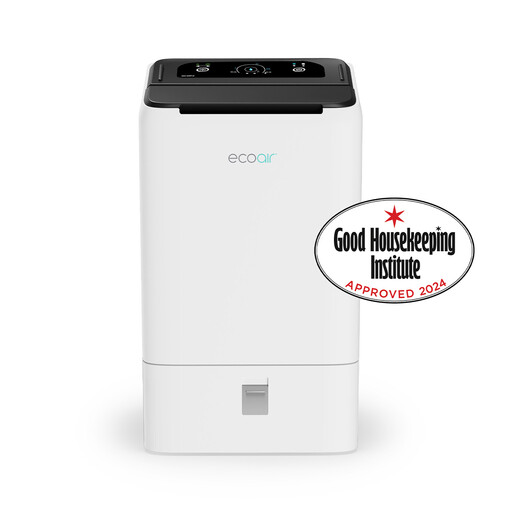
EcoAir DD2 Simple Desiccant Dehumidifier, 9 litres/day, White
Consider this desiccant model for a cool spare room if its stated operating range covers the temperatures your office reaches.
The product title gives a 9 litres/day extraction rating and lists a laundry mode. Check the rating’s test conditions before treating it as the amount you would collect each day.
If you plan to run it during calls or for long periods, compare its noise and power figures at the intended setting.
View on Joybuy
Common questions
Is a desiccant dehumidifier suitable for a cold spare-room office?
It can be a suitable choice if the exact model is rated for the temperatures your room reaches. Electrical Safety First says desiccant types perform better in cooler or unheated environments; check the individual model’s operating range rather than assuming all desiccant units share one.
Will a dehumidifier solve condensation or mould on its own?
No: it can help control moisture, but it does not replace ventilation or address the cause of persistent damp. GOV.UK guidance explains that moisture trapped without effective ventilation can become condensation; investigate recurring problems rather than relying solely on the appliance.
What if damp keeps returning in a spare room I rent?
Report persistent damp or mould to your landlord and describe where and when it occurs. For homes in England, GOV.UK guidance discusses landlords’ duties relating to damp and mould; using a dehumidifier is not a substitute for addressing an underlying problem.
How can I use a dehumidifier safely while working from home?
Follow the exact model’s instructions for placement, ventilation clearance, cleaning and drainage. Keep vents and filters clear, empty the tank before moving the unit, and check the manufacturer’s guidance before leaving it running unattended.


