For a large living room that stays cool in winter, consider a desiccant dehumidifier whose stated coverage fits the measured room area. If the room is normally heated, compare compressor models too, particularly for electricity use; whichever type you choose, check its humidity controls, noise and drainage, and address ventilation or underlying leaks alongside the appliance.
Who this matters to
Households with recurring window condensation
A large living room with repeatedly wet windows calls for a check of room coverage, humidity control and how collected water will be emptied or drained. GOV.UK notes that moisture trapped without effective ventilation can condense on cold surfaces.
Households with a cool living room
If heating is intermittent or the room stays cold, the appliance’s operating-temperature range becomes important. EcoAir and Meaco position their desiccant models for lower-temperature use, but the stated range should be checked for the exact model.
People using the room while the appliance runs
For moisture control in a shared living space, the quoted sound level, tank-emptying routine, drainage option and automatic humidity control can matter as much as the extraction figure.
What to check before buying
Start with the room’s usual winter temperature when comparing appliance types, then assess coverage and the demands of regular use in that room.
Desiccant dehumidifier
Consider when: The living room stays cool or is heated intermittently, and a particular model’s stated coverage fits its measured area.
Trade-off: Low-temperature claims vary by model; compare its power consumption with a compressor alternative if it will run regularly.
Compressor dehumidifier
Consider when: The living room is normally heated and electricity use is a leading concern.
Trade-off: EcoAir’s technology guidance favours desiccant operation in colder conditions, so check the compressor model’s stated operating range against the room temperature.
| Concern | What to check | Who this matters to |
|---|
| Large-room coverage |
Measure the floor area and compare the exact model’s stated coverage; check its humidity control rather than choosing by litres per day alone. EcoAir claims up to 90 m² for the DD3 Classic MK3 and up to 85 m² for the DD3 Simple. |
When condensation keeps returning across a large shared room, I need coverage that fits the space rather than an extraction figure on its own; around 42% of consumers put coverage first. |
| Everyday disruption |
Compare quoted power consumption and sound levels in the relevant modes, plus tank capacity, drainage and whether a hose is supplied. |
If the machine will run while I use the living room, noise, electricity use and emptying the tank all affect my choice; about 33% of consumers give everyday use priority. |
| Cold-room suitability |
Note the usual winter room temperature and check the exact model’s operating range and conditions attached to its extraction claim. |
With intermittent heating, I need a machine specified to operate at the temperatures my room actually reaches; roughly 25% of consumers place cold-room suitability first. |
Buying pitfalls
-
Treating a dehumidifier as a substitute for ventilation or repairs
GOV.UK explains that moisture can become trapped without effective ventilation. Perth & Kinross Council also identifies leaks and building defects among possible causes of persistent damp.
Use appropriate ventilation and manage moisture sources alongside the appliance. Investigate persistent damp patches, water ingress or mould rather than simply selecting a larger machine.
-
Choosing by litres per day alone
An extraction figure does not, by itself, establish whether a model fits your living room or how conveniently it will operate there.
Measure the room and check the exact model’s claimed coverage, operating range, humidity control, sound level and water-handling options.
-
Assuming desiccant always uses less electricity
Ebac argues that compressor models can use less electricity in normal occupied-home conditions, while desiccant manufacturers emphasise colder-room operation. Neither position establishes the result for every pair of appliances.
For a normally heated living room, compare the quoted power consumption and operating conditions of specific desiccant and compressor models.
-
Overlooking the route for collected water
Regular tank emptying may be inconvenient, and a continuous-drain connection does not mean that a hose is supplied.
Check tank capacity, hose inclusion and dimensions, and whether you have a suitable drain route that follows the appliance instructions.
For example, Meaco says its DD8L supports continuous drainage but does not include the hose.
Brands to consider
EcoAir
Its DD3 desiccant range provides model-specific coverage and low-temperature claims to compare against a measured room.
- EcoAir states coverage of up to 90 m² for the DD3 Classic MK3 and up to 85 m² for the DD3 Simple, with the DD3 Simple described as operating down to 1°C.
- Those figures apply to the named DD3 models, not every EcoAir appliance or every room condition; check the sound level and drainage arrangements for the model under consideration.
Meaco
Its DD8L desiccant models are options to examine for a cooler living room.
- Meaco recommends desiccant technology for applications below 10°C.
- Meaco states that the DD8L has a continuous-drain option but does not include the hose; check the particular model’s coverage and water-handling requirements.
Pro Breeze
Its 10 L desiccant model offers stated room coverage and operating-temperature figures for comparison.
- Pro Breeze lists a built-in humidistat, operation from 1–40°C and suitability for spaces up to 35 m² for this model.
- The stated 35 m² limit needs checking against the measured living room; it should not be treated as equivalent to another model’s larger claimed coverage.
Ebac
A compressor-model comparator when the living room is normally heated and electricity use matters.
- Ebac argues that compressor dehumidifiers can use less electricity than desiccant models in normal UK home conditions.
- That is Ebac’s commercial position, not a result for every model or a cold living room; compare exact appliances and their stated operating conditions.
Desiccant models on Joybuy
This desiccant option is relevant to a cooler living room, but its fit for a large room depends on the coverage stated for this exact model.
 No image available
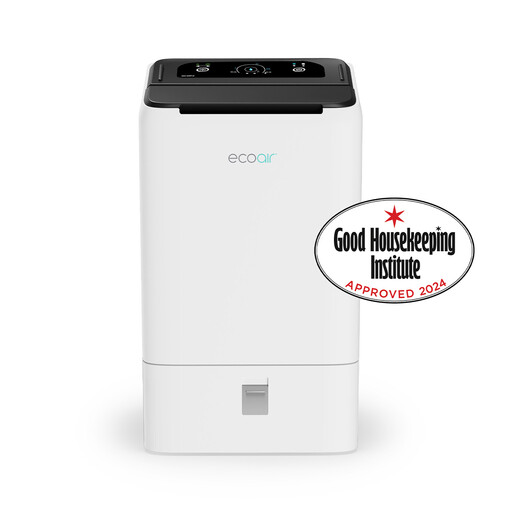
EcoAir DD2 Simple Desiccant Dehumidifier, 9 L/day, White
Consider this desiccant model if the living room is cool, but confirm its stated room coverage against your measured space before choosing it.
The product name states 9 L/day extraction, low-temperature performance and a laundry mode. Check the exact operating-temperature range, sound level, humidity controls, tank capacity and drain-hose arrangements for your intended use.
Joybuy
Frequently asked questions
Will a desiccant dehumidifier fix wet living-room windows by itself?
Not necessarily: a dehumidifier can help manage airborne moisture, but it does not replace ventilation or fix leaks. GOV.UK explains that moisture trapped without effective ventilation can condense on cold surfaces; investigate persistent damp or water ingress as well as managing household moisture.
Should I choose desiccant or compressor technology for a large living room?
Consider desiccant if the room is cool and the exact model’s stated coverage fits its measured area. If it is normally heated, compare compressor models too: Ebac argues they can use less electricity in normal UK home conditions, while EcoAir and Meaco position desiccant models for colder use. Check the specific appliances’ operating ranges, power consumption and noise.
Will I need to empty the tank every day?
The emptying frequency depends on the room’s moisture load, operating mode and tank size, so do not assume a daily schedule. If frequent emptying would be impractical, check for continuous drainage and a suitable drain route; EcoAir says the DD3 Classic MK3 includes a 1-metre hose, whereas Meaco says the DD8L’s hose is not included.


