For laundry in a cool room, a desiccant dehumidifier with a footprint you can accommodate, a manageable water tank and a laundry setting is a sensible choice. Compare noise and power draw in the mode you will actually use, particularly if the airer shares your living space. Keep the airer in a ventilated room and the appliance clear of drips; removing airborne moisture does not fix leaks or persistent damp.
Who is this for?
People drying laundry in a small flat
If one or two airer loads regularly dry indoors, the appliance needs a practical place to stand as well as somewhere for collected water to go. Islington Council advises using a clothes rack in a well-ventilated room when indoor drying is necessary.
Households with a cool drying room
A weakly heated or draughty room makes operating-temperature guidance worth checking. Meaco and Pro Breeze both identify cold conditions as a reason to consider their desiccant ranges, although individual models still need to be assessed on their own specifications.
Consumers sharing space with the appliance
When the airer is near a desk, bedroom or walkway, compare the unit's dimensions, noise in the intended mode, power draw and water-emptying arrangements. A description such as ‘quiet’ cannot tell you how intrusive a particular setting will be.
What matters when choosing?
Start with the temperature of your drying room, then check where the unit can stand and how you will manage the water and electricity used during a laundry session.
| Concern |
What to check |
Who this matters to |
| Drying in a cool room |
Check the model's operating-temperature guidance and the conditions behind its extraction figure. |
If my laundry dries in a weakly heated room, I want a unit intended to operate at that temperature rather than choosing by litres per day alone. Around 42% of consumers would put cool-room performance first. |
| Space and disturbance |
Compare width and depth, plus stated noise for the setting you expect to use; leave the clearance required by the manual. |
When the airer is near where I work or sleep, I need room for the appliance and a noise level I can live with. Roughly 33% of consumers would make placement and disturbance their primary concern. |
| Moisture and electricity use |
Check tank capacity or drainage arrangements, and the stated power draw in laundry mode. |
I may need to empty the tank during a load, and I do not want moisture spreading through the flat while the unit runs. About 25% of consumers would prioritise managing water and electricity use. |
Mistakes to avoid
-
Choosing by litres per day alone
An extraction figure depends on its stated temperature and humidity test conditions. EcoAir's technology guidance also distinguishes the conditions under which compressor and desiccant machines extract moisture, so headline figures do not by themselves settle a cold-room choice.
Compare the operating-temperature guidance, test conditions and power draw alongside the extraction figure.
-
Leaving laundry mode running without checking power draw
A laundry setting may use more power than a lower setting. Meaco states a 330 W laundry-mode figure for the DD8L Junior at 20°C and 60% relative humidity; that figure should not be assumed to describe another model or different conditions.
Check the intended model's mode-specific wattage and controls, and use the laundry setting for the drying period rather than assuming it needs to run continuously.
Long sessions on a higher-power setting increase electricity use.
-
Placing the unit under dripping clothes
The Meaco DD8L Zambezi Z2 manual warns against water entering the appliance and blocked air intakes. Those instructions concern that model; the clearance and placement instructions for another unit may differ.
Use a stable, level position clear of drips, keep the air intakes unobstructed and follow the exact model's filter-cleaning instructions.
-
Relying on the dehumidifier to solve every damp problem
Indoor laundry adds moisture, but condensation and damp may have other causes. East Lothian Council warns that untreated condensation can lead to mould and damage; a dehumidifier cannot repair a leak or building defect.
Dry clothes in a ventilated room, deal with visible condensation and investigate persistent or unexplained damp separately.
Brands to consider
These ranges provide useful specification points to compare; a brand's guidance or a feature on one model does not apply automatically to every model it makes.
Meaco
The DD8L desiccant range includes compact models aimed at laundry drying and cooler rooms.
- Meaco lists a laundry mode for the DD8L Junior, dimensions of 500 × 351 × 188 mm and noise figures of 39, 43 and 48 dB(A), depending on mode.
- Use the noise and power figure for the mode you expect to run; Meaco's guidance favouring desiccant below 10°C is brand guidance, not a guarantee for every drying room.
EcoAir
EcoAir's desiccant range includes portable models and larger units with laundry and drainage features.
- EcoAir states that its DD3 Classic MK3 has an 11 L/day extraction rating, a 4.2 L tank, laundry mode and a 1 m continuous-drain hose.
- That larger model may occupy more space than a small flat can spare. Check its dimensions and power draw before treating the larger extraction figure as useful for your load.
Pro Breeze
Pro Breeze offers desiccant machines positioned for cold spaces as well as compressor models with laundry settings.
- Pro Breeze states that its desiccant range can operate down to 1°C, making model-specific temperature guidance relevant to an unheated drying room.
- Pro Breeze notes that desiccant models can use more energy. Its advice to place one laundry-mode model about 50 cm from hanging clothes is not a clearance rule for every appliance.
Desiccant models on Joybuy
These EcoAir desiccant models are relevant to drying laundry in a cool room. Compare the space each needs, water collection and the intended operating mode before choosing one for a small flat.
 No image available
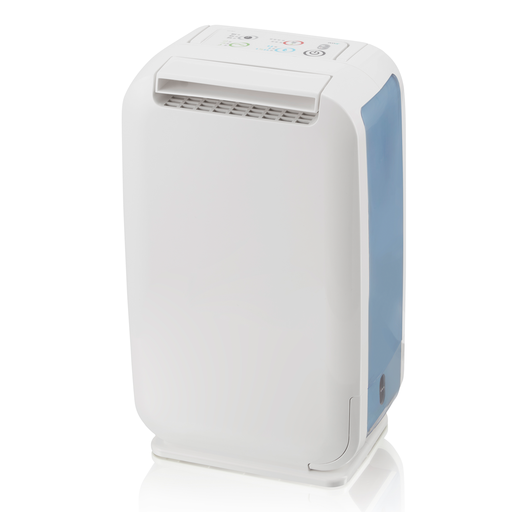
EcoAir DD1 Mini desiccant dehumidifier, 1.8 L tank, white
Consider this model if you need a desiccant unit for a cool laundry room and can empty a 1.8 L tank. Its stated extraction is up to 6 L/day; check the conditions behind that figure, the unit's dimensions, noise and power draw for your intended setting.
View on Joybuy
 No image available
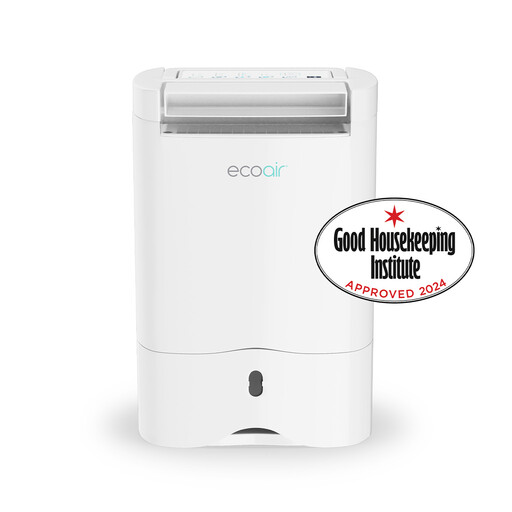
EcoAir DD3 Slimline desiccant dehumidifier, 3 L tank, white
The stated 3 L tank and laundry mode are worth considering if you want to collect water during a drying session. Its extraction is stated as up to 10 L/day; check the test conditions, actual dimensions, laundry-mode noise and power draw. If you plan to drain it continuously, confirm hose compatibility and a safe downward route.
View on Joybuy
 No image available
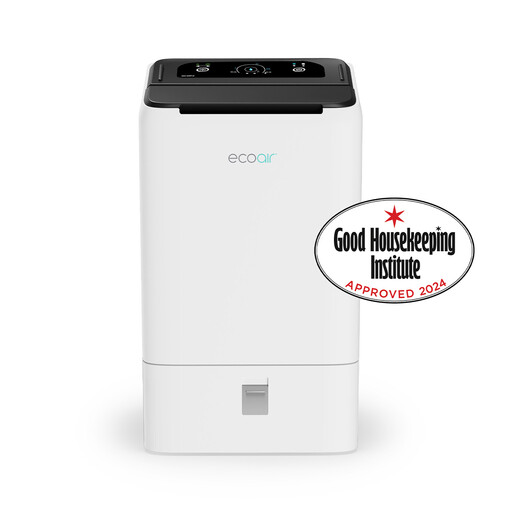
EcoAir DD2 Simple desiccant dehumidifier, 9 L/day, white
The laundry setting makes this a model to assess for a cool indoor drying room. The stated extraction is up to 9 L/day; compare its test conditions with your room and check tank capacity, dimensions, noise and laundry-mode power draw before deciding whether it fits your routine.
View on Joybuy
Common questions
Does a desiccant dehumidifier make sense in a small flat?
It is particularly worth considering if the room where you dry laundry is cool or weakly heated. Meaco recommends desiccant technology for applications below 10°C, but you should still compare the dimensions, noise and power draw of the specific model you would use.
Where should I place it beside a clothes airer?
Put the airer in a ventilated room and position the appliance on a stable surface where clothes cannot drip onto it or block its airflow. Follow your model's clearance instructions; Pro Breeze recommends about 50 cm from hanging laundry for one of its laundry-mode models, not as a universal distance.
Can I use a desiccant dehumidifier in a bathroom?
Only use a particular model there if its own instructions explicitly permit it. The Meaco DD8L Zambezi Z2 manual says not to use that model in a bathroom and warns against water dripping onto or into it.
Will it solve mould or damp caused by a leak?
No. A dehumidifier can help collect moisture from indoor laundry, but it cannot fix a leak or building defect. East Lothian Council warns about damage from untreated condensation, while Islington Council advises ventilation when clothes must dry indoors; persistent or unexplained damp needs separate investigation.


