People drying laundry beside their desk
If calls or concentrated work take place near the rack, check noise on the intended setting, whether a quieter fan speed is selectable and where the airflow can be directed.


For laundry drying in a cool home office, look for a desiccant dehumidifier with a laundry setting or adjustable airflow, then check the noise level on the setting you would use while working. Compare extraction, power use and water management together: a larger litres-per-day figure alone cannot tell you how quickly clothes will dry in your room. Keep wet laundry clear of the appliance, close the drying room while it runs and ventilate appropriately afterwards.
The right balance depends on whether the drying rack competes with desk work, sits in a cool room or handles frequent loads.
If calls or concentrated work take place near the rack, check noise on the intended setting, whether a quieter fan speed is selectable and where the airflow can be directed.
If the room is unheated or often chilly, compare each model’s stated operating-temperature range with the room conditions. Which? identifies desiccant models as a route to consider for cooler temperatures.
Regular loads make the laundry setting, stated extraction rate and tank or drainage arrangement worth checking alongside the noise and power use of the setting you expect to run.
Start with the room and your working day, then compare laundry controls and water management. For consumers choosing a desiccant dehumidifier to help dry laundry in a home office, these priorities reflect different primary needs; the percentages are approximate.
| Concern | What to check | Who this matters to |
|---|---|---|
| Laundry drying and moisture removal | Look for a laundry setting or adjustable airflow, then compare stated extraction conditions and how the tank is emptied. | If I dry regular loads indoors, I want the machine to manage laundry moisture without stopping for an avoidable tank-emptying break. Around 42% of consumers put this need first. |
| Noise and desk space | Compare dB(A) figures for the setting you would use during calls, and allow the clearance required by the model’s instructions. | When the rack shares my workspace, I need to take calls and place the appliance without crowding the desk area. This is the leading concern for around 33% of consumers. |
| Cool-room use and electricity | Check the stated operating-temperature range and power consumption for each relevant setting. | If my office stays cool or I run the machine often, I need settings that suit the room and a power figure I can use with my own tariff. Roughly 25% of consumers prioritise this balance. |
An extraction figure is measured under stated conditions; it does not promise the same drying time in every room. The setting used to reach it may also have different noise and power figures from a quieter setting.
Compare extraction conditions, dB(A), watts, tank capacity and operating-temperature range for the settings you would actually use.
Furniture close to the appliance can obstruct airflow, while open windows can work against moisture removal during a drying cycle.
Follow the model’s clearance instructions and close external windows and doors while it runs; ventilate appropriately afterwards. Which? advises that most dehumidifiers need at least 20 cm between the unit and walls or furniture, although model instructions take precedence.
Restricted airflow or incoming humid air can prolong a drying cycle.
Drips near electrical components create a safety risk. Meaco’s DD8L Zambezi Z2 manual says not to let water drip onto the dehumidifier and warns against using that model inside a bathroom.
Set the rack away from the unit, keep garments clear of its vents and follow the chosen model’s instructions for water exposure and placement.
The UK Office for Product Safety and Standards’ August 2024 recall identifies a fire risk for electriQ CD10L dehumidifiers with serial-number prefixes 2209, 2301 or 2302; it does not establish a recall for every electriQ model.
Check the model and serial number when considering older or used stock. Owners of an affected CD10L should follow the recall instruction to unplug it and stop using it.
These examples illustrate model-level features to compare, not an endorsement of every product from each brand or an indication of Joybuy availability.
EcoAir’s DD1 Simple MK3 and DD128 show different approaches to controls, directed airflow and water capacity within its desiccant range.
The DD8L Junior is a reference point for combining a laundry setting with a separately selectable quiet fan speed.
The EDD8L illustrates features such as a humidistat and laundry setting, but electriQ lists that particular product as no longer available.
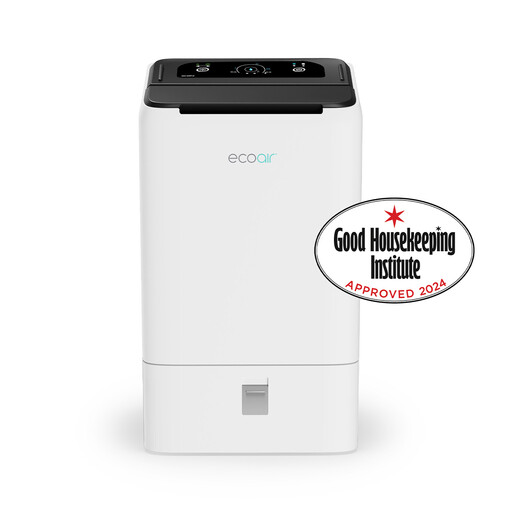
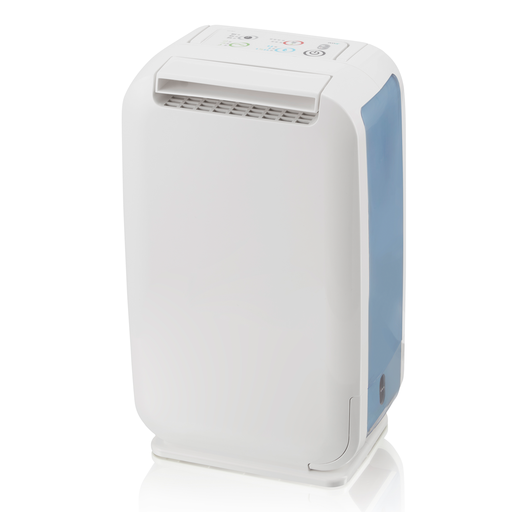
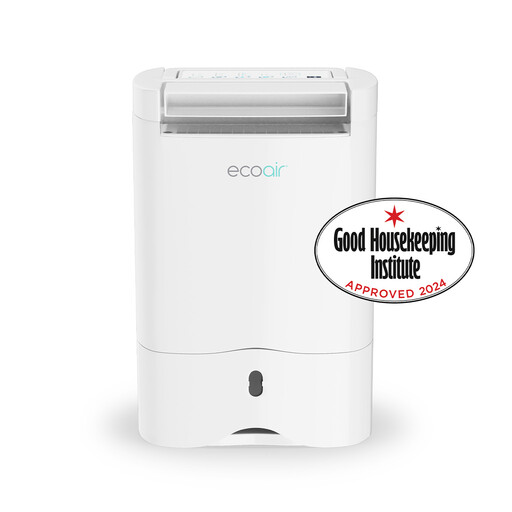
These EcoAir desiccant models are listed with laundry settings for indoor drying. Compare their stated extraction and water-management features, then check mode-specific noise, power use and room-temperature suitability before choosing one for a working space.
 No image available
For indoor laundry loads, Joybuy lists a Laundry mode and extraction of up to 9 L/day. The listing also describes automatic shut-off when the tank is full and a continuous-drain option. Check the noise and power figures for your intended setting, the tank capacity and the operating-temperature range against your workspace.
 No image available
For moving between a work area and a drying area, Joybuy describes a carry handle and lightweight design. The listing specifies a Laundry mode, extraction of up to 6 L/day, a 1.8 L tank, automatic full-tank shut-off and a continuous-drain option. Compare mode-specific noise and power use, and check the stated temperature range if the room is cool.
 No image available
For longer laundry runs, Joybuy lists a 3 L tank, automatic full-tank shut-off and a continuous-drain option. It also specifies a Laundry mode and extraction of up to 10 L/day. Check its noise and power figures for the setting you plan to run, as well as its temperature range and whether its airflow can be directed towards the rack.
Usually, yes, if you can close that room while it runs and position the appliance safely away from the rack. Keep its air intake and outlet clear, follow its placement instructions and ventilate the home appropriately after drying.
No: water must not drip onto or into the appliance. Keep the rack offset from the unit, prevent garments from covering its vents and follow the selected model’s clearance and water-safety instructions.
Use the wattage stated for that specific setting and the time you expect to run it: watts multiplied by hours, then divided by 1,000, gives kilowatt-hours. Apply your own electricity tariff to that figure; do not use a different model’s or quieter setting’s wattage as a substitute.
Not necessarily. Which? points to desiccant models for cooler temperatures, so a consistently heated office gives you reason to compare other dehumidifier types too. Check your room temperature alongside the noise and power figures for the settings you would actually use.
Do not rely on the appliance alone if damp or mould persists: address the moisture source and any ventilation or building issue. If you rent, report the problem to your landlord and seek guidance applicable to where you live; rules should not be assumed to be identical across the UK.