People working in cooler rooms
If your office is a conservatory, converted room or other intermittently heated space, check that the dehumidifier is specified to operate at the temperatures the room reaches.


A desiccant dehumidifier is worth considering for a cool or intermittently heated home office, provided its stated operating range covers your room. Compare humidity control, water removal and the practical disturbance of running it near your desk. Keep ventilation working and investigate recurring damp rather than relying on the appliance to resolve its cause.
If your office is a conservatory, converted room or other intermittently heated space, check that the dehumidifier is specified to operate at the temperatures the room reaches.
If you plan to run a unit during the working day, humidity controls, tank-full shut-off and the task of emptying the tank matter alongside its extraction rating.
An appliance may help manage airborne moisture while a suspected leak, ventilation problem or other property cause is reported and investigated. Middlesbrough Council advises private renters worried about damp or mould to report it to their landlord.
For one damp home office, start with the room’s temperature, then consider how much attention the unit will need during work and where the collected water will go. Treat recurring mould or a suspected property defect as a separate issue.
| Concern | What to check | Who this matters to |
|---|---|---|
| Cool-room operation | Check the minimum operating temperature and the conditions used for the stated extraction rate. | If my office gets cold between heating periods, I need a model specified to work at those temperatures; around 31% of consumers put cool-room operation first. |
| Control during work | Check whether the humidistat stops and restarts the unit automatically, and compare power draw by mode. | When I am at my desk, I want moisture control that does not need constant adjustment; roughly 31% of consumers prioritise low-interruption control. |
| Water removal | Check tank capacity and full-tank shut-off; for drainage, check the hose requirements and route to a suitable drain. | If damp persists through the working day, repeated tank emptying could interrupt me. Around 23% of consumers make water handling their primary concern. |
| Cause of recurring damp | Keep appropriate ventilation working, and document and report suspected leaks or persistent mould in rented accommodation. | If the damp keeps returning, I need its cause investigated as well as the air managed; about 15% of consumers put that issue first. |
A dehumidifier collects moisture, but it does not exchange indoor air for fresh outdoor air. Government ventilation guidance distinguishes that air-exchange role from moisture control.
Keep appropriate trickle vents unblocked and extractor fans working while using the appliance.
Extraction figures depend on stated test conditions, while power draw can vary by mode. EcoAir lists 300 W in low mode and 580 W in high mode for its DD1 Simple MK3.
Compare each exact model’s extraction conditions, operating range and the mode you expect to use.
Running a higher-power mode for longer increases electricity consumption.
A small tank needs emptying when it fills. Continuous drainage is useful only if the hose and route to a suitable drain work in your office.
Check tank capacity, full-tank shut-off and whether a compatible hose is included before planning a drainage setup.
Collecting moisture does not repair a leak or establish why damp keeps returning. Government guidance also recognises the risks associated with damp and mould in homes.
Document and report recurring damp or mould promptly in rented accommodation, and use the dehumidifier only as supplementary moisture control while the cause is addressed.
Meaco positions its DD8L desiccant model for household use, including colder spaces.
EcoAir’s DD1 Simple MK3 brings humidity and water-handling controls into a compact desiccant model.
Pro Breeze positions its specified 10L desiccant model for larger spaces and cooler conditions.
These EcoAir models are options to examine for moisture control in a home office that can get cool. If emptying the tank would interrupt work, check the exact model’s drainage requirements and whether your room has a suitable drain.
 No image available
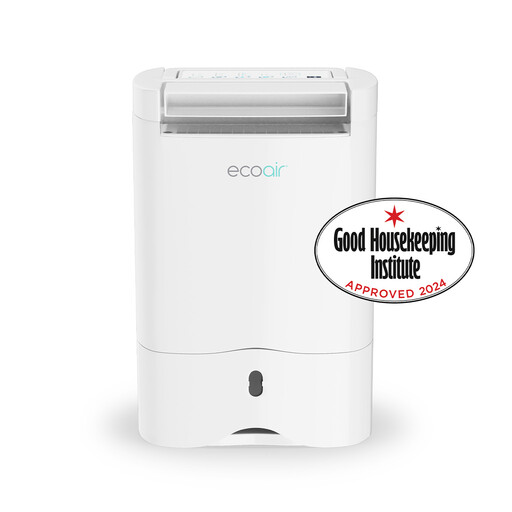
Consider this model if you want a slim unit and a stated low-temperature option for a home office.
The product name specifies extraction of up to 10 litres per day, a 3L tank and laundry mode. Check the extraction conditions, exact operating range, humidity controls and drainage requirements against your room.
 No image available
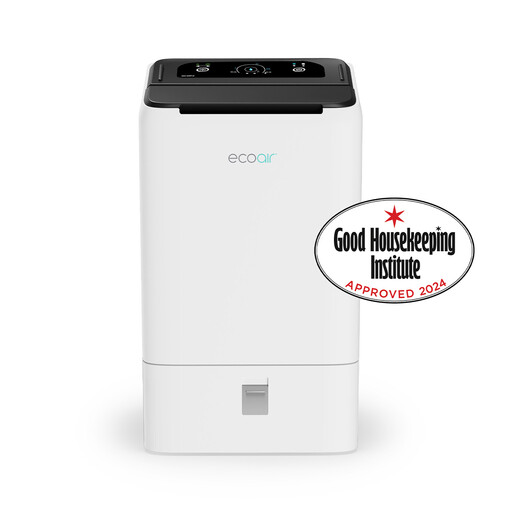
Consider this model if you may need to move a dehumidifier between rooms and want a stated low-temperature option.
The product name specifies extraction of up to 9 litres per day, a lightweight design and laundry mode. Check the extraction conditions, exact operating range, tank capacity and drainage requirements before choosing it for your office.
No. Government ventilation guidance describes ventilation as exchanging stale indoor air and moisture for fresh outdoor air. Use a dehumidifier to collect moisture while keeping appropriate vents and extraction arrangements working.
EcoAir’s DD1 Simple MK3 manual describes 40%–60% relative humidity as its comfort range. Use that as manufacturer guidance for that product line, and follow the controls and instructions for the model you choose.
Choose a tank if you can empty it reliably; consider continuous drainage if persistent damp makes that inconvenient and you have a suitable drain. Check the exact model’s hose requirements and whether the hose can be routed safely to that drain.
No. A dehumidifier can collect airborne moisture but cannot repair a leak or heating fault. Middlesbrough Council advises private renters worried about damp or mould to report it so their landlord can investigate.