What matters near a sofa?
Decide whether you need airflow at one seat or across the seating area before comparing features. Placement and power then determine which design is practical in your flat.
Compact desk or mini-tower fan
Choose it when: A nearby table or shelf can hold the fan and direct airflow at one seat is the main aim.
Trade-off: Its compact format does not, by itself, establish how well it will move air around the wider room.
Multi-directional air circulator
Choose it when: You want to direct air across or above the sofa instead of keeping a steady breeze on one person.
Trade-off: Check that its base fits securely on the surface you have available.
Height-adjustable cordless fan
Choose it when: You need to move between tabletop and floor positions or there is no convenient socket near the sofa.
Trade-off: Battery operation requires charging, and runtime varies with the operating setting.
| Concern | What to check | Who this matters to |
|---|
| Airflow coverage and direction |
Check horizontal oscillation and head adjustment; assess any stated reach for the exact model. |
If air needs to move beyond my seat, I want to aim it across or above the sofa rather than keep it pointed at me. Around 33% of consumers put wider, adjustable coverage first. |
| Noise during downtime |
Check which speed a stated dB figure describes, alongside any timer or display-dimming options you need. |
When I read or watch television beside the fan, I do not want its sound to dominate the room. Low disturbance is the main concern for around 27% of consumers. |
| Footprint and stable placement |
Compare the base dimensions with the available surface and make sure the fan can sit fully on a stable, hard surface. |
A narrow side table leaves little room for a fan that cannot sit securely, and I may need to store it between uses. Around 27% of consumers prioritise compact, stable placement. |
| Cordless placement and controls |
Check whether a battery is included, its runtime conditions and charging method; confirm any remote or timer is included. |
If the socket is across the room, I would rather move the fan than route a cable past the sofa. Cordless flexibility is the primary need for around 13% of consumers. |
Joybuy products for sofa-side use
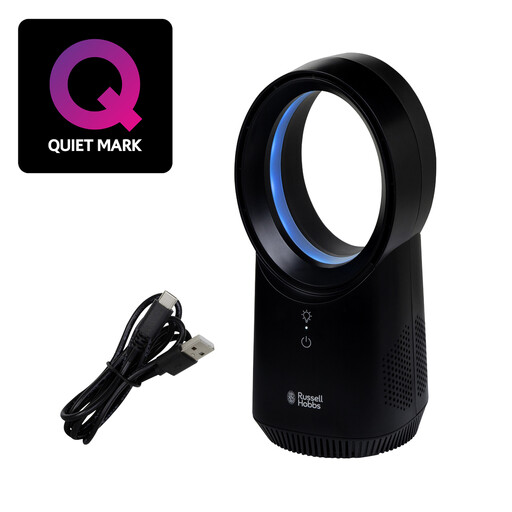
This compact cordless desk fan is relevant if you want nearby personal airflow without running a power cable to the sofa. Check its dimensions and direction controls against your intended position before choosing it for a wider seating area.
 No image available
Russell Hobbs RHBLDLUSB25B compact wireless bladeless desk fan, black
Consider it for personal airflow from a surface near the sofa when cordless placement is useful.
The listed variant has three speed settings, USB charging and a bladeless design. Check its dimensions against your surface, and confirm oscillation, tilt, noise at your intended speed and battery runtime if those features affect your choice.
View on Joybuy
Common questions
Will a desk fan lower the temperature of my small flat?
No: a desk fan moves air and can make you feel cooler, but it does not actively refrigerate the room as an air conditioner does. Choose one for airflow at the sofa or around the seating area, not as a substitute when lowering room temperature is the requirement.
Should a sofa-side fan oscillate?
Oscillation is useful when airflow needs to reach more than one sofa seat; a fixed or tilting head may be sufficient for a steady breeze at one seat. Check the exact model’s horizontal movement and vertical adjustment rather than assuming that either feature is included.
Can I use an extension lead for a fan beside the sofa?
Yes, if the extension equipment is suitable, undamaged and not overloaded. Electrical Safety First advises against daisy-chaining extension leads; fully unwind a cable reel and stop using equipment with damaged cables or plugs.
Is UKCA the only marking to look for when buying a fan for Great Britain?
No. GOV.UK’s Great Britain guidance on the Electrical Equipment (Safety) Regulations 2016, updated in March 2025, says recognition of certain goods meeting EU requirements, including CE marking, continues indefinitely. That does not establish whether an individual fan meets applicable requirements, and the Great Britain guidance should not be applied to Northern Ireland without checking its separate rules.


