Conservatory readers and loungers
If you sit in one chair for long stretches, adjustable direction and lower speed settings can help you avoid a constant breeze aimed at the same spot.


Choose an adjustable desk air circulator if you want airflow to sweep around the chair rather than stay directed at one spot. If close-range airflow is enough and a mains lead would be awkward, a rechargeable personal fan may suit you instead; whichever format you choose, check that it fits a stable surface and can be powered safely.
If you sit in one chair for long stretches, adjustable direction and lower speed settings can help you avoid a constant breeze aimed at the same spot.
For reading, calls or concentration, check the noise level at the setting you expect to use, as well as whether you can reach the controls without getting up.
A rechargeable personal fan can move between rooms or avoid an inconvenient mains lead. Check whether its close-range airflow meets your needs before choosing it for wider circulation.
Decide whether you need airflow around the seating area or only a breeze at close range, then check how the fan will fit and connect beside the chair.
| Concern | What to check | Who this matters to |
|---|---|---|
| Airflow direction | Check the exact model’s tilt and oscillation directions against the position of your chair. | If I want a breeze across the seating area rather than on one spot, I need to be able to redirect it. Around 42% of consumers put airflow coverage first. |
| Quiet seated use | Check which operating mode a stated noise figure describes and whether lower speeds and chair-reachable controls are available. | When I am reading or taking calls, I want airflow that does not distract me. Quiet seated use comes first for around 33% of consumers. |
| Placement and power | Measure the stable surface and check the route to a socket, or the charging arrangements for a wireless model. | If the socket is across a walkway or my side table is narrow, I need a position that will not put the fan or its lead in the way. Roughly 25% of consumers prioritise practical placement and power. |
A high-output setting may be uncomfortable close to a chair, and manufacturers’ airflow and noise figures may describe different operating conditions.
Decide whether you need a direct breeze or wider circulation, then check the exact model’s tilt, oscillation and lower settings.
A fan moves air rather than lowering the conservatory’s air temperature. The NHS says electric fans can help when the temperature is below 35°C.
Check the room temperature; in hotter conditions, use shade and other heat-management measures rather than relying on fan airflow alone.
A trailing lead can be a trip hazard. Electrical Safety First also warns against connecting one extension device to another.
Route the lead away from feet, children and pets. If you need an extension, check its rated load and fully unwind a cable reel.
A fan near a table edge or on an unstable support can be knocked over or pull on its lead.
Measure the intended space before ordering and place the fan on a stable, level surface.
Meaco’s desk-fan range includes portable models and table air circulators worth considering for different chair-side positions.
The Dyson Cool CF1 is a bladeless desk-fan option for readers who prefer a wipe-clean form without fast-spinning exposed blades.
Dreo’s TurboPoly 765S offers a tabletop or pedestal arrangement if the available placement may change.
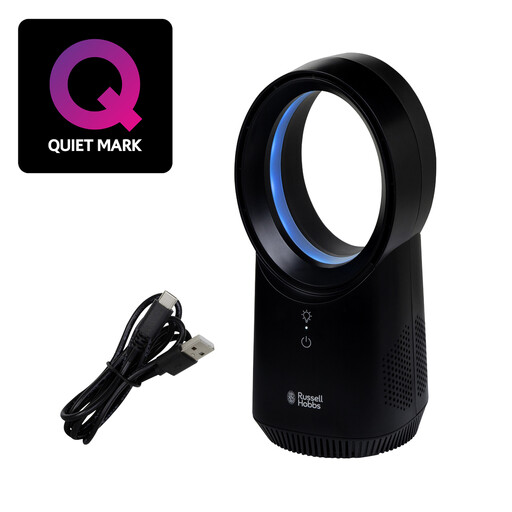
This rechargeable desk fan is a choice for close-range airflow beside the chair when avoiding a mains lead matters more than circulating air across the conservatory.
 No image available
Consider this model when personal airflow beside the chair is sufficient and a wireless fan would simplify placement. It has three speed settings and USB charging. Check its footprint, running time and airflow-direction controls against your intended use.
A desk fan moves air but does not lower the room’s air temperature. The NHS says electric fans can help below 35°C; if the conservatory reaches 35°C or more, do not rely on a fan alone to manage the heat.
Choose an air circulator if you want to direct airflow around more of the chair area; choose a small personal fan if a close-range breeze and easy relocation are your priorities. Check the exact model’s direction controls before assuming it will cover more than one seated position.
You can use an appropriately rated extension lead, but do not connect extensions together or run a lead across a walking route. Electrical Safety First advises using only one extension device per socket and fully unwinding cable reels.
Electrical Safety First advises against leaving an electric fan running overnight or while the home is empty. Unplug it when not in use, and stop using it if the cord is damaged or the fan develops an unusual noise or burning smell.
Unplug it and follow the instructions for your exact model. For the Dyson Cool CF1, Dyson instructs users to wipe the machine with a dry or damp cloth and not to use detergents or polishes; fans with grilles or blades may require different cleaning steps.