People working in a quiet shared space
If calls, television, reading or conversation happen near the desk, gentle airflow and noise at the intended speed matter more than a sound figure quoted without its operating mode.


For a desk in a shared lounge, look for low-speed control and adjustable airflow so the fan need not blow continuously at one person. Consider cordless operation if a mains cable would cross a shared space; if accessible spinning blades are a particular concern, consider a bladeless design. A fan moves air but does not lower the room’s air temperature, as Which? explains.
If calls, television, reading or conversation happen near the desk, gentle airflow and noise at the intended speed matter more than a sound figure quoted without its operating mode.
Moving between a desk and nearby seating makes the fan’s size, power arrangement and safe placement important. Cordless operation is worth considering when a cable would be awkward to route.
A stable position and a cable kept clear of traffic matter wherever someone could brush past the desk or reach the fan.
Start with where the airflow needs to go, then check how quietly the exact fan runs at a usable speed. Finally, decide whether its footprint and power arrangement work safely in the lounge.
| Concern | What to check | Who this matters to |
|---|---|---|
| Noise near other people | Low-speed options and whether a quoted dB(A) figure applies to minimum, maximum or a named mode. | I need a fan near calls or television without distracting anyone else. Around 29% of consumers put low disturbance first. |
| Airflow direction | Horizontal oscillation, vertical movement or manual tilt on the exact model. | Air should reach the desk and nearby seats without blowing at one person continuously. For around 36% of consumers, adjustable distribution is the main concern. |
| Desk fit and power | Base footprint and a safe cable route; for cordless fans, charging and claimed runtime at the intended setting. | I move between seats or have no convenient socket beside the desk. Flexible placement comes first for around 21% of consumers. |
| Household safety | A stable position away from the desk edge, cable condition and whether exposed blades are a concern. | Children, pets or people passing the desk could reach or knock the fan. Around 14% of consumers prioritise those placement and access risks. |
According to Which?, a fan moves air rather than lowering the room’s air temperature. Its benefit depends on where people are sitting.
Aim it towards occupied areas and switch it off when the lounge is empty.
A minimum, quiet-mode and maximum sound figure describe different operating conditions. Comparing them as though they were measured at the same speed can mislead.
Check the mode attached to each figure, particularly if the fan will run during calls or shared viewing.
Horizontal movement and vertical adjustment serve different seating layouts; a fan may offer one without the other.
Check the exact model’s oscillation and tilt before deciding where it will sit.
A small fan can still be knocked from a desk, while its cable may cross a busy part of the lounge.
Use a stable surface away from the edge, route the cable clear of walkways and inspect it after storage.
The documented Sefte models offer distinct options for a compact cordless fan or a desktop air circulator.
The documented CF1 is a bladeless desk-fan option when blade access, cleaning or remote controls influence the choice.
The documented BSF002-01 illustrates a conventional bladed desk fan with adjustable direction.
This cordless desk-fan option is relevant when a cable would be awkward around the shared lounge. Check its airflow movement and sound at the setting you would use if the breeze needs to reach other seats without disrupting them.
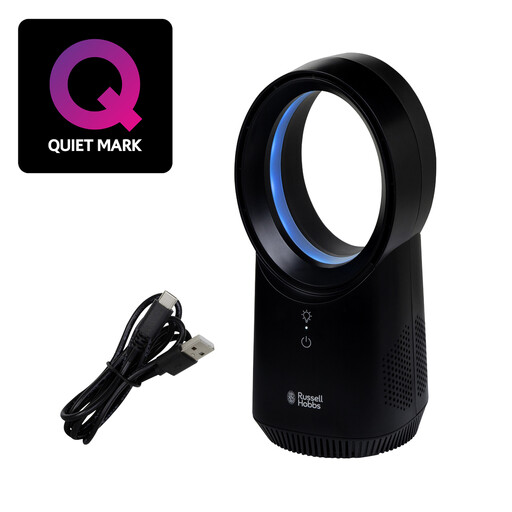 Image unavailable
Consider this model when you want to place a fan on the desk without a mains cable running across the lounge.
It has three speed settings and USB charging. If it needs to serve other seats or run during calls, check its oscillation or tilt, sound level at the intended speed, and battery runtime before choosing it.
No. Which? explains that a fan moves air rather than lowering the room’s air temperature. Position it where people can feel the airflow instead of leaving it running in an empty lounge.
Controllable oscillation and directional adjustment help move the breeze between positions. Check whether the exact fan moves horizontally, vertically or by manual tilt, and whether it has a gentle enough setting for nearby people.
Choose cordless operation if a safe mains-cable route is impractical or you regularly move the fan. It removes the cable during use but makes charging and runtime at your intended setting part of the decision.
Place it on a stable surface away from the edge and keep its cable clear of walkways and places where it could be pulled or chewed. Inspect the fan and cable after storage, and stop using it if either is damaged. Electrical Safety First advises checking that an electric fan has a UK 3-pin fused plug.