Small-desk evening sketchers
If you draw after someone else has settled down, look for a lamp you can aim at the sketchbook and dim without lighting the whole bedroom. Check that its base or clamp fits the space you actually use.


Choose a task lamp you can aim at the paper and dim without shining it into your eyes or across the shared room. A clamp can preserve desk space if it fits the furniture; a conventional articulated lamp needs room for its base, while a monitor light bar makes sense only if the paper sits beneath a compatible screen.
If you draw after someone else has settled down, look for a lamp you can aim at the sketchbook and dim without lighting the whole bedroom. Check that its base or clamp fits the space you actually use.
Fine lines, shading and erasing call for light that reaches the active part of the page without your hand casting a troublesome shadow. The Health and Safety Executive notes that more detailed tasks generally need more light; an adjustable head also lets you change direction as the drawing moves.
If you also assess coloured pencil, paper tone or printed references, compare the exact model’s colour-rendering and colour-temperature specifications. Those checks are less decisive when you only need to see graphite lines clearly.
Start with where the paper and lamp can sit, then consider light direction, adjustment and the effect on the other person in the room. Compare colour specifications if your work involves more than graphite.
| Concern | What to check | Who this matters to |
|---|---|---|
| Light on the drawing | Check whether the head can be aimed from a useful side of the paper. If illuminance is stated in lux, note its measurement distance before comparing lamps. | I need to see fine pencil marks without my hand shadow covering the line I am drawing; around 29% of consumers put directable task light first. |
| Glare and light spill | Look for adjustable brightness, a shielded light source and a head that points towards the page rather than across the room. | When someone else is resting nearby, I want enough light for the sketchbook without shining towards them; reducing glare and spill is the primary concern for roughly 29% of consumers. |
| Colour and tone | Compare the exact model’s stated CRI or Ra value and whether its colour temperature is fixed or selectable. | I also use coloured media or judge paper tone against a reference, so the appearance of colours under the lamp matters to me; around 21% of consumers place that need first. |
| Desk and mounting fit | Measure the available surface or clamp edge, including nearby clearance, and check that the cable can reach a socket without creating a snag risk. | A narrow desk leaves little room for a base, and a clamp is useful only if it attaches securely; fitting the lamp into the setup comes first for roughly 21% of consumers. |
An illuminance figure depends on where it was measured. Lux stated at 30 cm cannot be treated as directly equivalent to lux stated at 45 cm.
Look for the measurement distance and consider whether the lamp can aim light over the part of the page you use.
A clamp may not seat securely if the edge is too thick or obstructed by a lip, drawer rail or wall.
Measure the usable edge and clearance, then compare them with the exact lamp’s clamp requirements before ordering.
Colour rendering does not tell you whether the light source will be visible to your roommate or whether the beam can be kept on the paper.
Check dimming, shade design and head adjustment separately from the CRI specification.
A monitor-mounted bar stays tied to the screen’s position, which may not suit a sketchbook or drawing board placed elsewhere.
Check monitor compatibility and the paper’s position. If you need to change which side lights the page, consider a movable desk or clamp lamp instead.
Makes clamp and drafting lamps aimed at work on desks, drawing boards and easels.
Offers lighting for precision work where directing light over the work area is important.
Makes conventional articulated desk lamps, including models intended for drawing and other task work.
Offers monitor-mounted light bars for desks where the paper can sit beneath the screen.
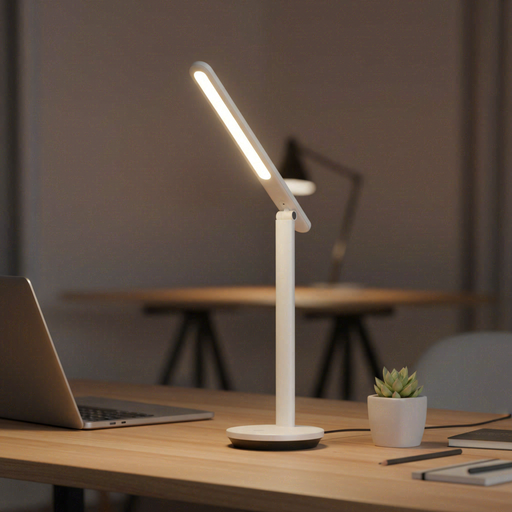
This folding desk lamp is a choice to consider when adjustable brightness and a compact setup matter. Check its light direction and desk fit against your sketching position before deciding.
 No image available
For a compact sketching desk, consider this folding lamp if adjustable brightness is a priority. Check how its light reaches your paper without shining towards the other person in the room.
The White variant is described as rechargeable. Confirm its dimensions and battery runtime for your intended placement and drawing sessions.
Choose enough adjustable light to see the marks on your paper without uncomfortable glare, rather than aiming for one lux figure regardless of setup. The Health and Safety Executive notes that detailed tasks generally need more light; when comparing lamps, read any stated lux alongside its measurement distance.
Put the lamp on the side that keeps your drawing hand from shading the active area, then aim its head down towards the paper. The useful side depends on your drawing hand and posture, so repositioning matters more than a fixed left-or-right rule.
Not necessarily: for graphite-only drawing, start with whether you can control brightness, glare and hand shadows. A stated colour-rendering index becomes a more relevant comparison if you also judge coloured media, paper tone or references under the lamp.
Check the exact lamp version’s plug and power requirements, supplier information and instructions against your desk setup. Plan a cable route that reaches the socket without crossing a walking area or catching on the furniture.
If it can still be used, consider a reuse route; otherwise, check your local authority’s electrical-waste collection or a retailer take-back option. GOV.UK describes waste electrical and electronic equipment arrangements as supporting recovery, reuse and recycling rather than disposal with general waste.