Who each format suits
The useful distinction is whether one opened tin can become two meals, or whether lunch needs to be a self-contained portion.
Households that also pack desk lunches
Four full-size tins make sense when several people eat the beans or you can use an opened tin across meals. Sainsbury’s lists eight half-can servings in its 4 x 400g pack; check the chosen tin’s instructions for storing any remainder.
Office workers without leftover storage
A separate 200g microwaveable pot avoids opening a full-size tin for one lunch, provided you have access to the equipment specified on its pack. Heinz Snap Pots, for example, have instructions for heating an individual pot.
Shoppers comparing reduced recipes
Look at salt and sugars for the serving you expect to eat, as well as the ingredients. A reduced recipe is compared with a named standard recipe; it is not a claim that every brand has the same nutrition values.
What to check before choosing
Start with the portion you can use at work, then check preparation, the exact recipe and its label.
| Priority |
What to check |
Your needs |
| Portion and storage |
Check the number and size of tins or pots, servings per container and the opened-pack storage instructions. A 4 x 400g Sainsbury’s pack lists eight half-can servings. |
I can share a full-size tin or keep the rest refrigerated for another meal. If neither works at the office, a separate pot is more practical. |
| Workplace heating |
Check whether the pack calls for a microwaveable dish, cover and stirring, or permits heating an individual pot. Follow its instructions for heating and serving. |
At work, I need a preparation method that fits the microwave and utensils available to me. |
| Salt, sugars and ingredients |
Compare the same serving size and read the ingredients. Sainsbury’s lists 0.59g salt per half-can for its reduced-sugar-and-salt 4 x 400g beans, against 1.16g for its standard 4 x 400g beans; the reduced recipe includes steviol glycosides. |
If I prefer a reduced recipe, I want to know what changes in the particular beans I am buying, including whether they contain a sweetener. |
| Allergens and dietary suitability |
Read the ingredient and allergen information on the exact pack. M&S Food states that its 400g baked beans are not suitable for people with milk or egg allergy. |
For an allergy or dietary requirement, I need the statement for this recipe, not an assumption based on baked beans generally. |
Brand and retailer references
These examples illustrate pack formats and recipe differences; a retailer listing for one product does not describe every product sold under that name.
Heinz
The reviewed range includes standard and No Added Sugar 4 x 415g tins, alongside 4 x 200g microwaveable Snap Pots.
- The pots offer separate portions for lunches where storing an opened tin is impractical.
- The tin and pot recipes have different serving sizes and nutrition panels; compare the particular variants you would eat.
Sainsbury’s
Sainsbury’s lists standard and reduced-sugar-and-salt own-label beans in 4 x 400g packs.
- Its listings give a direct comparison: 1.16g salt per half-can for the standard pack and 0.59g for the reduced pack.
- The reduced recipe includes steviol glycosides, so check the ingredients if you avoid sweeteners.
Waitrose Essential
The reviewed reduced-salt-and-sugar beans come in an individual 420g tin rather than a sealed four-tin pack.
- Individual tins let you try the recipe or choose how many to keep at home.
- Waitrose & Partners instructs shoppers to transfer unused beans to a non-metallic container, refrigerate them and use them within two days.
M&S
The M&S Food example is a 400g tin with product-specific nutrition and dietary information.
- Its product information lists 0.53g salt per 100g, a basis for checking the amount you intend to serve.
- M&S Food says this product is not suitable for people with milk or egg allergy.
Tesco
The Tesco Groceries example is a Heinz standard 4 x 415g listing, not a Tesco own-label recipe.
- Its listing specifies the four-tin format and salt per half-can, which can inform a comparison with other packs.
- Check the brand and recipe on each listing rather than treating a retailer name as the product identity.
Joybuy family-pack options
These Branston multipacks are options for households that can use full-size tins across meals: two contain four 410g tins, while one contains six. Check how you will handle an opened tin before choosing a pack for a single desk lunch.
 No image available
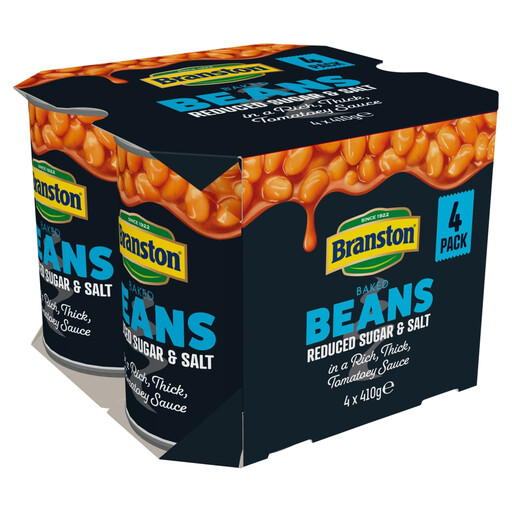
Branston Reduced Sugar & Salt Baked Beans, 4 x 410g
This four-tin reduced-recipe pack suits lunches where you can use or refrigerate the remainder of an opened 410g tin. It contains steviol glycosides; check the ingredients if you avoid sweeteners. Transfer leftovers to a suitable container, refrigerate and use within two days.
View on Joybuy
 No image available
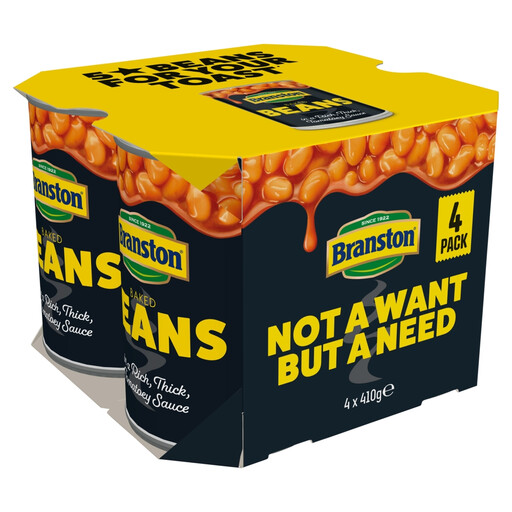
Branston Baked Beans, 4 x 410g
This standard four-tin pack is an option when a household can use the full-size cans across meals. Its preparation instructions call for microwave heating in a covered container; refrigerate unused beans and use them within two days.
View on Joybuy
 No image available
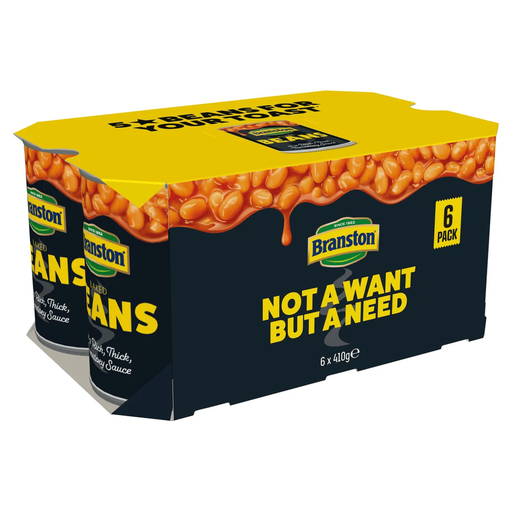
Branston Beans in Tomato Sauce, 6 x 410g
Six full-size tins suit a household planning several meals rather than occasional single desk lunches. Check the pack’s reheating instructions if you intend to prepare a tin at work. Transfer unused beans to a covered container, refrigerate and use within two days.
View on Joybuy
Desk-lunch questions
Does a four-tin family pack work for one desk lunch at a time?
It works if you can use or properly store the remainder of each opened tin. The reviewed 400–415g tins provide about two half-can servings; without a way to keep leftovers refrigerated, a separate 200g pot avoids opening a full-size tin for one lunch.
Can I microwave baked beans in their metal tin?
No. Follow the chosen product’s instructions: the reviewed full-tin directions call for a suitable microwaveable, non-metallic container, with covering and stirring as directed. Heinz Snap Pots have different instructions that permit heating an individual pot after peeling back its film.
What changes in a reduced-sugar-and-salt family pack?
The change depends on the recipe and its stated comparator. Sainsbury’s describes its reduced 4 x 400g beans as containing 30% less sugar and salt than its own standard beans; its listings give 0.59g salt per half-can for the reduced pack and 1.16g for the standard pack. The reduced recipe includes steviol glycosides.
How long can I keep beans after opening a tin?
Use the storage instructions on the exact pack. The reviewed Sainsbury’s and Waitrose Essential products instruct shoppers to move unused beans to a non-metallic container, refrigerate and use them within two days; the reviewed M&S product states three days.
How should I check allergens when choosing a pack?
Read the ingredient and allergen information on the exact can or pot before buying or eating it. Suitability is recipe-specific: M&S Food states that its reviewed 400g baked beans are not suitable for people with milk or egg allergy.


