
24/7 Customer Support

Free returns

Same-day & Next-day Delivery

Quality Guaranteed
Download the APP
Categories
A cluttered desk can lead to a cluttered mind, making it difficult to focus and be productive. Whether you are working from a home office, studying for exams or managing a busy corporate desk, the constant battle against stray papers, pens and cables is a familiar one. The right desk organiser can transform your workspace from a source of stress into a hub of efficiency.
This guide is designed to help you navigate the options available and select a solution that fits your specific needs. As a Joybuy Product Recommendation Officer, my role is to provide objective, practical advice to help you find functional products that genuinely improve your day-to-day life. Let's explore how to bring order back to your desk.
Before you purchase, consider these key factors to ensure you select an organiser that will serve you well.
The first step is to evaluate your available desk area and the items causing the most clutter. If your desk surface is limited, a vertical solution like a wall file organiser can be an excellent way to free up space. For those with more room, a comprehensive desktop organiser with drawers might be more suitable. Think about your daily tasks. Are you constantly reaching for documents, or is your main challenge corralling stationery? Your workflow should dictate the form of your organiser.
The material of an organiser affects both its appearance and its longevity. A metal desk organiser often provides a sleek, modern look and is exceptionally durable, making it ideal for holding heavy files or books. Mesh metal designs offer the added benefit of visibility, so you can see what's inside. Plastic organisers are typically more lightweight and can be a versatile choice, often featuring multiple moulded compartments perfect for a stationery organiser.
There is no one-size-fits-all solution for home office organisation. If your primary issue is a mountain of paperwork, look for a dedicated file holder for desk or an A4 document holder with multiple tiers. If pens, sticky notes and paper clips are your main problem, a caddy-style organiser with small, distinct compartments will be more effective. Identifying the source of your clutter is crucial to choosing the right tool for the job.
Based on functionality, design and user needs, here are some noteworthy options to consider for your workspace.
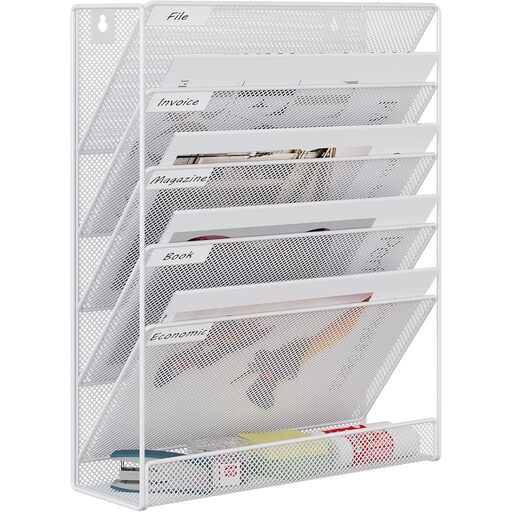
Why It Stands Out: This organiser’s key strength is its versatility. It can be mounted on a wall to maximise vertical space or used as a freestanding unit on a desk or floor. Its six-tier design is ideal for sorting multiple projects, subjects or types of documents.
The construction is a durable, powder-coated metal that resists rust and oxidation. A thoughtful addition is the flat tray at the bottom, perfect for holding small stationery items like pens, keys or tape that might otherwise get lost.
Pros:
Who is it for? This is an excellent choice for individuals in a home office or study with limited desk surface area. Its ability to get papers off the desk and onto the wall makes it a powerful tool for home office organisation. It's also great for anyone managing multiple ongoing projects who needs a clear, visual filing system.
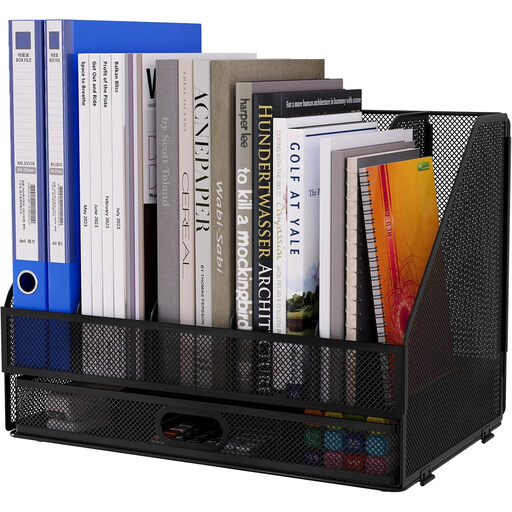
Why It Stands Out: This unit is an all-in-one command centre for your desk. It combines five vertical slots for files, notebooks and ring binders with a slide-out desktop organiser with drawers for smaller items. This integrated approach tackles both paper and stationery clutter in a single, compact footprint.
Made from high-quality metal with a powder-coated finish, this office organiser is built for stability and long-term use. The mesh design allows you to quickly identify contents without pulling everything out.
Pros:
Who is it for? This is ideal for professionals and students who need a robust, multi-functional solution. If you handle a mix of A4 documents, folders and various stationery items, this organiser provides a designated spot for everything, helping to maintain a tidy and efficient workspace.
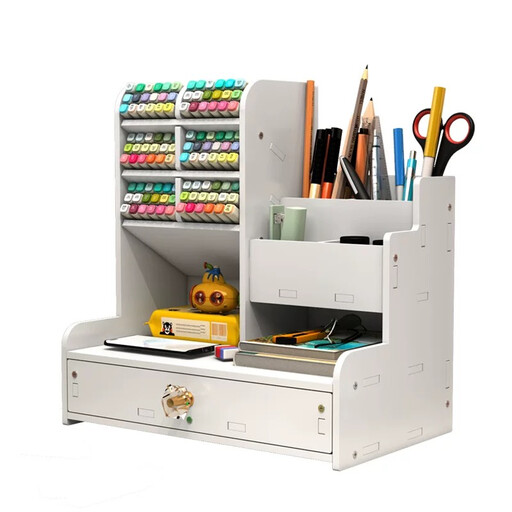
Why It Stands Out: This organiser focuses squarely on taming stationery chaos. Its clever, compact design combines multiple pen/marker holders, a small file rack for letters or notepads and a small drawer for items like paper clips or USB drives.
Constructed from durable plastic, it's lightweight and requires no assembly. You can place it on your desk and start organising immediately. It’s a simple but highly effective tool for anyone whose clutter is more about small items than large documents.
Pros:
Who is it for? This is a perfect stationery organiser for students, artists, crafters or office workers who find their desks overrun with pens, highlighters, scissors and other small tools. Its compact size makes it suitable for even the smallest of desks or as a companion to a larger paper-focused organiser.
The recommendations above cover a range of common needs, but every workspace is unique. If you're looking for a different size, material or configuration, there are many other solutions available.
To see a wider selection of organisational tools, we invite you to explore our full range of stationery racks.
Explore All Stationery Racks on Joybuy
Q1: What is the best way to organise a desk? A: An effective method involves a three-step process: declutter, categorise and contain. First, remove everything that doesn't belong. Second, group similar items together (e.g., writing tools, pending documents, tech accessories). Finally, use a desk organiser that provides a specific home for each category, keeping your most-used items within easy reach.
Q2: How can I make my small desk more organised? A: With a small desk, thinking vertically is key. Use a wall file organiser or a monitor stand with built-in storage to lift items off the surface. Opt for compact, multi-functional organisers that combine several functions, such as a pen holder with a small drawer, to maximise utility without taking up precious space.
Q3: Are metal or plastic desk organisers better? A: Neither is inherently better; it depends on your priorities. Metal organisers offer superior durability and stability, making them excellent for heavy items like binders and books. They also lend a modern, industrial aesthetic. Plastic organisers are lightweight, often more affordable, and available in a vast array of shapes and colours, making them great for organising smaller, lighter stationery items.