For close comparisons between a photograph and a reference, choose a lamp with a documented colour-rendering rating at the setting you intend to use and controllable daylight-balanced light. Calibrite, for example, specifies CRI 95+ and a 5,000K mode for the GrafiLite; a broad, adjustable task lamp may suit larger print layouts, but a desk lamp alone does not establish the controlled viewing conditions covered by the International Organization for Standardization’s ISO 3664:2025.
Who needs which setup?
Print-to-monitor hobbyists
If you compare a photograph with an edited image on a calibrated display, look for a setting you can use consistently and adjust to the comparison. Calibrite and ILFORD both describe print-comparison uses for their viewing lamps.
Large-print and album reviewers
If prints or album pages occupy much of your desk, check how far the lamp reaches and whether you can reposition its head to light the work without your hands casting shadows. Redgrass and Daylight Company offer adjustable designs for broader work areas.
Colour-critical proof checkers
If you routinely need defined, repeatable conditions for assessing proofs, consider a controlled viewing cabinet rather than relying on a desk lamp. The International Organization for Standardization’s ISO 3664:2025 addresses viewing conditions for prints; JUST Normlicht offers a desktop cabinet with D50 and D65 modes.
What matters when choosing a lamp?
For hobby-room print review, start with the purpose of the comparison, then check the relevant light setting, the area you need to illuminate and how the lamp will fit your desk.
| Concern |
What to check |
Who this matters to |
| Colour fidelity |
Check the stated CRI or Ra for the exact lamp and operating mode, alongside a setting suited to your print-reference comparison. |
If I am judging subtle differences between a print and a reference, brightness alone will not answer my colour question. Around 36% of consumers put colour fidelity first. |
| Repeatable comparisons |
Look for a setting you can select again, plus dimming if you need to adjust light beside a calibrated monitor. |
When I return to the same photograph later, I want a consistent lamp setting rather than a judgement altered by changing room light. Roughly 29% of consumers prioritise repeatable comparisons. |
| Coverage and shadows |
Compare your print layout with the lamp’s stated coverage, reach and head adjustment; read quoted lux values with their measurement distances. |
With an album or several prints spread out, I need light across the work without my hands obscuring it. About 21% of consumers make coverage and shadow control their main concern. |
| Desk fit |
Measure the available space and, for a clamp lamp, the desk edge; check the supplied mounting and power arrangements. |
If my hobby desk also holds a monitor or albums, the lamp must fit before its other features help me. For approximately 14% of consumers, a compact, practical setup comes first. |
Buying pitfalls to avoid
-
Choosing by colour temperature alone
A daylight label or 5,000K setting does not tell you how the lamp renders print colours. ILFORD, for example, publishes different colour-rendering values for different ILFOLUX settings.
Check the exact model’s CRI or Ra at the mode you plan to use, particularly if matching colours is your reason for buying.
-
Assuming a desk lamp controls the whole room
The International Organization for Standardization’s ISO 3664:2025 addresses defined viewing conditions for prints; putting a lamp above a desk does not establish those conditions.
For hobby comparisons, reduce mixed room light and keep the lamp setting consistent. Consider a controlled D50/D65 viewing system if repeatable, colour-critical proof assessment is essential.
-
Using a narrow light for a broad print layout
A high colour-rendering rating does not tell you whether an entire album or several prints will be evenly lit. Lux figures also depend on the distance at which they were measured.
Measure the working area and check reach, head adjustment and any stated coverage at its specified distance.
-
Overlooking mounting and power
A clamp lamp needs a suitable desk edge, and the supplied power arrangement must suit where you will use it.
Check the clamp opening, whether the intended base or clamp is supplied, and the plug or adapter details for the exact product offered by the seller.
Relevant brands for reference
Calibrite
The GrafiLite is a compact lamp Calibrite positions for desktop print and colour-swatch assessment.
- Its stated features include CRI 95+, a 5,000K mode, three intensity settings and a neutral-grey A4 mat.
- The A4 mat and compact arrangement point towards close desktop review rather than lighting a large print display.
ILFORD
The ILFOLUX Colour Viewing Lamp is intended for examining prints and colour references.
- ILFORD lists four colour-temperature settings, dimming, a diffuser and base or clamp mounting, with colour-rendering data by setting.
- Check the published Ra value for the mode you will use rather than treating one colour-rendering figure as applying to every setting.
Redgrass
The R9 Desk Lamp is a precision-work task light with a fixed 5,000K setting.
- Redgrass lists an extended CRI of 98.5+ and two rotating light bars that can be aimed over a print.
- Its fixed daylight setting does not provide warmer modes for previewing a print under different room lighting.
Daylight Company
The Luminos is a clamp-mounted task lamp designed for a broad work surface.
- Daylight Company specifies a 112 cm arm, wide shade and CRI 95+ for the Luminos.
- Its stated colour temperature is 6,000K rather than 5,000K, and its clamp needs a compatible desk edge with an opening of up to 75 mm.
JUST Normlicht
Its desktop DLS viewing cabinet is a controlled-viewing option for repeatable proof assessment.
- The DLS offers switchable D50 and D65 modes and controlled UV content.
- A desktop cabinet requires substantially more space than a hobby desk lamp and is a different purchasing commitment for occasional print review.
Joybuy products for desk-based print review
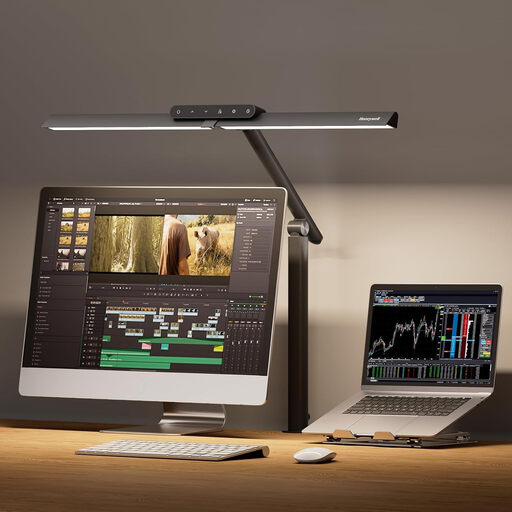
This clamp-mounted task lamp is a choice to consider when adjustable positioning matters at a hobby-room desk. Confirm its light settings and coverage against the prints you intend to review.
 No image available
Honeywell HJ1 Sunturalux clamp desk lamp, black (UK)
Consider this clamp lamp if you want to position light over prints while keeping the desk surface clear.
The product title states 1,200 lm, four colour modes and stepless dimming.
If you need a particular print-viewing condition, check whether 5,000K is selectable and what colour-rendering rating applies at that setting. Also confirm coverage across your prints, clamp fit and the supplied UK power arrangement.
View on Joybuy
Questions about reviewing prints
Do I need a colour-viewing lamp rather than a bright desk lamp?
Choose a lamp with documented colour rendering at your intended setting if you are judging whether a print matches a reference, swatch or calibrated screen. A general bright lamp can help you inspect a photograph, but brightness alone does not establish its suitability for colour comparisons.
Should I use 5,000K or 6,500K to review photographic prints?
Use the setting that suits the comparison you are making rather than assuming one is always correct. Calibrite positions the GrafiLite’s 5,000K mode for print assessment, while ILFORD offers both 5,000K and 6,500K on the ILFOLUX for examining a print under different stated settings.
Can a desk lamp create an ISO 3664 viewing setup?
No, a desk lamp does not do so by itself. The International Organization for Standardization’s ISO 3664:2025 specifies viewing conditions for photographic and photomechanical prints; consider a controlled viewing system when your proof assessments require defined, repeatable conditions.
How should I light a print beside a calibrated monitor?
Keep the lamp setting and room light consistent, and position the light so you can see the print without reflections on the screen. For its GrafiLite, Calibrite advises selecting daylight illumination and adjusting the dimmer to correspond with calibrated-monitor brightness; that is guidance for that product, not a universal calibration setting.


