Choose a desktop that supports your recording software and audio interface before deciding how much picture-processing or expansion capacity you need. A compact Mac mini may suit a space-limited macOS setup, while a tower is worth considering when the same computer will also handle demanding video work or needs internal expansion. Check the exact software versions, drivers, memory, storage and display connections for the configuration you intend to buy.
Who is this for?
Composers with large instrument sessions
If you write to picture using a digital audio workstation (DAW), sampled instruments and plug-ins, start with software support, memory and audio storage rather than graphics specifications alone. Avid, for example, sets out a dedicated audio record and playback drive requirement for Pro Tools.
Composers who also work on picture
If you edit or prepare animation footage as well as scoring it, check the requirements of your video software alongside those of your DAW. Apple lists hardware media engines for supported formats on Mac mini, while HP offers workstation configurations positioned for video editing and review.
Home-office users with limited desk space
A compact desktop can leave more room for a keyboard controller, speakers and an audio interface. Plan where the computer and connected devices will sit, then check the ports and display limits of the exact configuration rather than relying on its size alone.
What matters when choosing?
Choose the software and audio-interface setup first; then decide whether the computer only needs to play reference video or must also edit and render it. That distinction helps determine whether a compact desktop or a more expandable machine is relevant.
Compact macOS desktop
Consider when: Your DAW, essential plug-ins and interface support the intended macOS and Apple-silicon configuration, and desk space is limited.
Check before choosing: Match memory and storage to your projects, and confirm the required displays and peripherals against the exact Mac mini configuration.
Compact Windows workstation
Consider when: Your tools require Windows and you want workstation configuration choices without allocating space for a tower.
Check before choosing: Graphics, memory, storage and ports vary by model; confirm the supported Windows version and audio-interface driver too.
Expandable tower
Consider when: Picture editing, rendering, internal drives or PCIe cards make expansion a real part of the workflow.
Accept that: A tower takes more room, and its graphics and expansion capacity need not benefit a project centred on audio and supplied reference video.
| Concern |
What to check |
Who this matters to |
| DAW and audio compatibility |
Check the exact DAW, plug-in and interface-driver versions against the operating system and processor platform. For Pro Tools, Avid specifies at least 16GB RAM and a dedicated audio record and playback drive. |
If my scoring setup cannot run its essential plug-ins or connect to my interface, other hardware specifications will not solve the problem. Around 42% of consumers put audio-system compatibility first. |
| Picture workload |
Decide whether you will play supplied reference video or also edit, transcode or render it; check the video software’s requirements for the latter. |
I need the same computer to handle picture work as well as the score, so the video workload shapes my choice. Around 33% of consumers make picture-handling capacity their primary concern. |
| Desk space and connections |
Measure the intended space and match every display, audio device and external drive to the configuration’s ports and display limits. |
My home-office desk has to accommodate the computer and recording equipment without leaving a device disconnected. For around 25% of consumers, placement and connectivity are the main priority. |
Buying pitfalls
-
Choosing the processor before checking the software
A powerful desktop can still be unsuitable if an essential DAW, plug-in or audio-interface driver does not support its operating system or processor. Avid publishes specific system and audio-device requirements for Pro Tools.
Make a list of the software, interface and control surfaces you use, including their versions, before comparing computer configurations.
-
Buying tower capacity for an audio-focused project
Workstation expansion and professional graphics options address particular workloads; they do not establish an advantage for a scoring project that mainly uses a DAW and supplied reference video.
Choose a tower for a defined need, such as internal cards, additional drives or substantial picture work, rather than for its workstation label.
-
Assuming a compact computer will connect to everything
A scoring desk may include several displays, an audio interface, external storage and MIDI hardware. The available connections and display combinations depend on the selected configuration.
Map each device to a port before ordering, and check any planned adapter or hub against the capability that device requires.
-
Overlooking the old computer
UK guidance from the Office for Product Safety and Standards and the Department for Environment, Food & Rural Affairs describes recovery, reuse and recycling as the purposes of waste electrical and electronic equipment arrangements.
Check the collection or drop-off options available locally, and erase personal data before handing over the old computer.
Brands to consider for these desktop routes
Apple
Mac mini is a compact macOS route for a scoring desk where Apple-silicon software compatibility and a small footprint are priorities.
- Apple lists hardware H.264, HEVC, ProRes and ProRes RAW media engines and configuration-dependent external-display support for Mac mini.
- Confirm the exact DAW, plug-ins and audio-interface driver for the intended macOS and Mac mini configuration.
Dell
Precision includes compact Windows workstation configurations for a desk that needs workstation hardware in a smaller format.
- Dell’s Precision 3280 specification lists processor, NVMe storage, memory and professional NVIDIA graphics options.
- Those options vary by configuration; check the exact device and its connections against your audio and picture software.
HP
HP Z desktops include compact and tower routes for Windows users whose scoring setup may also involve video work.
- HP positions its Z2 Mini for HD video editing and review and lists tower configurations with greater memory and expansion options.
- HP’s video-workload positioning does not mean a higher-tier workstation is necessary for audio-focused scoring.
Lenovo
ThinkStation P Series is Lenovo’s Windows workstation route for creators considering an expandable desktop.
- Lenovo highlights scalability and thermal design in its ThinkStation workstation positioning.
- Check the particular model’s configuration and suitability for your software and recording position; brand positioning does not establish DAW performance or operating noise.
Joybuy desktop choices
These choices cover compact Mac minis and larger towers. Compare them against your scoring software first, then consider whether your picture workload, storage needs and available space make their particular configurations useful.
 No image available
Stormforce Cyclone Intel Core i7, 32GB RAM, 2TB SSD, RTX5080
Consider this tower if the computer will also handle substantial picture work and you have room for a larger desktop.
The product name specifies Intel Core i7, 32GB RAM, a 2TB SSD, RTX5080 graphics and Windows 11. Check your DAW and interface-driver support and whether your audio workflow needs a separate recording drive.
View on Joybuy
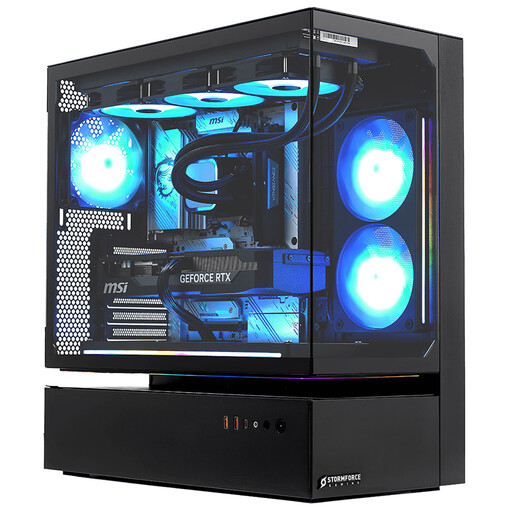 No image available
Stormforce Cyclone AMD Ryzen 7, 32GB RAM, 2TB SSD, RTX5080
This tower is worth assessing if scoring is accompanied by picture editing or rendering and a larger case fits your workspace.
The product name specifies AMD Ryzen 7, 32GB RAM, a 2TB SSD and RTX5080 graphics. Confirm the installed operating system, software and driver compatibility, and any dedicated audio-drive requirement.
View on Joybuy
 No image available
Apple Mac mini (2026) M5 Pro, 15-Core CPU, 16-Core GPU, 24GB RAM, 512GB SSD, Silver
Consider this compact Mac if your essential scoring software and interface support the intended Apple-silicon and macOS setup.
This configuration names an M5 Pro with a 15-Core CPU, 16-Core GPU, 24GB RAM and a 512GB SSD. Check whether that storage suits your sample libraries and projects, whether your DAW requires a dedicated audio drive, and which peripherals are included.
View on Joybuy
No image available
Apple Mac mini (2026) M6, 12-Core CPU, 12-Core GPU, 24GB RAM, 512GB SSD, Silver
This compact Mac is another option for a space-limited scoring desk, provided the intended macOS setup supports your audio tools.
This configuration names an M6 with a 12-Core CPU, 12-Core GPU, 24GB RAM and a 512GB SSD. Check capacity for project media and samples, your DAW’s audio-drive guidance and which peripherals are included.
View on Joybuy
 No image available
Lenovo Legion T7 34IAS10, Core Ultra 7 265K, 32GB RAM, 1TB SSD, RTX 5070 Ti
Consider this tower if the desktop will serve graphics-heavy work as well as scoring, and its larger format fits the room.
The product name specifies an Intel Core Ultra 7 265K, 32GB RAM, a 1TB SSD, RTX 5070 Ti graphics and Windows 11 Home. Confirm DAW and interface-driver support, and plan any separate audio recording storage your software requires.
View on Joybuy
Frequently asked questions
How should I choose between macOS and Windows for animation scoring?
Choose the platform that supports the exact versions of your DAW, essential plug-ins, audio-interface driver and control-surface software. Avid specifies supported systems and audio devices for Pro Tools; although Cockos offers REAPER for both macOS and Windows, DAW availability alone does not establish third-party device or plug-in compatibility.
Do I need a dedicated graphics card to score animation?
Not solely because the project includes animation reference video. If you will also edit or render demanding picture material, compare the video software’s graphics requirements with the exact desktop configuration; Apple lists hardware media engines on Mac mini, while HP positions particular workstation configurations for video work.
Can Pro Tools record audio to the system drive?
Plan for a dedicated audio record and playback drive in a Pro Tools setup: Avid lists one or more such drives in its system requirements, alongside a 16GB RAM requirement. Check your own DAW’s storage guidance if you use different software.
What should I do with an old desktop in the UK?
Check a suitable local collection or recycling route for the old electrical equipment rather than placing it with general household rubbish. UK waste electrical and electronic equipment guidance from the Office for Product Safety and Standards and the Department for Environment, Food & Rural Affairs addresses recovery, reuse and recycling; erase personal data before handing the computer over.


