
24/7 Customer Support

Free returns

Same-day & Next-day Delivery

Quality Guaranteed

Unlock Your Welcome Offers: FREE Delivery | Up to 80% OFF | Free 30-day JoyPlus trial
Download the APP
A pair of desktop Bluetooth speakers can make a laptop, monitor or projector feel far more capable, but product listings often make comparison difficult. Large wattage figures, “Hi-Res” labels and long battery claims do not always tell you how a speaker will suit a UK home office, gaming setup or living room.
The practical approach is to look beyond headline marketing and check the specifications that affect everyday use: sound architecture, connection options, physical size, power supply and battery limitations.
A high RMS figure indicates potential output power, but it does not independently describe clarity, bass control or stereo separation. Driver size, cabinet construction, amplifier design and speaker positioning also matter.
For example, compact computer speakers for PC may use small full-range drivers, while a larger tabletop speaker may separate bass and treble through dedicated drivers. A 2.1-channel design can provide a fuller low-frequency presentation, but it may take up more space on your desk.
Bluetooth is convenient, but its capabilities vary. Bluetooth 5.3 speakers may support newer connection features, while the audio result also depends on the codec supported by both the speaker and your phone or computer. LDAC, for instance, is relevant only when the source device supports it.
Bluetooth range is affected by walls, furniture and wireless congestion. A stated range of up to 10 metres is generally a guide for open conditions, not a guarantee throughout a typical UK home.
A built-in battery makes a speaker easier to move from a desk to a shelf, but it does not automatically provide water or dust resistance. The Xiaomi Desktop Speaker, for example, is specified as not water-resistant and is intended for dry indoor environments.
Also check whether the quoted playtime is an “up to” figure. Volume level, wireless connection, lighting and battery age can all affect actual playback time.
For voice calls, podcasts and general desktop listening, a compact full-range speaker can be sufficient. For music, gaming and films, consider the physical driver layout:
A speaker with more output is not automatically suitable for a small desk. Excessive volume can be uncomfortable in a near-field listening position, so placement and room size remain important.
Bluetooth is useful for phones and tablets, but wired connections can reduce pairing interruptions and make switching between devices simpler. If you are buying wireless speakers for a home office, look for a combination of:
Do not assume that every USB-C port carries digital audio. Check the product specification and included cables before purchase.
Measure the available space, including the depth behind your monitor and room for cables. Some compact desktop speakers are sold as a stereo pair, while a single tabletop wireless speaker may use a wider cabinet.
For battery models, check:
For UK buyers, also review the supplied safety information, warranty terms, responsible seller details and disposal guidance for rechargeable batteries and electrical equipment.
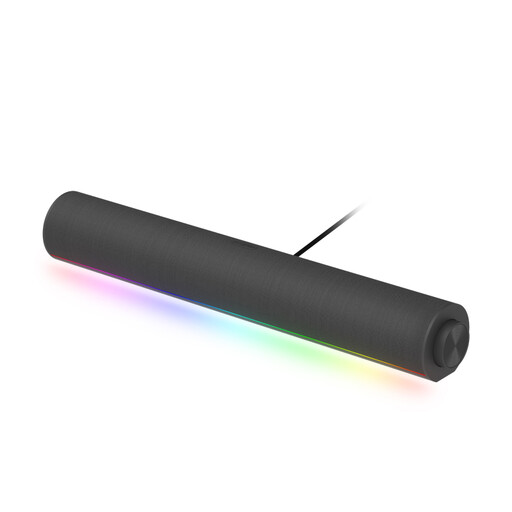
Why This Fits Their Persona: A practical option for laptop, PC, projector and TV listening where simple controls and flexible positioning matter more than advanced networking.
The listing specifies a 2.1-channel layout, Bluetooth range of up to 10 metres and both mains and built-in battery power. It also clearly states that the speaker is not water-resistant.
Compact 32 cm-wide design, touch controls, Bluetooth connectivity and a built-in 2-inch low-frequency driver.
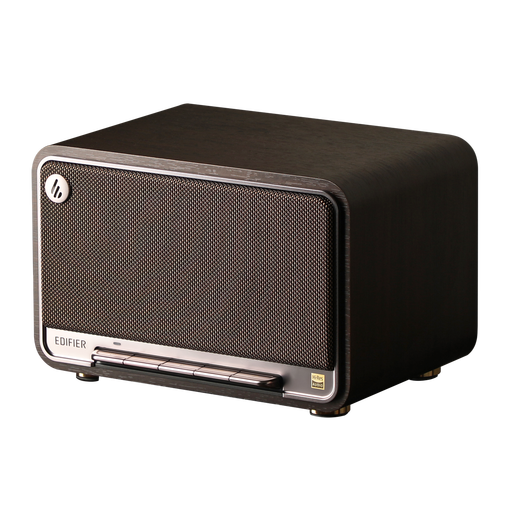
Why This Fits Their Persona: Suitable for listeners wanting a substantial tabletop system for a study, lounge or bookshelf, with wired and wireless sources.
Its stated 2.1 acoustic architecture, MDF cabinet and separate drivers provide more useful information than a wattage figure alone. The 11-hour battery claim is clearly presented as maximum playtime.
60W RMS output, support for 24-bit/96kHz audio, LDAC, AirPlay 2, USB-C and AUX inputs.
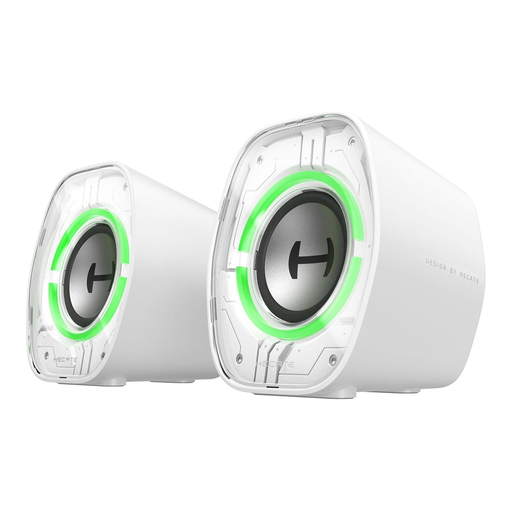
Why This Fits Their Persona: Designed for compact PC setups where gaming, films and music share the same desk.
It lists USB-C/USB-A, AUX and Bluetooth 5.4 rather than relying on a single connection. Its 10-degree tilted baffle is designed for desktop positioning.
Three EQ modes, nine lighting modes, a 2.5-inch full-range driver and a stated Bluetooth latency of up to 40 ms.
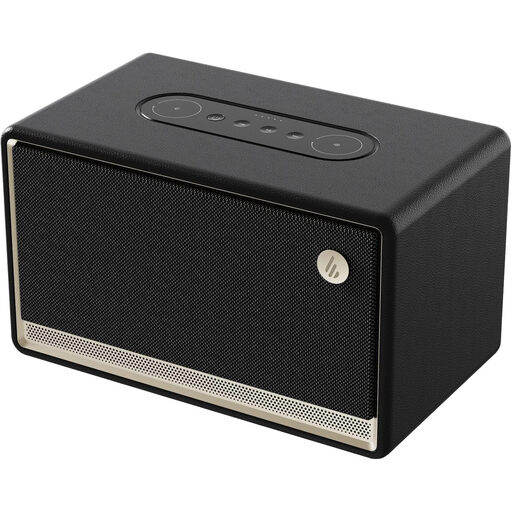
Why This Fits Their Persona: A single larger speaker for a home office, shelf or occasional move between rooms, with battery operation for use away from the mains.
The specification identifies Bluetooth, Wi-Fi, USB and AUX connectivity, plus a built-in battery. It also states an up-to-12-hour playtime rather than presenting battery life as unlimited.
30W + 15W x 2 RMS output, Bluetooth 5.3, multi-point pairing, AirPlay 2 support and 5,200mAh battery capacity.
We have compiled a complete, real-time list of products that fully satisfy these strict selection criteria and UK safety regulations.
Yes, provided your computer supports Bluetooth or the speakers offer a wired input. USB-C, USB-A and AUX connections can be useful alternatives when Bluetooth pairing is unavailable or when you want a more consistent connection for gaming and video calls.
Battery lifespan depends on charging frequency, heat exposure, storage and usage. Mains-powered models avoid battery wear during normal desktop use, while portable models should be charged and stored according to the manufacturer’s instructions. Avoid disassembling or puncturing rechargeable lithium-ion batteries.
Battery speakers use relatively little power while charging, but the exact running cost depends on battery capacity, charging efficiency and electricity tariffs. A mains-powered speaker also consumes power when operating, so switch it off when not required. In practical terms, standby and charging habits matter more than the Bluetooth connection itself.