Card makers with few free sockets
If you mainly design vocabulary cards in a browser, you may want the screen and computer in one unit rather than planning power for a separate monitor.


For vocabulary-card design with few free plug sockets, an all-in-one is the more direct choice if you do not already own a monitor: its screen and computer are integrated. A mini desktop makes more sense if you can reuse a compatible monitor, although that screen still needs power; consider a tower when ports or upgrade potential matter more than a compact setup. Check your design software’s requirements and the electrical load of the complete workstation before deciding.
If you mainly design vocabulary cards in a browser, you may want the screen and computer in one unit rather than planning power for a separate monitor.
If you already have a suitable display, a mini desktop lets you keep it. Check the display connection and allow for the monitor’s own power lead.
If your work may extend beyond simple web-based cards, check each intended application’s current operating-system, processor, memory and storage requirements before choosing a compact computer.
Choose it when: You need a computer and screen but want fewer separately powered core desk components.
Accept that: The display and computer are chosen together, so the screen and internal configuration both need to suit you.
Choose it when: You have a suitable monitor to reuse and want a small computer.
Allow for: A separate powered display and any peripherals or connection accessories your setup requires.
Choose it when: Ports or upgrade potential take priority over a compact workstation; Lenovo describes these as strengths of its tower range.
Allow for: A separate monitor and the space and cabling of a larger computer.
| Concern | What to check | Who this matters to |
|---|---|---|
| Powered components | Whether the screen is integrated; the plugs and combined load of the complete setup. | With few sockets free, I want to avoid adding a separately powered monitor. Around 36% of consumers would put an integrated setup first. |
| Screen clarity | Display size and native resolution, whether built in or on a monitor you own. | When reviewing small words and card layouts, I want a screen I can work on comfortably. Roughly 29% of consumers would make display suitability their primary concern. |
| Monitor reuse | Matching display connections and any cable or adapter needed. | I have a monitor I want to keep, so replacing the computer without replacing the screen matters most. Around 21% of consumers would prioritise reusing their display. |
| Software needs | Each intended app’s current operating-system, processor, memory and storage requirements. | If I move into installed creative software, I need the desktop to suit those applications, not just browser-based cards. About 14% of consumers would put that software fit first. |
A small computer still needs a display. Apple specifies external-display connections for the Mac mini, so its compact size does not remove the monitor’s power lead.
List what you will reuse, then check monitor inputs, cables and which peripherals come with the computer.
A monitor, connection accessory, keyboard or mouse may be needed separately.
Configurations differ: Apple lists a 24-inch 4.5K iMac display, while Dell lists a 23.8-inch Full HD option in its all-in-one range. Neither specification describes every model in that range.
Check the exact listing’s native resolution, memory, storage, ports, operating system and included peripherals.
Electrical Safety First warns that plugging one extension lead into another can overheat the wall-socket plug.
Do not chain leads. If you need an extension lead, check its marked current rating and the combined load of the equipment connected to it.
Canva’s published requirements apply to Canva, not to every installed creative application you might use later.
Identify the software you plan to run and check its publisher’s current system requirements before settling on a processor, memory or storage configuration.
Apple offers an integrated iMac route and a Mac mini route for use with an external display.
Lenovo’s desktop range includes all-in-one, mini and tower formats.
Dell is relevant if you want to compare Windows all-in-one configurations.
These models cover an all-in-one with a built-in screen and mini desktops for use with a separate monitor. Choose the form factor before comparing their individual configurations.
 No image available
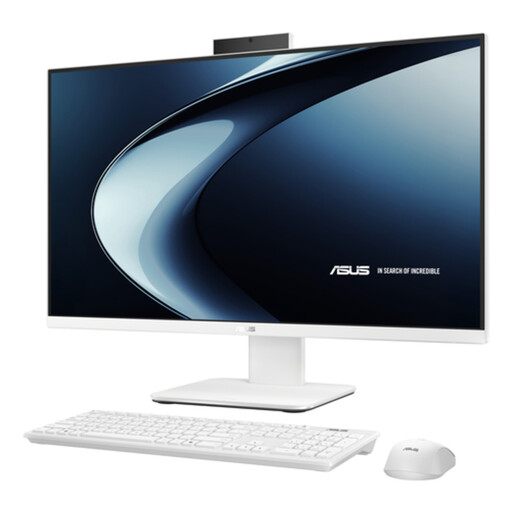
Consider this all-in-one if you need a built-in screen rather than a separately powered monitor.
The listed configuration has a 27-inch Full HD display, Intel Core i7-13620H, 16GB DDR5 RAM, a 512GB SSD and Windows 11 Home.
Check whether Full HD suits the detail you want to see in card layouts, and confirm which keyboard and mouse are included.
 No image available
Consider this mini desktop if you have a compatible monitor and want to keep using it.
This variant lists a 15-core CPU, 16-core GPU, 24GB RAM and a 512GB SSD.
A display, keyboard and mouse are not included. Check your monitor connection, its separate power needs and your design software’s macOS requirements.
No image available
This is another mini-desktop option for someone keeping a separate, compatible monitor.
This variant lists a 12-core CPU, 12-core GPU, 24GB RAM and a 512GB SSD.
A display, keyboard and mouse are not included. Confirm monitor connectivity and power needs, and check your intended software’s macOS requirements.
 No image available
Consider this compact Windows desktop if you have a monitor to connect and do not need a built-in screen.
The listed variant has an Intel Core 5 processor, 16GB RAM and a 512GB SSD.
A separate monitor is required. Check its connection and power needs, and confirm whether a keyboard and mouse are included.
 No image available
This mini PC is an option if you plan to use a separate compatible display.
Its title lists a 6-core/12-thread Ryzen 5 7640HS, 24GB LPDDR5 RAM, a 512GB PCIe 4.0 SSD, USB 4.0 and HDMI 2.1, and states support for 4K triple-screen output.
Confirm how your display will connect, what peripherals are included and which power connections the complete setup needs.
Not necessarily; start with the requirements of the service you will use rather than treating all card design as demanding local creative work. Canva specifies an up-to-date supported browser, JavaScript and a stable internet connection for its browser service; check another app’s own requirements if you use one.
An extension lead can provide outlets, but you still need to check its rating and the combined load of connected equipment. Electrical Safety First advises against plugging one extension lead into another and notes that a single socket is typically limited to 13A, or about 3,000W.
Check local-authority or retailer collection and take-back arrangements rather than putting electrical equipment in ordinary household rubbish. UK guidance on waste electrical and electronic equipment addresses its recovery, reuse and recycling; the available arrangement will depend on where you live and the service you use.