What matters when choosing?
Start with the software and workload you actually run. Move towards a more specialised workstation only when its particular configuration addresses a capacity, expansion or reliability requirement you can identify.
Configurable tower
Consider it when: One local database runs alongside ordinary development or office applications, with room needed for later memory or storage upgrades.
Trade-off: The installed specification and expansion limits depend on the exact configuration, not the tower’s product-family name.
Expansion-focused workstation
Consider it when: Disruptive downtime or expected storage growth makes configuration-dependent options such as ECC memory or RAID-capable storage relevant. Dell describes such options within its Precision range.
Trade-off: Confirm which features the selected system actually includes; none replaces a tested backup.
High-core-count workstation
Consider it when: Your concurrent services, virtual machines or other parallel work demonstrably need substantially more processor and memory headroom.
Trade-off: Extra cores do not resolve a memory shortage or provide a recovery plan; check space and power requirements for the exact machine.
| Concern |
What to check |
Who this matters to |
| Memory and processor headroom |
List the database engine and applications running concurrently; check installed RAM, supported maximum RAM and the exact processor. |
If I run development tools beside the database, I need enough capacity for both as my data grows; around 36% of consumers put workload headroom first. |
| Storage and recovery |
Check drive capacity and the storage configuration, then plan a separate backup destination and a restore test. |
When lost work would be difficult to recreate, I need to know I can recover it after a failure; recovery is the primary concern for around 29% of consumers. |
| Expansion and serviceability |
Check free memory slots, supported capacity, spare drive connections and access arrangements for the exact model. |
If my database may grow, I want a practical way to add capacity without replacing the desktop; around 21% of consumers place expansion first. |
| Personal-data security |
Assess access controls, encryption where appropriate, supported updates and protection of backups. |
If I process personal data at home, I need controls suited to that data and its risks; security is the leading concern for around 14% of consumers. |
Desktop choices on Joybuy
These desktops offer different starting memory, storage and form-factor choices for running a local database at home. Match each configuration to your software and workload, and check its expansion and recovery arrangements separately.
 No image available
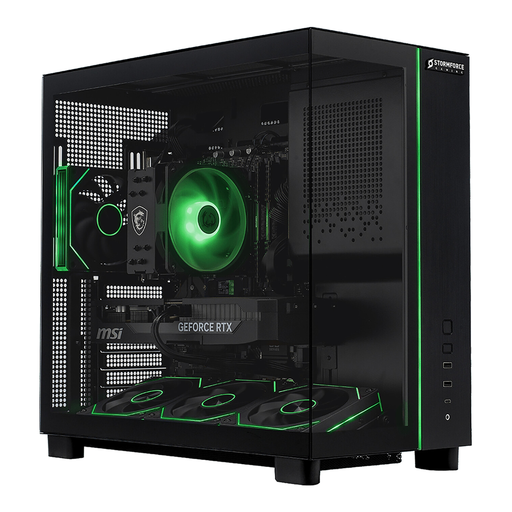
Stormforce Defiance AMD Ryzen 7, 32GB RAM, 2TB SSD
Consider this tower if a local database will share the desktop with development applications. The product name specifies 32GB RAM, a 2TB SSD and Windows 11; confirm memory expansion and database-software compatibility for your intended setup.
The product title and description disagree on the graphics model, so confirm the exact graphics configuration if it matters to other work you do.
View on Joybuy
 No image available
Stormforce Cyclone Intel Core i7, 32GB RAM, 2TB SSD, RTX5080
This tower is a choice to assess if you run a database beside other desktop applications. Its product name specifies 32GB RAM, a 2TB SSD and Windows 11; check supported memory and storage upgrades against expected growth.
View on Joybuy
 No image available
CyberPowerPC JOYB1013 Ryzen 7 9800X3D, RTX 5080, 32GB DDR5, 2TB SSD
Assess this desktop if you need to run a local database alongside other applications. The product name specifies 32GB DDR5 RAM, a 2TB NVMe SSD and Windows 11 Home; check the available upgrade options and software compatibility before choosing it.
View on Joybuy
 No image available
CyberPowerPC JOYB1010 Core Ultra 7 265KF, RTX 5070, 32GB DDR5, 1TB SSD
Consider this desktop for a local database and other applications if its storage capacity fits your data and growth plans. The product name specifies 32GB DDR5 RAM, a 1TB NVMe SSD and Windows 11 Home; check available storage expansion and database-software compatibility.
The listed Core Ultra 7 265KF has no integrated graphics, so display output relies on the installed graphics card.
View on Joybuy
 No image available
FIREBAT R3 Mini PC, Ryzen 5 7430U, 16GB LPDDR4, 512GB SSD
This compact desktop is worth assessing if your local database and other files fit its stated 512GB SSD and your applications fit within 16GB RAM. Check memory and storage upgrade options, warranty and database-software compatibility before choosing it.
View on Joybuy
Common questions
How much RAM and storage should a local database desktop have?
Size both for your database and the applications running alongside it, then allow for growth. Microsoft Learn recommends at least 4 GB of memory for non-Express editions of SQL Server 2025 and says memory should increase as database size grows; that software recommendation is not a complete desktop specification. Check your current data size, concurrent tools and the chosen desktop’s expansion limits.
Do I need a separate backup if my desktop has multiple drives?
Yes: internal storage arrangements do not replace a separate, tested backup. The PostgreSQL Global Development Group documents recovery using a base backup and archived write-ahead log files, and warns that some volatile write-back caches present a power-loss risk. Choose a backup destination and test how you would restore your own database.
Can I run a local database on a Linux workstation?
You can consider Linux when your database engine, administration tools and the exact desktop configuration support it. Dell lists Ubuntu Linux 24.04 as an option for its UK Precision 7875 Tower, but an operating-system option on that model does not establish compatibility for every database or desktop listed here.
Does keeping personal data in a database at home change my security responsibilities?
Keeping personal data at home does not remove the need to assess appropriate security measures. The Information Commissioner’s Office explains that the UK GDPR security principle calls for appropriate technical and organisational measures; consider access controls, encryption where appropriate, protected backups and the ability to restore data in light of your circumstances and risks. No particular desktop model establishes compliance on its own.


