Everyday fixed-home users
If the computer will mainly handle browsing, email, banking, documents, video calls and streaming, start with the software and storage you need rather than a graphics-heavy configuration.


Choose a tower if demanding software, ports or later component changes are central to your decision, but check what the exact configuration allows you to upgrade. An all-in-one puts the computer and screen together for a simpler fixed-desk setup, making its display and connections especially important to check. A mini PC lets you choose or reuse a screen and input devices separately; confirm that your peripherals and required software will work with it.
If the computer will mainly handle browsing, email, banking, documents, video calls and streaming, start with the software and storage you need rather than a graphics-heavy configuration.
An integrated computer and display can suit a fixed workspace where fewer separate components matter more than the ability to choose or replace the screen independently.
If creative, technical or graphics-heavy applications are important, compare exact components and connections. Check documented memory and storage options if you expect your requirements to change.
Choose the form of computer around your desk and peripherals, then compare configurations against the applications you actually use.
Consider it when: Later memory or storage changes, dedicated graphics options or a wider choice of connections matter to you.
Allow for: A separate display and input setup; upgrade options vary by model and configuration.
Consider it when: You want the computer and screen together on a fixed desk.
Allow for: Choosing the screen and computer as one unit rather than replacing the display independently.
Consider it when: You have a suitable monitor and input devices, or want to select them yourself.
Allow for: Checking display connections and software compatibility before assembling the setup.
| Concern | What to check | Who this matters to |
|---|---|---|
| Everyday performance | For a new Windows desktop, compare installed RAM, SSD capacity and the requirements of your usual applications. Which? suggests at least 8GB RAM, preferably 16GB, and a 512GB SSD for everyday buying; Microsoft's Windows 11 installation minimums are not the same as buying guidance. | If I mainly browse, manage documents and make calls, I want enough capacity for those tasks without choosing components I am unlikely to use. Around 31% of consumers put this routine-use need first. |
| Integrated setup | For an all-in-one, check the exact screen, stand, ports and webcam, plus whether its keyboard and mouse are included. | At a shared home desk, I would rather have the computer and screen together, provided the display suits the space. Roughly 25% of consumers make a simpler integrated setup their main concern. |
| Demanding or changing workloads | Match the processor and graphics configuration to your software; check the selected model's documented memory, storage and port options. | If my creative or technical applications may become more demanding, I want to understand the available component choices before committing. About 25% of consumers prioritise that flexibility and workload fit. |
| Existing peripherals and software | Check monitor connections, input-device compatibility and whether required applications run on the operating system you choose. | I may already have a screen I want to keep, or an application that determines my operating-system choice. For around 19% of consumers, that fit is the primary concern. |
Microsoft lists 4GB RAM and 64GB storage as Windows 11 installation minimums. For an everyday new desktop, Which? instead suggests at least 8GB RAM, preferably 16GB, and a 512GB SSD.
Compare the computer with the applications, files and browser use it needs to handle; use operating-system minimums as an eligibility check.
The screen is part of the purchase, while display features and supplied input devices differ between configurations.
Check the chosen model's screen, stand, ports, webcam, keyboard and mouse before ordering.
If the supplied setup does not meet your needs, you may need a separate accessory or adapter.
Dell's desktop configurations illustrate model-dependent graphics, memory and storage choices; Lenovo's description of towers is category guidance, not a specification for every tower.
Read the exact configuration and support documentation for graphics, memory slots, storage expansion and ports before relying on a future upgrade.
Dell's UK desktop range includes tower and slimmer desktop designs for buyers comparing conventional Windows setups.
The IdeaCentre range covers towers, mini desktops and all-in-ones, so it offers several ways to configure a fixed desk.
HP's UK desktop and all-in-one lines cover everyday computing and configurations intended for more demanding applications.
Mac mini is a compact macOS desktop used with a separately chosen display and input devices; iMac is Apple's all-in-one route.
These choices cover separate desktop towers, a tower-and-peripherals bundle and a mini PC. Compare what each setup includes before deciding which fits your desk; an all-in-one remains a separate route to consider.
 Image unavailable
Consider this Windows 11 Home tower if your software calls for dedicated graphics and you are arranging a separate fixed-desk setup.
 Image unavailable
This Windows 11 tower is a separate-computer option to assess for graphics-intensive applications, subject to their specific requirements.
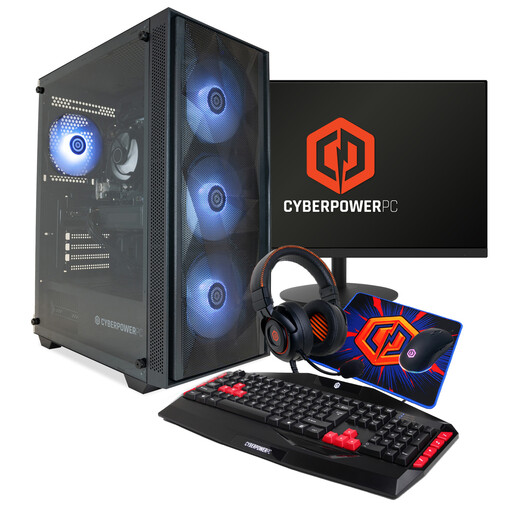 Image unavailable
Consider this bundle if you need a separate desktop and the main desk peripherals together, rather than a computer with an integrated screen.
 Image unavailable
This Windows 11 desktop is another tower configuration to compare against the needs of demanding software at a fixed desk.
 Image unavailable
Consider this separate mini PC for routine home computing if a compact computer suits your desk and you can connect the peripherals you need.
For a new Windows desktop used for routine tasks, Which? suggests at least 8GB RAM, preferably 16GB, and a 512GB SSD. Check the requirements of your own applications before settling on a configuration; Microsoft's Windows 11 installation minimums are a different threshold.
Check its operating system before buying: Microsoft states that Windows 10 support ended on 14 October 2025. If you need Windows for a long-term replacement, confirm the exact computer's Windows 11 configuration and compatibility with your essential software and peripherals.
Ask the retailer about its electrical take-back route before arranging disposal. GOV.UK describes same-type electrical waste take-back for relevant retailers; check whether you can use a drop-off route and whether home collection would involve a transport charge.