Choose a desktop around the demands of your largest expected music project: processor and audio-interface compatibility for real-time work, then enough RAM and fast SSD space for your libraries. Before ordering, confirm that the exact configuration can run both monitors at their intended resolution and refresh rate. A DAW-focused tower, a configurable Windows workstation and a Mac Studio each offer a different route, but software compatibility and the specification of the particular build matter more than the category name.
Who is this for?
Sample-library builders
If your orchestral, cinematic or multi-instrument collection is growing, consider installed RAM, SSD space and how you could expand them. Native Instruments notes that heavier use of its products can call for more processor resources and RAM.
Low-latency producers and recordists
If you record through an audio interface or run many instruments and plug-ins together, check the complete audio setup rather than the processor alone. Ableton identifies CPU, RAM, fast storage and a suitable low-latency interface as relevant to demanding projects.
Two-screen studio organisers
If you want a DAW view on one display and a mixer, plug-in or sample browser on the other, check the ordered desktop’s outputs against both monitors and their cables. Microsoft explains how Windows arranges detected displays, but the physical connections depend on the computer configuration.
What matters when choosing?
DAW-focused tower
Consider it when: You want a supplier to configure a tower around music-production software, audio connections and room for a growing library.
Keep in mind: Studio-oriented positioning is a supplier claim, not proof of quieter operation or lower latency; check the ordered build’s ports, expansion and cooling.
Windows workstation tower
Consider it when: Your essential software or hardware calls for Windows and you want to assess internal storage or PCIe expansion.
Keep in mind: A workstation name does not establish how much RAM or SSD space the ordered configuration includes.
Mac Studio
Consider it when: Your DAW, libraries, licence tools and audio interface work with the chosen macOS and Apple Silicon configuration, and you want a compact desktop.
Keep in mind: Decide on memory and internal storage when ordering; display support alone does not establish audio-software compatibility.
| Concern |
What to check |
Who this matters to |
| Real-time audio work |
Check the exact processor and whether your audio interface has a suitable connection and driver for the chosen operating system. |
If I record or play software instruments together, I need the interface and computer to suit that workload; around 42% of consumers put real-time audio work first. |
| RAM and library storage |
Compare installed RAM and fast SSD capacity with your named libraries, projects and plans for expansion. |
As my library grows, I want space for its files and memory for the instruments I use together. For around 33% of consumers, library capacity is the primary concern. |
| Two-monitor connections |
Confirm simultaneous display support, outputs and cables for both monitors at the resolution and refresh rate you intend to use. |
When I spread the DAW and sample browser across two screens, both displays need to work in the intended layout; around 25% of consumers prioritise that workspace need. |
Buying pitfalls
-
Choosing by processor name alone
Processor capacity matters, but RAM, storage, cooling and the audio-interface connection can also affect a demanding session. A processor label cannot establish how the complete setup will behave.
Compare the configured computer and interface requirements with your largest expected project, including the operating system and driver support.
-
Assuming the base SSD will hold a growing library
Workstation configurations vary in SSD capacity. A drive that accommodates applications may leave too little room for the libraries and projects you intend to install.
Add up the installed sizes of your planned libraries and allow for projects and updates. Check the selected tower’s storage connections if later expansion matters.
Adding a drive later may also mean arranging an enclosure, cables or time to move library files.
-
Relying on a two-monitor label
Two-screen use depends on compatible graphics outputs, monitor inputs and support for both displays at the intended settings.
Write down both monitor models and their required resolution and refresh rate, then check them against the exact desktop configuration before choosing cables or adapters.
Your connection plan may require different cables or adapters.
-
Changing platform without checking studio software
A DAW may run while a required plug-in, sample engine, licence manager or interface driver does not support the chosen operating system or processor architecture. Native Instruments says its products do not currently support Windows ARM systems.
List the tools you rely on and check each developer’s current compatibility requirements for the exact operating-system version and architecture before ordering.
Brands to consider for this setup
3XS / Scan
A configurable tower route for music-production work.
- Scan says its pro-audio systems are configured and tested with music software and hardware. Its listed 3XS Pro DAW build pairs 32GB RAM with separate 1TB and 2TB M.2 SSDs.
- Those drive and memory figures apply to that build. Check the selected system’s display outputs, cooling, expansion and warranty; the supplier’s positioning does not establish a noise or latency advantage over other desktops.
Apple
A compact macOS route for a studio whose essential tools support the selected Mac Studio configuration.
- Apple’s UK specification for the 2025 Mac Studio lists 36GB unified memory on the M4 Max configuration and support for up to five displays.
- Choose memory and internal storage with future libraries in mind, and confirm each DAW, plug-in and interface driver separately; display capability does not establish their compatibility.
Lenovo
A configurable Windows workstation-tower route, represented here by the ThinkStation P3 Tower Gen 2.
- Lenovo lists a UK configuration with an Intel Core Ultra 7 265K processor and 32GB DDR5 RAM.
- That listed configuration has a 256GB SSD. Check the ordered storage, expansion, graphics outputs and audio-interface connections against your library and monitors.
HP
A Windows workstation-tower route represented by the Z2 Tower G9.
- HP Store UK lists a Z2 Tower G9 configuration with an Intel Core i9, 32GB RAM and 1TB storage.
- HP says components vary by custom configuration. Confirm memory, storage and display connections on the particular desktop you order.
Dell
A configurable Precision workstation-tower route for assessing processor, graphics and storage options.
- Dell’s UK Precision 5860 listing includes a configuration with an AMD Radeon Pro W6400 graphics card specified with two DisplayPort outputs.
- The cited configuration also lists 16GB RAM and a 512GB SSD. Assess the ordered specification against your libraries and confirm that its display connections suit both monitors.
Joybuy desktop options
These Windows desktop options offer different stated processor, memory and SSD configurations for building a sample library. For any one of them, check your DAW and audio-interface compatibility and confirm two-monitor support for your particular screens before buying.
 No image available
CyberPowerPC JOYB1013, Ryzen 7 9800X3D, RTX 5080, 32GB, 2TB, white
Consider this Windows desktop if its stated memory and SSD capacity suit the libraries you plan to install.
AMD Ryzen 7 9800X3D; NVIDIA GeForce RTX 5080 16GB; 32GB DDR5; 2TB NVMe SSD; Windows 11 Home.
Check that its graphics configuration can drive both intended monitors at their chosen settings, and confirm support for your DAW, plug-ins and audio interface.
View on Joybuy
 No image available
CyberPowerPC JOYB1010, Core Ultra 7 265KF, RTX 5070, 32GB, 1TB, black
This Windows desktop is an option if its stated SSD capacity accommodates your planned libraries, projects and updates.
Intel Core Ultra 7 265KF; NVIDIA GeForce RTX 5070 12GB; 32GB DDR5; 1TB NVMe SSD; Windows 11 Home.
Check two-monitor operation at your required settings, along with DAW, plug-in and audio-interface support.
View on Joybuy
 No image available
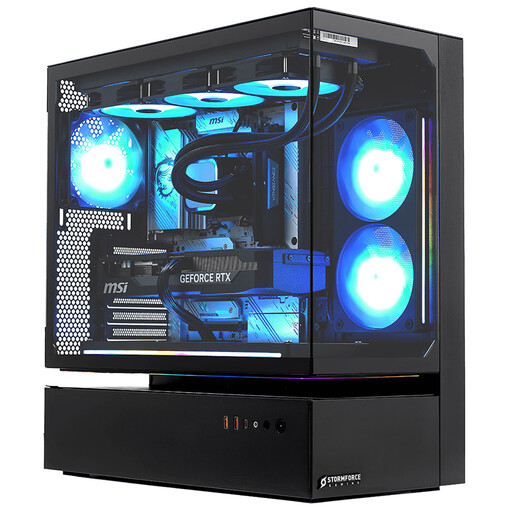
Stormforce Cyclone, Intel Core i7, RTX 5080, 32GB RAM, 2TB SSD
Consider its stated RAM and storage against the size of the sample collection you expect to use.
Intel Core i7; RTX 5080; 32GB RAM; 2TB SSD; Windows 11.
Confirm the exact graphics outputs and simultaneous monitor modes, as well as compatibility with your studio software and audio interface.
View on Joybuy
 No image available
Stormforce Cyclone, AMD Ryzen 7, RTX 5080, 32GB RAM, 2TB SSD
Its stated RAM and SSD capacity may fit a growing collection if you check the installed sizes of your own libraries first.
AMD Ryzen 7; RTX 5080; 32GB RAM; 2TB SSD.
Confirm all graphics outputs and support for both monitors at your intended settings before relying on it for a two-screen layout. Check your DAW and audio-interface requirements too.
View on Joybuy
 No image available
Stormforce Defiance, Ryzen 7 5700X, RTX 5070, 32GB RAM, 2TB SSD
Assess its stated RAM and SSD capacity against your planned libraries and projects.
AMD Ryzen 7 5700X; RTX 5070; 32GB RAM; 2TB SSD; Windows 11.
Check the graphics outputs and simultaneous display modes for your monitors, plus the connections and driver support required by your audio interface.
View on Joybuy
Frequently asked questions
How much RAM should a sample-library desktop have?
Start with the requirements of the libraries and projects you actually use: Ableton recommends at least 16GB RAM for Live, while Native Instruments says heavier use can require more. Check how many instruments and plug-ins you expect to run together before deciding whether a configuration with more memory is warranted.
Does the sample library need its own SSD?
A separate SSD is not a universal requirement; prioritise fast storage with enough capacity for your operating system, applications, projects and libraries. A separate drive can make that capacity easier to plan, but check each library’s installation instructions and total installed size before ordering.
How do I set up two screens in Windows?
First confirm that the exact desktop, cables and monitors support both displays simultaneously. Once connected, Microsoft’s Windows guidance explains how to identify and arrange them in Settings > System > Display; choose Extend if you want different windows on each screen.
Do two video ports guarantee support for my monitors?
No: port count alone does not establish simultaneous operation at both monitors’ intended resolution and refresh rate. Check the exact graphics specification, each monitor’s inputs and any adapter or dock in the connection path.


