What matters when choosing?
For sound-effect cue writing, establish your busiest likely session and essential software first, then decide how much recording connectivity and future expansion your setup needs.
| Concern | What to check | Who this matters to |
|---|
| Plug-ins and sample libraries |
Compare the DAW’s guidance for demanding sessions with the chosen CPU and memory; allow SSD space for locally stored libraries and projects. |
If my cues use many plug-ins or large libraries, I need room for those sessions to grow beyond an installation minimum. Around 36% of consumers put library and plug-in capacity first. |
| Recording and monitoring |
Confirm the interface connection, supported driver and DAW requirements on the selected operating system. |
When I record or monitor effects, I need my interface and desktop to work together without disrupting the session. Roughly 29% of consumers prioritise recording and low-latency operation. |
| Software compatibility |
Check the exact DAW release, essential plug-ins and interface drivers against the intended operating-system and processor combination. |
If I have active projects, I cannot choose a new platform on hardware specifications alone. About 21% of consumers place continuity of their existing software workflow first. |
| Expansion and desk space |
Check free M.2, SATA and PCIe capacity on a tower, or the chosen memory, storage and external connections on a compact desktop. |
I may need another drive or hardware connection later, but I also have to fit the computer into my workspace. Approximately 14% of consumers make expansion or footprint their primary concern. |
Desktop choices on Joybuy
These compact Mac desktops and Windows towers offer different starting points for a cue-writing setup. Match any configuration to your DAW, interface and library needs; the listed graphics hardware does not establish an advantage for audio-only work.
 No image available
Apple Mac mini (2026) M5 Pro, 24GB RAM, 512GB SSD
Consider this compact Mac if your cue-writing software and interface support the intended macOS setup. The listed configuration has a 15-core CPU, 16-core GPU, 24GB RAM and 512GB SSD. Check compatibility before moving active projects, and plan for a separate display, keyboard and mouse.
View on Joybuy
No image available
Apple Mac mini (2026) M6, 24GB RAM, 512GB SSD
This is another compact Mac option for a compatible macOS cue-writing workflow. Its listed configuration has a 12-core CPU, 12-core GPU, 24GB RAM and 512GB SSD. Check your DAW, plug-ins and interface drivers, and plan for a separate display, keyboard and mouse.
View on Joybuy
 No image available
Stormforce Cyclone Intel Core i7, 32GB RAM, 2TB SSD, RTX5080
Consider this tower if a Windows setup with substantial listed memory and local storage fits your cue-writing plan. The product name specifies 32GB RAM, a 2TB SSD, RTX5080 graphics and Windows 11. Check your audio-interface driver and the space needed for the tower; its listed dimensions are 31.7 × 54.2 × 57.9 cm.
View on Joybuy
 No image available
Stormforce Defiance Ryzen 7 5700X, 32GB RAM, 2TB SSD, RTX5070
This tower is worth considering if your planned projects call for the listed 32GB RAM and 2TB SSD capacity. Its product name also identifies an AMD Ryzen 7 5700X and RTX5070. Confirm the ports and free internal slots you need, as well as DAW and interface-driver compatibility.
View on Joybuy
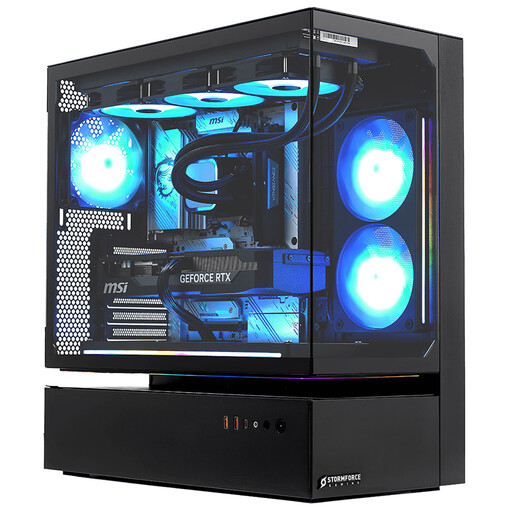 No image available
Stormforce Cyclone AMD Ryzen 7, 32GB RAM, 2TB SSD, RTX5080
Consider this tower if 32GB RAM and a 2TB SSD suit your local projects and libraries. The product name also specifies an AMD Ryzen 7 and RTX5080. Confirm software and interface compatibility, and allow for the listed 31.7 × 54.2 × 57.9 cm chassis when planning its position.
View on Joybuy
Common questions
How much RAM and storage do I need for sound-effect cues?
Choose capacity for your expected projects and locally stored libraries, not just the space needed to install a DAW. Ableton lists 8GB RAM as a Live 12 minimum, while Avid specifies 16GB for Pro Tools; check the requirements of your own software and total the files you intend to keep on the desktop.
Do I need a dedicated graphics card for audio cue writing?
Not for audio work solely because it is a cue-writing desktop. Ableton describes a dedicated GPU as optional for video work; assess graphics requirements separately if your workflow includes video or graphics-heavy applications.
Should I choose a Mac desktop or a Windows tower?
Choose a Mac when your essential DAW, plug-ins and interface drivers support the selected Mac and macOS version; choose a Windows tower when your tools require Windows or internal expansion drives the decision. Logic Pro is available on Mac, while Lenovo’s ThinkStation P3 Tower illustrates a PCIe expansion route. Check the exact configuration rather than relying on the platform name alone.
What should I check before connecting an audio interface?
Check the interface’s connection, supported operating system, driver version and your DAW’s audio-device requirements together. A matching USB or other physical port does not, by itself, establish that the complete recording setup will work as intended.
Can I update the operating system as soon as the desktop is set up?
Check your production software and hardware before a major operating-system update. Ableton advises confirming DAW, plug-in, hardware and driver compatibility before updating macOS; back up active projects and finish critical work before changing a working setup.


