Home-desk multitaskers
If you regularly keep documents, meetings and other applications visible at a settled desk, compare usable screen area and positioning for your work surface.


A desktop monitor suits work done mainly at one desk, while a portable display is more practical when you need a second screen at different work locations. Before choosing either, check your laptop’s supported video outputs and external-display limit, then confirm the monitor or dock connections, any charging requirement and the space available for comfortable positioning.
If you regularly keep documents, meetings and other applications visible at a settled desk, compare usable screen area and positioning for your work surface.
If you need an extra display away from a permanent desk, consider carrying weight, available surfaces and whether the video and power connections will work at each location.
If you repeatedly connect a laptop, check whether the monitor, cable or dock supports the video, charging and peripheral connections you need.
| Concern | What to check when buying | Who this matters to |
|---|---|---|
| Usable screen space | Compare screen size, native resolution, scaling and desk depth for your intended viewing distance. | I want documents and calls visible together without assuming that a higher pixel count automatically gives me more readable space. Around 31% of consumers put usable document and application space first. |
| Laptop video and charging | Check the laptop’s video-capable ports and display limit, the monitor input and cable; compare USB-C power delivery with the laptop’s charging requirement. | I need to know that my own laptop can send video through the connection, and that any expected charging or peripheral functions are supported. Around 31% of consumers prioritise laptop connection compatibility. |
| Moving between locations | Check the display’s packed size and weight, plus the stand, cable and power arrangement needed at each work surface. | I need a second screen in more than one place and can accept less physical viewing area than a larger fixed display. Around 23% of consumers make carrying and setup their main priority. |
| Fit at the desk | Measure the available surface and consider the stand, viewing distance and room for separate input devices. | I want the display to fit my work surface and be positionable for my setup, rather than choosing a size that leaves too little room. Around 15% of consumers prioritise a comfortable fit at the work surface. |
A USB-C socket may provide data or charging without the video function needed by a USB-C monitor. Power delivery is a separate specification, too.
Check the exact laptop port’s video capability, the monitor input and power output, and the cable before choosing a one-cable setup.
Depending on the equipment, you may need a different cable, adapter or separate charger.
A portable display gives you a second screen in more locations, but its smaller physical size offers less viewing area than a larger fixed display.
Choose a portable model if you will use it at different suitable work surfaces; otherwise compare a desk monitor’s footprint and stand.
Moving it between locations can also mean arranging a sleeve, stand and suitable power connection.
A dock does not by itself increase the number of external displays a particular laptop supports. Apple advises checking the display support for the specific Mac.
Confirm the laptop’s supported external-display count and the proposed dock and monitor connections before buying additional equipment.
These model examples illustrate different screen and connection arrangements; features described for one product should not be assumed across a brand’s entire range.
The 27E1N1600AE/00 is a 27-inch QHD desktop example with USB-C power delivery; a separate professional model illustrates a Thunderbolt route.
The GW2490 is a 23.8-inch Full HD desktop example to compare when a compact second screen fits the workspace.
The ProLite XUB3293UHSN-B5 illustrates a larger fixed-desk display with a USB-C dock, network connection and KVM for managing desk peripherals or two computers.
The ThinkVision M14d illustrates a portable route with a 14-inch, 2240 × 1400 display listed at 600 g.
The P2725QE illustrates a fixed-desk 27-inch 4K USB-C hub monitor for comparing screen detail and integrated connections.
These Joybuy options cover fixed-desk monitors and a portable display for adding screen space to a laptop setup.
 No image available
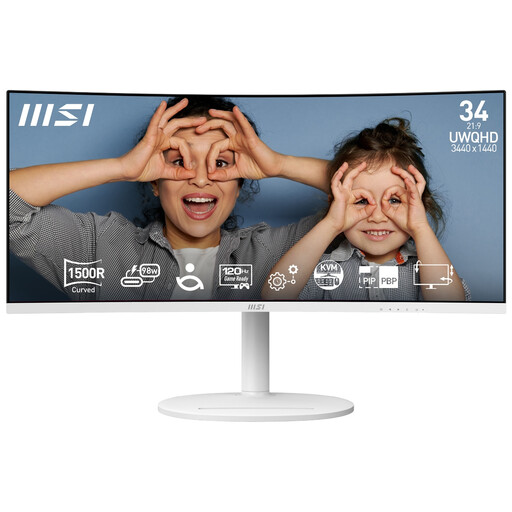
For a fixed desk where keeping multiple applications visible side by side is a priority.
34-inch, 3440 × 1440, 21:9 display; 120Hz; 1500R curvature.
USB-C power delivery up to 98W and built-in KVM are listed; check laptop video support and charging requirements.
Height, swivel and tilt adjustment are listed.
 No image available
For a fixed desk where a 27-inch 4K display and a USB-C laptop connection suit the setup.
IPS 4K UHD display with USB-C power delivery up to 65W.
Tilt, height, swivel and pivot adjustment are listed; check whether 65W meets your laptop’s charging requirement.
 No image available
For carrying an additional screen between work locations when a compatible USB-C video connection is available.
15.6-inch Full HD display, 1920 × 1080 resolution and listed weight of 780 g.
USB-C DisplayPort Alternate Mode is specified; check that the laptop supports it.
 No image available
For a fixed desk where a 27-inch WQHD screen and adjustable positioning suit the workspace.
2560 × 1440 display with HDMI, DisplayPort and USB-C connectivity.
USB-C power delivery and height, tilt, swivel and pivot adjustments are listed; confirm the laptop’s video and charging requirements.
 No image available
For a fixed desk where a 27-inch 4K display and adjustable positioning suit work across documents and applications.
3840 × 2160 resolution with USB-C, HDMI and DisplayPort inputs.
A USB hub and height, pivot, swivel and tilt adjustments are listed; check the laptop’s USB-C video support before relying on that connection.
No. For USB-C video, check that the laptop port supports DisplayPort Alt Mode or an appropriate Thunderbolt video connection, and confirm the cable and monitor input. A data-only or charging-only USB-C port is not sufficient for that setup, according to Dell Support.
No. Apple Support says the number of supported external displays depends on the particular Mac. Check its display-support specifications, ports, and the proposed dock and monitor connections before buying.
The Health and Safety Executive describes a standard setup with the top of the screen approximately at eye level and about an arm’s length away. For prolonged laptop use, its guidance also suggests a separate keyboard and mouse so the screen can be raised, or a separate display; adapt the arrangement to your workstation.