QLab-dependent cue operators
If you use QLab 5 to operate cues, its macOS requirement determines your platform choice before processor specifications do. Figure 53 specifies macOS 11 or later.


Choose a compatible Mac if your cueing workflow requires QLab 5: Figure 53 says the application is Mac-only and needs macOS 11 or later. If you write cues in REAPER without needing QLab, Cockos supports Windows, macOS and Linux, so existing software and peripherals can guide the platform choice. Choose a tower for a specific expansion need, and plan the adjustable screen and input-device arrangement separately from the computer.
If you use QLab 5 to operate cues, its macOS requirement determines your platform choice before processor specifications do. Figure 53 specifies macOS 11 or later.
If you edit and organise sound effects in REAPER, you can consider Windows, macOS or Linux, according to Cockos. Check your plugins, audio interface and controllers before settling on a system.
If you alternate desk heights, the screen, keyboard, mouse and cables need as much attention as the computer’s location. The Health and Safety Executive advises a screen top at eye level, a screen about an arm’s length away and a keyboard just below elbow height.
Start with the cueing application: a QLab 5 requirement narrows the choice to a compatible Mac, while REAPER leaves several operating systems open. Then check the complete workstation and whether your work calls for internal expansion.
| Concern | What to check | Who this matters to |
|---|---|---|
| Cueing-software platform | Identify the required application and version. Figure 53 specifies a Mac running macOS 11 or later for QLab 5. | If I must operate cues in QLab 5, another operating system will not meet that requirement; around 40% of consumers put cueing-software compatibility first. |
| Editing workflow and peripherals | Confirm the DAW’s operating-system support and compatibility with your plugins, audio interface and controllers. | When I edit cues in a cross-platform DAW, I want to keep using the tools my workflow depends on. Around 30% of consumers make that continuity their primary concern. |
| Standing-desk setup and expansion | Measure the space and cable travel, and check screen and keyboard adjustment. If you need internal upgrades, check the exact tower configuration. | I need the display and controls to remain workable as the desk moves, with room for expansion if my setup calls for it; around 30% of consumers prioritise that physical setup. |
Figure 53 says QLab 5 is Mac-only. A faster processor or larger drive will not resolve that operating-system mismatch.
List the cueing application and version alongside required plugins, licences, audio interfaces and controllers before choosing a desktop. Make macOS a requirement if your workflow needs QLab 5.
Discovering that requirement after purchase could mean changing computers or migrating the workflow.
Apple’s Mac mini display support depends on the selected chip and connections; tower display outputs can likewise vary by graphics configuration.
Match the exact computer configuration to your display count, resolution, refresh requirements, ports and cable arrangement before ordering.
The arrangement may call for additional cables or adaptors, or a different computer configuration.
A height-adjustable desk does not itself position the screen or keyboard. The Health and Safety Executive’s guidance addresses the arrangement of the whole workstation.
Check screen, keyboard and mouse positions at the intended standing height, then make sure cables have enough slack throughout the desk’s movement.
A monitor arm, keyboard support or cable-management adjustment may be needed.
HP positions its Z2 Tower for demanding work and expansion, but those capabilities do not establish a benefit for straightforward sound-cue writing.
Identify a specific need—such as intensive audio post-production, video work, internal drives or a required PCIe card—before choosing a workstation-class configuration.
Mac mini is a compact desktop route when cue operation requires QLab 5 on macOS.
OptiPlex Tower is a conventional desktop route for a workflow that needs internal expansion.
ThinkCentre M-series towers offer another conventional form factor to consider for expansion alongside a Windows-based workflow.
Z2 Tower is a workstation-class route to assess when cue writing is part of a more demanding workload.
These Mac mini configurations are relevant if your cueing workflow requires macOS; the Windows desktop is a separate option for a Windows-compatible DAW workflow such as REAPER. Check the exact software, peripherals and standing-desk arrangement before choosing between them.
 Image unavailable
Consider this macOS desktop if your cue workflow needs QLab 5; confirm its macOS version meets Figure 53’s macOS 11-or-later requirement.
The listed variant has an M6 chip with a 12-core CPU and 12-core GPU, 16GB memory and a 256GB SSD.
Check compatibility with your audio equipment and whether the display, keyboard and mouse you need are included.
 Image unavailable
This macOS configuration is worth considering for a QLab 5 workflow if its connections and memory suit your wider setup; confirm the installed macOS version and peripheral compatibility.
The listed M5 Pro variant has a 15-core CPU, 16-core GPU, 24GB memory and a 512GB SSD.
The display, keyboard and mouse are not included, so plan their positioning at the standing desk separately.
Image unavailable
Consider this macOS variant if you need its listed memory and storage for your cue-writing setup; check the macOS version against QLab 5’s requirement and confirm your peripheral connections.
Its product title specifies a 12-core CPU, 12-core GPU, 24GB memory and a 512GB SSD.
The display, keyboard and mouse are not included. Confirm the exact display configuration before planning a multi-monitor desk.
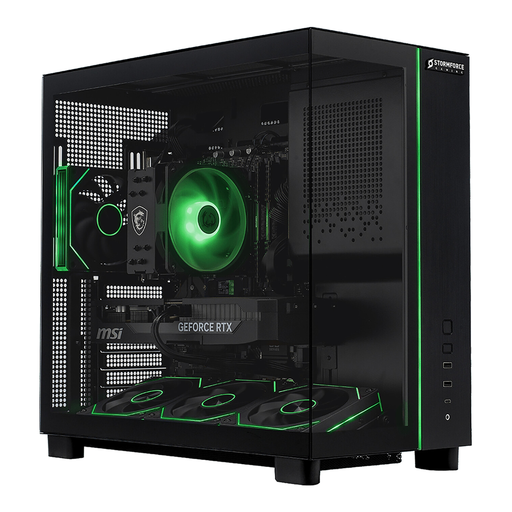 Image unavailable
Consider this Windows 11 desktop for a Windows-compatible DAW workflow that does not require QLab 5; check your plugins, audio interface and controllers.
The product title specifies 32GB memory and a 2TB SSD. Its title names RTX 5070Ti graphics, while its descriptions name RTX 5070, so confirm the graphics configuration before buying.
Plan where the tower will sit and check whether your display, keyboard and mouse are included.
You need a compatible Mac if your workflow requires QLab 5: Figure 53 says it is Mac-only and requires macOS 11 or later. For a REAPER-based workflow without QLab, Cockos supports Windows, macOS and Linux; check your other software and hardware before choosing.
Check the whole workstation, not just the computer: display adjustment, desk height, keyboard and mouse positions, cable travel and computer placement. The Health and Safety Executive advises a screen top at eye level, a screen about an arm’s length away and a keyboard just below elbow height.
For employees in the UK, the Health and Safety Executive says display-screen-equipment rules can apply at fixed, home and hot-desk workstations. Employers must assess a workstation when a worker uses display-screen equipment daily as part of normal work for continuous periods of an hour or more, and must plan breaks or changes of activity for display-screen-equipment users. These are employer duties, not an identical set of obligations for every private or self-employed buyer.
Choose a tower when your workload calls for specific internal drives, a PCIe card, discrete graphics or later expansion—not merely because you write cues. Dell and Lenovo describe expandable tower configurations, but the available features depend on the exact model; if you require QLab 5, its Mac-only requirement still comes first.