Choose a desktop that supports your exact audio software, plug-ins and interface before deciding between macOS and Windows. Plan memory and audio-session storage around your workflow, then choose a separate monitor whose surface, position and connections work beside the window. A compact Mac mini suits a compatible macOS workflow with limited desk space; a Windows tower makes more sense when internal expansion matters, while workstation-class hardware needs a specific workload to justify it.
Who this setup suits
Editors with an established audio workflow
If you already use a particular digital audio workstation (DAW), plug-ins and audio interface, check their compatibility with the intended operating system before changing desktop platforms. Avid publishes separate system requirements for Pro Tools.
Editors working beside a bright window
Choose the external screen as part of the setup, not as an afterthought. Monitor features such as the anti-glare surface and adjustable stand listed by Dell for its U3225QE are worth checking on the exact display you plan to use, alongside its position relative to the window.
Users planning internal upgrades
If later memory, storage or add-in hardware is central to your plans, compare tower configurations rather than assuming a compact desktop will meet those needs. Dell and HP list expansion options for the tower lines discussed below; check the exact configuration before choosing one.
What to check before buying
Settle software and interface compatibility first, then work out the audio-storage plan and monitor setup. Treat internal expansion as a separate choice driven by hardware you expect to add.
| Concern | What to check | Who this matters to |
|---|
| Audio-workflow compatibility |
Check the exact DAW release and operating system, plus plug-ins, the interface driver and licence method. |
If I depend on an existing interface and plug-ins, changing platforms could interrupt my editing workflow; around 34% of consumers put compatibility first. |
| Memory and session storage |
Compare installed memory with your DAW requirements and plan a dedicated audio drive where required. Avid specifies 16GB RAM and one or more dedicated audio record/playback drives for Pro Tools. |
When I keep active dialogue sessions locally, I need a storage plan beyond the system installation; roughly 33% of consumers make session memory and storage their primary concern. |
| Screen visibility |
Check the chosen monitor’s surface, adjustment and position relative to the window, as well as its connection to the desktop. |
Beside a bright window, I need to see waveforms and controls without distracting reflections; about 25% of consumers prioritise screen visibility. |
| Internal expansion |
Check the exact configuration’s memory support, drive bays and PCIe slots against the hardware you intend to add. |
If I expect to add internal drives or PCIe hardware later, a small enclosure may limit my plans; around 8% of consumers put expansion first. |
Buying pitfalls
-
Choosing the computer before the screen
Display outputs do not determine how much a nearby window reflects in the screen. Dell lists anti-glare and anti-reflective treatment for its U3225QE monitor, but the result in your room also depends on placement.
Check the exact monitor’s surface, stand adjustment, connections and position at your desk alongside the desktop.
Allow desk space for a separate display and confirm what is included with the computer you choose.
-
Assuming processing power preserves your audio workflow
A DAW release, operating system, plug-ins and audio-interface driver must work together. Avid specifies supported systems and audio-device requirements for Pro Tools.
Make a list of your exact software versions, interface model, driver and licence method before choosing macOS or Windows.
-
Using system SSD capacity as the whole storage plan
Installed applications and active audio media have different storage demands. For Pro Tools, Avid calls for one or more drives dedicated to audio recording and playback.
Work out space for active projects separately, then check suitable internal or external drive connections on the desktop.
Your workflow may require an additional internal or external audio drive.
-
Choosing workstation hardware without a matching workload
HP lists a Z2 Tower G1i configuration with 128GB RAM and RTX PRO 5000 Blackwell graphics. Those specifications are not requirements for routine dialogue cleanup.
Identify the applications, concurrent tasks or expansion plans that need that capacity before prioritising it over compatibility, storage and the display.
Relevant brands to consider
Apple
The Mac mini is a compact macOS option if your DAW, plug-ins and audio interface support the intended system.
- Apple’s UK Mac mini specifications list a 16GB unified-memory entry configuration and external-display support through Thunderbolt and HDMI.
- Check the chosen storage configuration and plan a separate monitor for the bright-window desk.
Dell
The OptiPlex Tower Plus line offers a Windows tower option when internal expansion matters more than a small enclosure.
- Dell lists DDR5 and NVMe options and up to three PCIe slots for the line.
- Confirm the current configuration and availability before planning around a particular model.
HP
The Z2 Tower G1i workstation line is relevant to workflows with a defined need for substantial capacity or expansion.
- HP lists a Z2 configuration with 128GB RAM, a 2TB SSD and RTX PRO 5000 Blackwell graphics, and describes higher memory and multiple-NVMe options for the line.
- Do not treat that configuration as the baseline for dialogue repair; match its capacity to the applications you actually run.
Joybuy desktop choices
These Mac mini and Windows desktop options offer different starting configurations for a dialogue-editing setup. For each one, check your software and interface compatibility, audio-drive plan and separately chosen screen before buying.
 Image unavailable
Apple Mac mini (2026) M6, 24GB, 512GB SSD, Silver
A compact macOS choice if your audio software and interface support the intended system.
The listed M6 has a 12-core CPU and 12-core GPU. Check your audio-drive plan and the monitor’s connection and position beside the window.
View on Joybuy
 Image unavailable
CyberPowerPC JOYB1013, 32GB, 2TB SSD, White
A Windows tower to consider if its configuration fits your existing audio workflow and desk space.
The title lists an AMD Ryzen 7 9800X3D, GeForce RTX 5080 16GB, 32GB DDR5, a 2TB NVMe SSD and Windows 11 Home. Confirm whether your sessions need a separate audio drive and choose the display for the room.
View on Joybuy
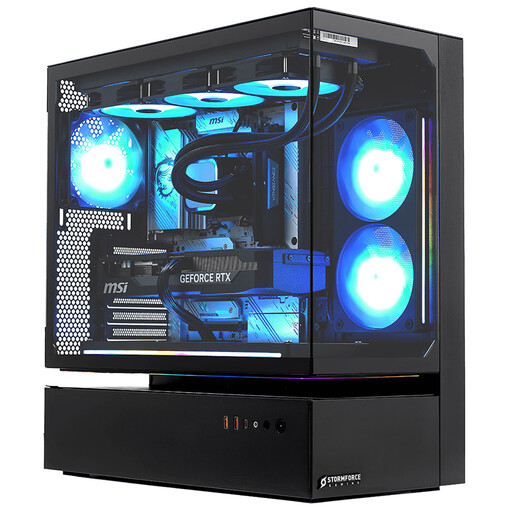 Image unavailable
Stormforce Cyclone Ryzen 7, 32GB, 2TB SSD, RTX5080
This Windows desktop is worth comparing if you want the stated memory and SSD capacity for a compatible editing workflow.
Check your DAW and interface versions, whether you need a dedicated audio drive, and the connection and positioning of your chosen monitor. The graphics specification alone does not establish an audio-editing advantage.
View on Joybuy
 Image unavailable
Apple Mac mini (2026) M6, 16GB, 256GB SSD, Silver
A compact macOS configuration to assess against your exact DAW, plug-ins and audio interface.
The listed M6 has a 12-core CPU and 12-core GPU. Avid specifies 16GB RAM and dedicated audio record/playback storage for Pro Tools; plan project storage separately and check the monitor you intend to connect.
View on Joybuy
 Image unavailable
Lenovo Legion T7 34IAS10, 32GB, 1TB SSD
Consider this Windows tower if its size and configuration fit an audio workflow that may need room for later changes.
The title lists an Intel Core Ultra 7 265K, RTX 5070 Ti and Windows 11 Home. Check your interface and plug-ins, the requirement for a dedicated audio drive, and your chosen monitor; do not assume the graphics specification improves dialogue cleanup.
View on Joybuy
Common questions
Will a more powerful desktop fix glare beside a window?
No: choose and position the monitor to address reflections. Dell lists anti-glare treatment, an ambient-light sensor and height adjustment on its U3225QE; check the exact display and its position relative to your window rather than relying on desktop specifications.
What should I check for a current Pro Tools setup?
Start with Avid’s requirements for your Pro Tools release and operating system, then confirm your audio interface and driver. Avid specifies 16GB RAM for computer systems and one or more dedicated drives for audio recording and playback; check your installation and project-storage needs separately.
Is the desktop’s included SSD enough for dialogue sessions?
Check capacity against your applications and active projects rather than judging by the SSD size alone. If you use Pro Tools, Avid calls for one or more drives dedicated to audio recording and playback, so account for that requirement in your storage plan.
Do I need WEEE registration to buy a desktop for personal use in the UK?
The WEEE obligations described in GOV.UK guidance concern roles such as producers, importers, marketplaces and distributors, rather than registration simply for buying a desktop for personal use. If you are replacing a computer, check disposal or take-back arrangements with your council or retailer.


