Hosts with guests who like different flavours
Coca-Cola describes Diet Coke as lighter than its Original-Taste-like Zero Sugar variety. A small selection lets regular visitors choose without committing the cupboard to one flavour.


For a second home, choose the cola flavours regular visitors prefer rather than treating every diet or zero-sugar variety as interchangeable: Coca-Cola describes Zero Sugar as closer to Original Taste and Diet Coke as lighter. Keep a specifically labelled caffeine-free option if guests need one, and favour individual cans over a 2-litre bottle when an opened bottle is unlikely to be used within the three days stated on the cited Asda and Sainsbury's listings. Check the current ingredients and best-before marking before stocking up.
The useful mix depends on who visits the second home and how quickly opened drinks are used.
Coca-Cola describes Diet Coke as lighter than its Original-Taste-like Zero Sugar variety. A small selection lets regular visitors choose without committing the cupboard to one flavour.
Standard Diet Coke, Coca-Cola Zero Sugar, Diet Pepsi and Pepsi MAX list caffeine in their UK product information. Check for a named caffeine-free variant if a visitor avoids it.
Unopened cans offer separate servings across visits. If choosing a shared 2-litre bottle, account for the refrigeration and three-day after-opening instructions on the cited Asda and Sainsbury's products.
Start with the exact drink and ingredients, then choose a pack that fits the length and size of a typical stay.
| Priority | What to check | Your needs |
|---|---|---|
| Sugars and energy | Read the current nutrition panel per 100ml and confirm the exact variant. Coca-Cola Great Britain and Pepsi UK list 0g sugars per 100ml for the cited standard Diet Coke, Coca-Cola Zero Sugar, Diet Pepsi and Pepsi MAX products. | I want to stock a cola with no sugars listed per 100ml, without assuming that every drink called “diet” or “zero” has the same recipe. |
| Flavour | Compare the named varieties, not just “diet” against “zero”. Coca-Cola Great Britain describes Zero Sugar as closer to Original Taste and Diet Coke as having a lighter flavour blend; taste remains a personal preference. | Different guests may want different cola flavours, so I would start with a modest selection before buying more of one variety. |
| Caffeine | Check the full variant name and ingredients. The cited standard Coca-Cola and Pepsi diet or zero-sugar colas list caffeine; their named caffeine-free variants are distinct products. | If someone avoids caffeine, I need a can or bottle specifically labelled caffeine-free rather than relying on “zero sugar”. |
| Sweeteners | Read the ingredients and phenylalanine statement on the exact pack. The NHS says aspartame is unsuitable for people with phenylketonuria (PKU); caffeine-free does not necessarily mean aspartame-free. | A guest with a PKU-related dietary requirement needs the current ingredients checked before I put a cola aside for them. |
| Pack and storage | Check the best-before marking and unopened storage instructions. Tesco's listed canned Diet Cola should be kept cool and out of sunlight, while the cited Asda and Sainsbury's 2-litre bottles should be refrigerated and used within three days of opening. | For occasional short visits, separate cans may be easier to use; a shared bottle makes more sense when the group expects to finish it within its stated after-opening period. |
Coca-Cola Great Britain distinguishes Diet Coke's lighter flavour blend from Coca-Cola Zero Sugar's Original-Taste-like positioning. The label alone cannot tell you which guests will prefer.
Begin with smaller quantities of different varieties if visitors' preferences are unknown, then adjust what you keep for later stays.
An unwanted multipack can remain unused between visits.
The cited standard Coca-Cola and Pepsi diet or zero-sugar products list caffeine. Some caffeine-free variants still list aspartame, which the NHS says is unsuitable for people with PKU.
Check the exact variant and ingredients on the current pack; treat caffeine avoidance and PKU-related requirements as separate checks.
The cited Asda and Sainsbury's 2-litre cola listings instruct shoppers to refrigerate opened bottles and use them within three days.
Choose separate cans when visits are infrequent, or open a large bottle when the group expects to use it within the product's stated period.
A partly used bottle may need to be discarded before the next visit.
The NHS notes that carbonated drinks are associated with dental erosion because of their acid content, whether they contain sugar or sweeteners.
Choose zero-sugar cola for its stated sugar content, not on the assumption that it removes this consideration; keep water available as another drink.
These references describe particular UK product ranges or listings, not every drink made by each brand.
Its UK information distinguishes Coca-Cola Zero Sugar, Diet Coke and named caffeine-free variants.
Pepsi UK lists Diet Pepsi, Pepsi MAX and Pepsi MAX Caffeine Free as distinct colas.
Tesco lists its Diet Cola as an 8 × 330ml can multipack, providing separate servings.
Its listed Cola Zero comes in a 2-litre bottle for sharing during a stay.
Asda's listed Cola Zero is another 2-litre bottle option for a group visit.
RC Cola International describes a wider carbonated-drinks range.
These canned multipacks offer individual servings for a second home, including standard and caffeine-free diet or zero-sugar varieties. Choose by the exact variant and the guests who will drink it.
 No image available
A caffeine-free Diet Coke option in individual cans for guests who avoid caffeine. The product information lists 0g sugars per 100ml; check the current ingredients if aspartame or phenylalanine matters.
 No image available
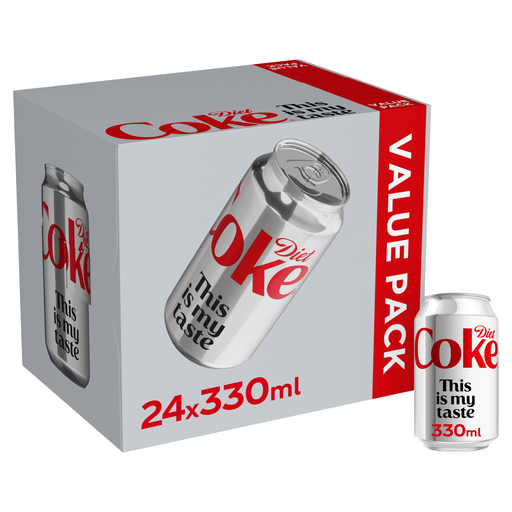
Individual cans of the flavour Coca-Cola describes as lighter than Coca-Cola Zero Sugar. The Joybuy product information lists 0g sugars per 100ml and cool, dry storage; this standard variant lists caffeine and aspartame.
 No image available
A separately named caffeine-free Pepsi MAX for individual servings. Pepsi UK describes this variant as containing no caffeine or sugar, but its ingredients list aspartame; check the current pack for a guest with PKU-related requirements.
 No image available
A standard Pepsi MAX multipack for serving guests one can at a time. Pepsi UK lists 0g sugars per 100ml for this variety; its ingredients include caffeine and aspartame, so it is not the caffeine-free variant.
 No image available
Individual cans of the variety Coca-Cola describes as closer to Original Taste. The Joybuy product information lists 0g sugars per 100ml and cool, dry storage; the standard formulation lists caffeine and aspartame.
Choose according to guests' flavour preferences, not an assumed winner. Coca-Cola Great Britain says both are sugar-free, but describes Zero Sugar as closer to Original Taste and Diet Coke as lighter. A small amount of each can help when preferences differ.
Not necessarily. The cited standard Coca-Cola Zero Sugar, Diet Coke, Diet Pepsi and Pepsi MAX products list caffeine in their UK information. Look for a specifically named caffeine-free variant and check its current label.
Do not assume that a diet or zero-sugar label makes a drink suitable. The NHS says aspartame is unsuitable for people with phenylketonuria (PKU), and the cited standard Coca-Cola and Pepsi varieties list it. Check the exact pack against the person's dietary requirements.
Follow the instructions on the particular pack and check its best-before marking. Tesco's listed canned Diet Cola should be kept cool, out of sunlight and not frozen; the cited Asda and Sainsbury's 2-litre bottles specify cool, dry storage away from direct or strong light.
That depends on when the next stay is. The cited Asda and Sainsbury's Cola Zero listings say to refrigerate their opened 2-litre bottles and use them within three days. For longer gaps, unopened cans avoid having a partly used bottle to manage.