Families packing everyday lunches
If the drink is for every school day, the choice differs from picking an occasional fizzy drink for its flavour. NHS guidance identifies water and milk as the preferred drinks for children.


For an everyday secondary-school packed lunch, choose water rather than a diet mixer: the NHS identifies water and milk as the preferred drinks for children. If the school permits a fizzy drink and you want one occasionally, check the exact pack for sugars, caffeine and serving size; zero sugar does not remove the acidity consideration.
If the drink is for every school day, the choice differs from picking an occasional fizzy drink for its flavour. NHS guidance identifies water and milk as the preferred drinks for children.
Check the sugars figure on the exact product, rather than assuming that “diet”, “light” and “zero sugar” mean the same thing. The labelled tonic-water examples below use different sugar declarations and serving sizes.
A no-sugar label does not establish that a drink is caffeine-free. Check the variant and the school’s packed-lunch policy before choosing a fizzy drink to take in.
Start with whether the drink is for daily use or an occasional lunch, then compare the exact label and the school’s rules.
| Priority | What to check | Your needs |
|---|---|---|
| Everyday drink | Decide whether this is the regular lunch drink or an occasional change. The NHS identifies water and milk as the preferred drinks for children. | I need something to pack routinely, not a fizzy drink chosen mainly for flavour. |
| Sugar label | Read sugars per serving and compare serving sizes. Tesco Groceries lists 0g per 250ml for Tesco Low Calorie Indian Tonic Water and Schweppes Slimline Tonic Water; Sainsbury’s lists less than 0.5g per 250ml for its Diet Indian Tonic Water. | If I’m replacing a sugary tonic, I want to know what this particular variant contains rather than relying on “diet” or “light” on the front. |
| Acidity | Check the ingredients as well as sugars. Wirral Community Health and Care NHS Foundation Trust notes that fizzy drinks may contain acids that can harm teeth; the listed tonic examples include citric acid. | For a drink taken to school frequently, I don’t want a zero-sugar label to settle the whole decision. |
| Caffeine and portion | Check caffeine information for the exact variant and the volume of its bottle or can. No sugar and no caffeine are separate product attributes. | I may want a caffeine-free drink in a single serving, rather than a larger container that makes the intended portion less clear. |
| School policy | Read the school’s current packed-lunch policy before buying a drink specifically to take in. Department for Education school-food guidance covers food and drink provided in state-funded schools in England; it does not establish a rule for every parent-provided packed lunch. | I need to know whether my school permits this type of drink in a packed lunch. |
Fentimans says its Naturally Light Tonic Water has 30% fewer calories than its standard tonic, but lists 3.4g sugar per 100ml. The comparison does not mean the drink contains no sugar.
Use the nutrition panel for the exact variant and compare sugars using the stated serving size.
Reducing sugar does not make a carbonated drink equivalent to water. NHS guidance favours water and milk for children, while Wirral Community Health and Care NHS Foundation Trust notes the potential effect of acids in fizzy drinks on teeth.
Pack water for routine school-day drinking; treat a permitted fizzy mixer as an occasional choice.
Sugar and caffeine describe different features of a drink. Britvic has described Pepsi MAX No Caffeine as a no-sugar, caffeine-free cola variant, but that does not establish the caffeine content of another product.
Check caffeine information on the exact pack when avoiding it matters.
Department for Education guidance addresses food and drink provided in state-funded schools in England. It does not, on its own, tell a family what its school permits in a parent-provided packed lunch.
Check the individual school’s current packed-lunch policy before choosing a fizzy drink for school.
Its Low Calorie Indian Tonic Water is an own-label tonic to compare when sugar on the label is the deciding factor.
Slimline Tonic Water is a branded tonic option for comparing a no-sugar label with ingredients and pack format.
Its Diet Indian Tonic Water gives shoppers another per-serving sugar declaration to compare.
Its soda water and Naturally Light tonic illustrate why products from the same mixer brand need separate label checks.
Refreshingly Light Indian Tonic Water is a lower-calorie version to assess by its own ingredients and sugar label.
Britvic’s Pepsi MAX No Caffeine announcement is relevant when the drink under consideration is cola rather than tonic.
These options cover an occasional slimline tonic in small cans and a separate caffeine-free cola choice for households specifically considering cola. Neither replaces water as the routine lunch drink.
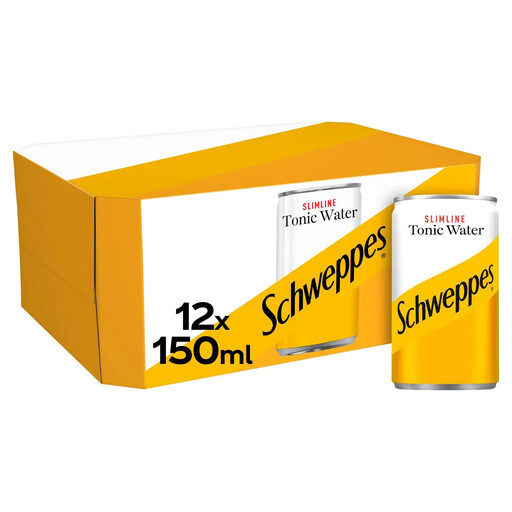 No image available
The individual 150ml cans offer a defined portion if an occasional tonic is permitted in a packed lunch. Check the current pack for sugars and caffeine; choosing a slimline tonic does not remove the consideration of acids in fizzy drinks.
 No image available
This is a cola-style option for an occasional lunch, not a tonic mixer. The pack contains 24 × 330ml cans; check the current label and the school’s policy before choosing it for a packed lunch.
Choose water for routine school-day drinking. The NHS identifies water and milk as the preferred drinks for children; a diet mixer is better treated as an occasional fizzy alternative if the school permits it.
No. Wirral Community Health and Care NHS Foundation Trust notes that fizzy drinks may contain acids that can harm teeth, and the Tesco, Schweppes and Sainsbury’s tonic listings include citric acid. Check ingredients as well as sugars.
Not necessarily: compare the sugars figure and serving size for the exact drink. Tesco Groceries lists 0g per 250ml for Tesco Low Calorie and Schweppes Slimline tonics; Sainsbury’s lists less than 0.5g per 250ml for its Diet Indian Tonic, while Fentimans lists 3.4g per 100ml for Naturally Light Tonic.
No such permission follows from the Department for Education guidance on food and drink provided in state-funded schools in England. Check the individual school’s packed-lunch policy before sending a fizzy drink.