What should you check?
Start with the child’s age and the role of the drink, then compare squash labels on the basis of what will be served in the glass.
| Priority | What to check | Your needs |
|---|
| Everyday drink |
Consider water or plain milk before a flavoured drink. Healthier Together NHS identifies water and milk as the preferred drinks for children aged 5 to 12 and describes well-diluted sugar-free squash as an acceptable option. |
I want a flavoured choice for some snack times without making squash the only drink available. |
| Age and ingredients |
NHS guidance says children aged 4 or younger should avoid drinks containing sugar or sweeteners. Check the ingredient list for sweeteners, including aspartame (E951) where PKU is relevant. |
The drink is for a younger child, or I need to check an ingredient against an individual dietary restriction. |
| Prepared-drink nutrition |
Read sugars and energy for the diluted serving, including its stated size. Compare like with like: nutrition for concentrate is not the same as nutrition for a prepared glass. |
I’m comparing what will go into a glass with snacks, not just claims printed on bottles. |
| Dilution and servings |
Follow the product’s own mixing direction and check its declared servings. Tesco Groceries lists 1 part squash to 19 parts water and 50 servings for its Quadruple Strength Orange 750ml; these figures are specific to that product. |
We make squash often, so the number of drinks prepared from a bottle matters more to me than bottle size alone. |
| Fruit and flavour |
Check fruit content separately from sugars and sweeteners. Marks & Spencer labels its Pink Grapefruit High Juice as 50% fruit juice and no added sugar; neither statement by itself establishes the prepared drink’s sugar content. |
I’m looking for a particular flavour, but I still want to read the nutrition panel and ingredients. |
Brand and range examples
These label examples show why concentration, prepared-drink nutrition and ingredients need checking product by product; they do not describe every squash made by each brand.
Robinsons
Its Orange No Added Sugar 1L is a single-strength orange option with a stated mixing direction.
- Tesco Groceries lists 1 part concentrate to 4 parts water, with 3 kcal and 0g sugars per prepared 250ml serving.
- Its ingredients include acesulfame K and sucralose; no added sugar does not mean no sweeteners.
Tesco
Tesco Quadruple Strength Orange No Added Sugar 750ml is a concentrated own-label format.
- Tesco Groceries declares 50 servings when mixed at 1 part squash to 19 parts water.
- Check its sweeteners and compare nutrition using the stated prepared-serving size, not the concentrate alone.
Waitrose Essential
Essential No Added Sugar Summer Fruits is a double-strength squash with a suggested mixing ratio.
- Waitrose & Partners declares 60 servings and suggests 1 part squash to 9 parts water.
- The label identifies naturally occurring sugars, so its no-added-sugar claim should not be read as sugar-free.
M&S
Its range includes Orange Squash and Pink Grapefruit High Juice, two different fruit-content formats.
- Marks & Spencer labels Orange Squash as double strength with 20% fruit, and Pink Grapefruit High Juice as 50% fruit juice.
- Check the chosen product’s nutrition and ingredients; the Pink Grapefruit High Juice information lists sucralose.
Vimto
Vimto No Added Sugar Squash 1L offers a mixed-fruit flavour.
- Tesco Groceries lists 5 kcal and 0.8g sugars per stated 250ml serving.
- The ingredient information lists sucralose and acesulfame K; check the current allergen statement if relevant.
Joybuy squash options
These Joybuy options are no-added-sugar squash concentrates in orange, blackcurrant, pineapple and passion fruit, and summer-fruits flavours. For a child, check the current bottle’s ingredients and dilution directions before serving.
 No image available
Robinsons Orange No Added Sugar Squash 1L
An orange concentrate for households choosing a no-added-sugar flavour. Tesco Groceries lists 3 kcal and 0g sugars per diluted 250ml serving when prepared at 1 part concentrate to 4 parts water. It contains acesulfame K and sucralose; check the label for sulphites if relevant.
View on Joybuy
 No image available
Ribena Blackcurrant No Added Sugar Concentrate 1.5L
A 1.5L blackcurrant option for households making repeated drinks. Check the current label’s mixing directions and prepared-drink nutrition before comparing it with other concentrates. Its listed ingredients include aspartame, acesulfame K and sucralose; check the allergen information for sodium bisulphite if relevant.
View on Joybuy
 No image available
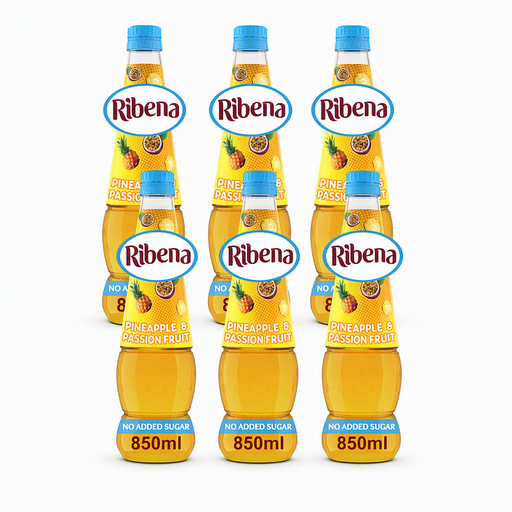
Ribena Pineapple and Passion Fruit No Added Sugar Squash 6 × 850ml
A six-bottle pack for households choosing this pineapple and passion-fruit flavour. Check the label for preparation directions and nutrition for the diluted drink before comparing servings. The listed ingredients include aspartame and acesulfame K; check the phenylalanine and sulphites declarations where relevant.
View on Joybuy
 No image available
Ribena Pineapple and Passion Fruit No Added Sugar Squash 850ml
An individual 850ml bottle of the pineapple and passion-fruit squash. Use the current bottle’s dilution instructions and prepared-drink nutrition when comparing it with other flavours or strengths. The listed ingredients include aspartame and acesulfame K; check the phenylalanine and sulphites declarations where relevant.
View on Joybuy
 No image available
Robinsons Summer Fruits No Added Sugar Squash 1L
A 1L summer-fruits option for those who prefer that flavour to orange or blackcurrant. Check the current bottle for its dilution direction and sugars per prepared serving before comparing drinks. Its listed ingredients include sucralose and acesulfame K; check the sulphites declaration if relevant.
View on Joybuy
Frequently asked questions
Does ‘no added sugar’ mean squash is sugar-free?
No. A product can contain naturally occurring sugars without added sugar. Waitrose & Partners identifies naturally occurring sugars in its Essential No Added Sugar Summer Fruits Squash, so check the prepared-drink nutrition rather than assuming the claim means 0g sugars.
Is diet squash suitable for children of every age?
No. NHS guidance says children aged 4 or younger should avoid drinks containing sugar or sweeteners. For children aged 5 to 12, Healthier Together NHS describes well-diluted sugar-free squash as acceptable, while identifying water and milk as the preferred drinks.
Can no-added-sugar squash contain sweeteners?
Yes. The product information for Robinsons Orange and Tesco Quadruple Strength Orange lists sweeteners, as does Tesco Groceries’ listing for Vimto No Added Sugar. Check the ingredients on the exact bottle, particularly when an individual dietary restriction applies.
How much water should I add to squash?
Follow the particular bottle’s directions: Tesco Groceries lists 1 part Robinsons Orange concentrate to 4 parts water and 1 part Tesco Quadruple Strength Orange to 19 parts water. Waitrose & Partners suggests 1 part Essential Summer Fruits to 9 parts water. Dilution does not override NHS age guidance on drinks containing sweeteners.
Can fruit juice replace squash throughout the day?
Fruit juice is not an unrestricted alternative. The NHS advises that children and adults have no more than a combined 150ml of fruit juice and smoothies a day. For children aged 5 to 12, Healthier Together NHS identifies water and milk as the preferred drinks.


