What should you check?
Start with the flavour and caffeine you want in your lunch drink, then compare the label and pack format.
| Priority |
What to check |
Your needs |
| Flavour |
Check which exact variant you are buying. Coca-Cola GB describes Coca-Cola Zero Sugar as closer to its Original Taste and Diet Coke as lighter; these are the brand’s descriptions, not a taste test. |
I would rather choose the flavour I expect to enjoy with lunch than treat every sugar-free cola as interchangeable. |
| Sugars and energy |
Read sugars and energy per 100 ml, then check the amount in your can or glass. An own-label diet cola need not use the same nutrition wording as a branded zero-sugar product. |
For a lower-sugar lunch choice, I want to compare the actual pack’s figures, not just its front-label name. |
| Caffeine |
Look for ‘caffeine-free’ in the exact product name and check the pack. Standard Diet Coke and Diet Pepsi contain caffeine; their caffeine-free variants are separate products. |
If I do not want caffeine before later lectures, I need the explicitly caffeine-free version, not simply a diet cola. |
| Pack and storage |
Compare an individual can with a 2-litre bottle for carrying. For the reviewed Tesco, Asda and Sainsbury’s bottles, follow the instructions to refrigerate after opening and use within three days. |
A can fits a lunch taken to campus; a larger opened bottle makes more sense where I can keep it refrigerated and share it. |
Brand and own-label references
These product-line details help distinguish flavours, caffeine variants and bottle formats; they do not describe every drink made by each brand.
Coca-Cola
Coca-Cola Zero Sugar, Diet Coke and their separately named caffeine-free variants offer different choices for a lecture lunch.
- Coca-Cola GB says Coca-Cola Zero Sugar is closer to Original Taste, while Diet Coke has a lighter flavour profile; it describes both as sugar-free and calorie-free.
- The standard versions contain caffeine. Check for ‘Caffeine Free’ when that distinction matters.
Pepsi
Diet Pepsi and the Pepsi Max range include sugar-free options, with separately named caffeine-free variants.
- Pepsi UK identifies Pepsi Max Caffeine Free as containing zero sugar and zero caffeine.
- Do not assume standard Pepsi Max or Diet Pepsi is caffeine-free. Check the ingredient and phenylalanine statements on the variant you choose.
Tesco
Tesco Diet Cola comes in a 2-litre bottle that may suit a shared fridge rather than a drink carried to one lecture lunch.
- Tesco describes it as a no-added-sugar cola with caffeine and sweeteners.
- Follow the bottle’s refrigeration and three-day use instructions after opening.
Sainsbury’s
Sainsbury’s Diet Cola is another 2-litre own-label option for drinks kept at home.
- Sainsbury’s lists less than 0.5 g sugars per 100 ml and 2 kcal per 250 ml glass for this product.
- It contains caffeine and sweeteners; refrigerate after opening and use within three days as directed.
Asda
Asda Diet Cola is a 2-litre own-label bottle for a fridge rather than an individual lunch pack.
- Asda lists less than 0.5 g sugars and 1 kcal per 100 ml, and 25 mg caffeine per 250 ml serving.
- Check whether its caffeine content suits you and follow the bottle’s instructions after opening.
Cola cans on Joybuy
These multipacks contain 330 ml cans for the diet, zero-sugar and caffeine-free choices discussed here. The pack supplies individual cans, rather than a single drink.
 No image available
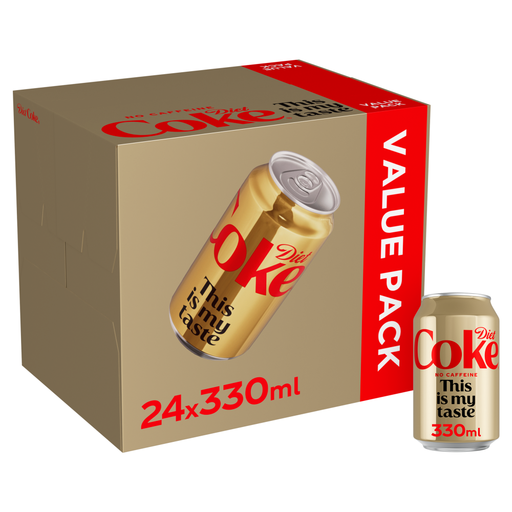
Diet Coke No Caffeine, 24 × 330 ml
A separately named caffeine-free Diet Coke for a lunch when you do not want caffeine. The multipack contains individual 330 ml cans; check the pack’s sweetener and phenylalanine information if relevant to you.
View on Joybuy
 No image available
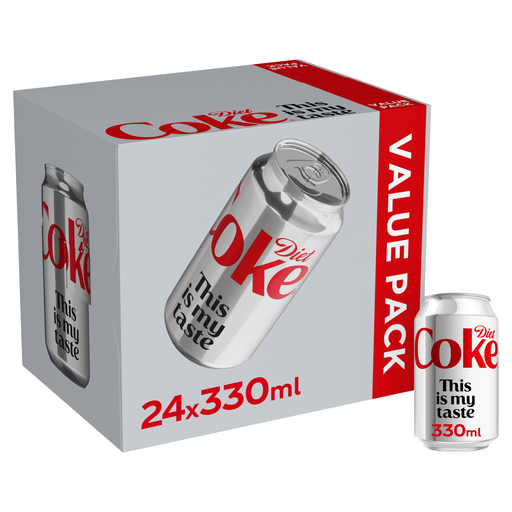
Diet Coke, 24 × 330 ml
For a lunch can if you prefer Diet Coke’s lighter flavour profile as described by Coca-Cola GB. This standard version contains caffeine; choose a separately labelled caffeine-free variant if you want to avoid it.
View on Joybuy
 No image available
Pepsi Max Caffeine Free, 24 × 330 ml
A zero-sugar, caffeine-free Pepsi Max variant for an individual lunch can. The pack contains 24 cans; check its sweetener and phenylalanine information if relevant to you.
View on Joybuy
 No image available
Pepsi Max, 24 × 330 ml
A pack of individual Pepsi Max cans for lunch if caffeine is acceptable to you. This is the standard version, not Pepsi Max Caffeine Free; check the exact pack for its ingredients.
View on Joybuy
 No image available
Coca-Cola Zero Sugar, 24 × 330 ml
For a lunch can if you prefer the Original Taste-style flavour Coca-Cola GB attributes to Zero Sugar. This standard variant contains caffeine, so check for a separately named caffeine-free version if needed.
View on Joybuy
Questions about diet cola
Is ‘zero sugar’ different from ‘diet’?
The names do not, by themselves, tell you which cola has less sugar. Coca-Cola GB says both Coca-Cola Zero Sugar and Diet Coke are sugar-free and calorie-free, but describes different flavour profiles: Zero Sugar is positioned closer to Original Taste, while Diet Coke is lighter. Compare the exact products’ labels.
Does diet cola contain caffeine?
It can. Standard Diet Coke and Diet Pepsi contain caffeine, while separately named caffeine-free versions are available. If you want none with lunch, check for ‘caffeine-free’ on the exact can or bottle.
What if I need to check for phenylalanine?
Read the physical label of the product you intend to drink. Some reviewed diet and zero-sugar colas contain aspartame and state that they contain a source of phenylalanine; do not assume the ingredients are the same across variants.
Is a 2-litre bottle practical for lecture lunches?
It is less convenient to carry for one lunch than an individual can and needs appropriate storage after opening. Tesco, Asda and Sainsbury’s advise refrigerating their reviewed 2-litre diet colas after opening and using them within three days, which makes a shared fridge a more practical setting.


