Shoppers avoiding sugar with their snacks
If you want a cola alongside crisps or popcorn without sugar, the next choice is whether you prefer an original-cola-style or a lighter diet-cola flavour.


For a TV-night snack, choose by the flavour profile you want: Coca-Cola describes Zero Sugar as closer to its Original Taste and Diet Coke as lighter, while Pepsi offers both Pepsi MAX and Diet Pepsi as sugar-free options. If you want to avoid caffeine in the evening, choose a specifically labelled caffeine-free variant rather than relying on “diet” or “zero sugar”; check the exact pack for sweeteners and phenylalanine information too.
If you want a cola alongside crisps or popcorn without sugar, the next choice is whether you prefer an original-cola-style or a lighter diet-cola flavour.
A sugar-free label does not establish that a cola is caffeine-free. Check for a specifically named caffeine-free variant when that distinction matters for your evening drink.
The cited Coca-Cola and Pepsi diet and zero-sugar variants carry a statement that they contain a source of phenylalanine. Check the exact pack if the intended drinker needs to avoid it.
For a TV-night drink, start with the sugar declaration, then narrow the choice by flavour style and whether you need a caffeine-free variant.
| Priority | What to check | Your needs |
|---|---|---|
| Sugar | Read the sugars figure per 100 ml on the exact pack. Coca-Cola Great Britain and PepsiCo UK list 0 g per 100 ml for their cited standard Zero Sugar, Diet Coke, Diet Pepsi and Pepsi MAX variants. | I want a cola without sugar alongside my snacks, so the nutrition panel matters more to me than the word “diet” alone. |
| Flavour style | Compare the brands’ descriptions, not an assumed taste ranking. Coca-Cola describes Zero Sugar as closer to Coca-Cola Original Taste and Diet Coke as having a different, lighter flavour blend. | For a familiar cola-style flavour, I would compare the original-style options; if I prefer a lighter diet-cola profile, I would look at the diet varieties. |
| Caffeine | Check the full variant name and ingredients. The cited standard Coca-Cola Zero Sugar, Diet Coke, Diet Pepsi and Pepsi MAX labels include caffeine flavouring; separately named caffeine-free versions are available. | When I want to avoid caffeine during a late viewing session, I need the pack to say caffeine-free rather than just sugar-free. |
| Sweeteners | Read the ingredients and phenylalanine statement on the exact variant. The cited products containing aspartame state that they contain a source of phenylalanine; caffeine-free does not remove that need to check. | If the person drinking the cola needs to avoid phenylalanine, I need to check the current pack before choosing it. |
The standard Coca-Cola Zero Sugar, Diet Coke, Diet Pepsi and Pepsi MAX variants cited by their manufacturers include caffeine flavouring.
If avoiding caffeine matters, compare packs explicitly labelled caffeine-free and read the ingredients for the chosen variant.
Coca-Cola describes Zero Sugar as closer to its Original Taste and Diet Coke as a different, lighter flavour blend. These are the manufacturer’s descriptions, not independent taste-test results.
Choose a flavour style you want to try rather than treating “diet” and “zero sugar” as interchangeable taste descriptions.
The cited diet and zero-sugar variants use aspartame and state that they contain a source of phenylalanine. A caffeine-free version can carry the same statement.
If phenylalanine avoidance is relevant to the intended drinker, check the ingredients and statement on the exact pack.
Coca-Cola Great Britain positions Coca-Cola Zero Sugar as closer to its Original Taste and Diet Coke as a separate, lighter-tasting sugar-free cola.
PepsiCo UK offers sugar-free Diet Pepsi and Pepsi MAX, as well as a separately named Pepsi MAX No Caffeine variant.
These options cover caffeine-free evening choices, standard zero-sugar cola and a diet-style cola. Compare the exact variant and pack details before choosing for your TV night.
 No image available
A diet-style cola option for a TV night when you want to avoid caffeine. The listing identifies this variant as caffeine-free and gives 0 g sugars per 100 ml. It states that the drink contains a source of phenylalanine; check the pack if that matters to the intended drinker.
 No image available
This 24-can option is identified as having no sugar and no caffeine, making it one to compare for a late viewing session. Its listing also states that it contains a source of phenylalanine; check the exact pack if relevant.
 No image available
For a standard zero-sugar Pepsi MAX rather than a caffeine-free variant, this listing identifies the drink as sugar-free. It lists caffeine flavouring and a phenylalanine statement. Check the pack size before ordering.
 No image available
A 24-can zero-sugar option if Coca-Cola’s Original Taste-style positioning appeals to you for a TV night. This standard variant lists caffeine and states that it contains a source of phenylalanine; it is not the caffeine-free version.
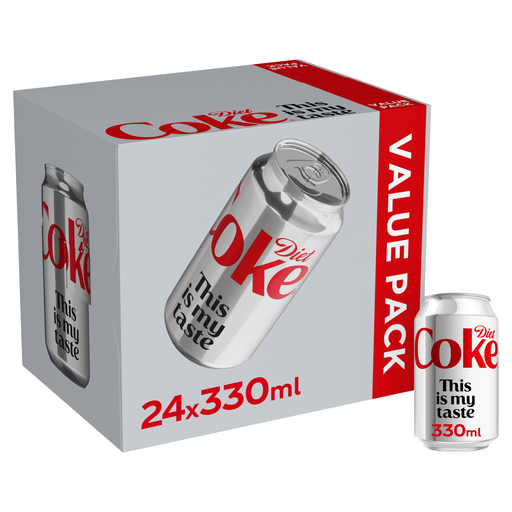 No image available
A 24-can sugar-free option for shoppers who prefer Diet Coke’s lighter flavour positioning. The listed standard variant contains caffeine and carries a phenylalanine statement, so check the exact pack if either affects your choice.
No. The cited standard Coca-Cola Zero Sugar, Diet Coke, Diet Pepsi and Pepsi MAX labels include caffeine flavouring. If you want to avoid caffeine for a late TV night, choose a specifically labelled variant such as Diet Coke Caffeine Free or Pepsi MAX No Caffeine and check the pack.
Coca-Cola Great Britain describes both as sugar-free, but positions Zero Sugar as closer to Coca-Cola Original Taste and Diet Coke as having a different, lighter flavour blend. That describes the brand’s intended flavours, not a guarantee of which you will prefer.
Yes. The cited labels for Coca-Cola Zero Sugar, Diet Coke, Diet Pepsi, Pepsi MAX and Pepsi MAX No Caffeine state that they contain a source of phenylalanine. Check the exact current pack if the intended drinker needs to avoid it.