What should you check?
Start with whether cola is an occasional choice or the usual after-school drink. If choosing cola, check sugar and caffeine separately; neither label answers every question about the drink.
Water or plain milk
Choose when: You need a routine after-school drink, particularly for a young child.
Trade-off: Neither provides cola flavour or fizz; the NHS advises that fizzy drinks are acidic and can damage tooth enamel.
Caffeine-free zero-sugar cola
Choose when: An occasional cola is wanted and both sugar and caffeine matter to the choice.
Trade-off: It remains a fizzy drink; check the sweeteners and any phenylalanine warning on the exact pack.
Standard diet or zero-sugar cola
Choose when: Sugar is the main consideration and caffeine is acceptable for the intended drinker.
Trade-off: Standard Coca-Cola Zero Sugar, Pepsi Max and the own-label examples discussed here contain caffeine or list it in their flavourings.
| Priority | What to check | Your needs |
|---|
| Sugar | Read sugars per 100ml and per serving on the exact product. A “zero added sugar” label is not the same wording as 0g sugars. | I want an occasional cola with no or very little sugar, and I’ll check the nutrition panel rather than the name alone. |
| Caffeine | Look for “Caffeine Free” or “No Caffeine” in the variant name, then check the ingredients. Diet and zero-sugar labels do not establish caffeine status. | If I’m avoiding caffeine later in the day, I need the specifically labelled version. |
| Routine drinking | Consider how often the drink is served and whether it is sipped between meals. The NHS says fizzy drinks are acidic and can damage tooth enamel. | For a usual after-school drink, I’d choose water or plain milk; zero sugar does not remove the acidity of fizzy cola. |
| Age | Check whether the drink is for a baby or young child. The NHS does not recommend diet or reduced-sugar drinks for this age group. | A zero-sugar cola label does not make it an appropriate drink for a young child. |
| Ingredients | Read the current sweetener list and any “contains a source of phenylalanine” warning, particularly when following a phenylketonuria (PKU) dietary plan. | Where a specialist dietary plan applies, I need to check the exact pack and follow that advice. |
| Flavour and serving | Distinguish Diet Coke from Coca-Cola Zero Sugar, and compare the can or bottle size as well as figures per 100ml. Coca-Cola describes Diet Coke as lighter in flavour and Zero Sugar as closer to Original Taste. | For an occasional cola, I can pick the flavour I prefer and check how much the container holds. |
Cola options on Joybuy
These multipacks cover caffeine-free and standard diet or zero-sugar colas for an occasional after-school snack. Compare the exact variant and its 330ml can size; the drink choices above also include water and plain milk for routine use.
 No image available
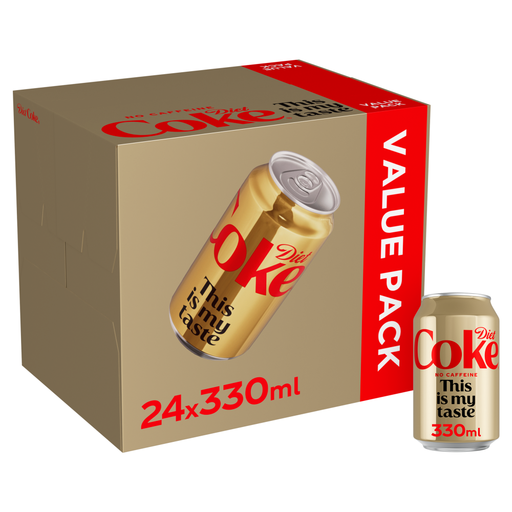
Diet Coke No Caffeine 24 × 330ml
For an occasional Diet Coke when caffeine avoidance matters. The listed nutrition information shows 0g sugars per 100ml; the 24-pack contains 330ml cans. It is still a fizzy drink, and the product description carries a phenylalanine warning.
 No image available
Pepsi Max Caffeine Free 24 × 330ml
For an occasional Pepsi Max without sugar or caffeine, as stated in the product description. The pack contains 24 cans of 330ml. Its ingredients include acids, and its description carries a phenylalanine warning.
 No image available
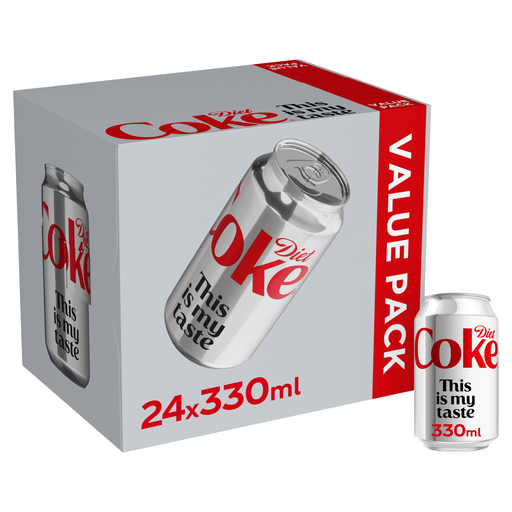
Diet Coke 24 × 330ml
For an occasional Diet Coke when caffeine is acceptable. Coca-Cola describes its flavour as lighter than Coca-Cola Zero Sugar. This listing shows 0g sugars per 100ml, lists caffeine and carries a phenylalanine warning; it is not the No Caffeine variant.
 No image available
Pepsi Max 24 × 330ml
For an occasional zero-sugar Pepsi Max when caffeine is acceptable. The listed nutrition information shows 0g sugars per 100ml, and the ingredients list caffeine. This 24-pack contains 330ml cans; its description carries a phenylalanine warning.
 No image available
Coca-Cola Zero Sugar 24 × 330ml
For an occasional zero-sugar cola when caffeine is acceptable. Coca-Cola describes this flavour as closer to Original Taste than Diet Coke. The listing shows 0g sugars per 100ml, lists caffeine and carries a phenylalanine warning; the pack contains 24 cans of 330ml.
Questions about after-school cola
Does a zero-sugar cola make sense for an occasional after-school snack?
It is an option when reducing sugar in an occasional cola is the aim, provided you check the exact product’s nutrition panel and caffeine status. For a routine drink, choose water or plain milk; the NHS says fizzy drinks are acidic and can damage tooth enamel.
Are diet or zero-sugar colas suitable for babies and young children?
The NHS does not recommend diet or reduced-sugar drinks for babies and young children. It also says fizzy drinks are acidic and can damage tooth enamel, regardless of a zero-sugar label.
How do I find a caffeine-free diet cola?
Choose a variant explicitly named “Caffeine Free” or “No Caffeine”, then check its current ingredients. Standard Coca-Cola Zero Sugar, Pepsi Max and Diet Pepsi list caffeine, as do the Sainsbury’s and Asda own-label examples discussed here.
Does zero sugar remove the concern about teeth?
No. The NHS says fizzy drinks are acidic and can damage tooth enamel. Removing sugar does not make fizzy cola equivalent to water or plain milk for routine between-meal drinking.
Do England’s school-food rules apply to an after-school snack at home?
The Department for Education’s school-food guidance concerns food and drink provided in state-funded schools in England. Its requirements for those schools should not be read as a rule about a parent or carer providing a snack at home, or as a single rule for every part of the UK.


