A plain digestive twin pack can be a convenient cupboard snack when you have around 60 to 90 minutes before training, but a biscuit alone does not match University College London Hospitals NHS Foundation Trust’s guidance for a snack containing carbohydrate and protein with minimal fat. If exercise starts in 15 to 30 minutes, consider its guidance for a faster-acting carbohydrate instead; check the exact pack’s nutrition and allergens before choosing.
Who might consider a twin pack?
People planning a snack before training
A plain digestive may be convenient when there is around 60 to 90 minutes before exercise. University College London Hospitals NHS Foundation Trust advises that a snack in this window should include carbohydrate and protein with minimal fat, so check how the biscuit fits alongside anything else you plan to eat.
Households using biscuits over several occasions
A twin pack offers two separate packs, but total weight and biscuit count still differ. Tesco lists McVitie's Original at 2 x 360g, while Sainsbury's lists a 2 x 315g version; choose an amount you can store and use.
People checking ingredients and allergens
The plain digestive listings identify wheat, while other warnings vary by product. Check the current label of the exact pack, particularly if milk or nuts also matter to you.
What should you check?
Start with the time before exercise, then compare the biscuit label and the amount you will use; a twin pack is a format choice, not a complete pre-workout snack in itself.
| Priority | What to check | Your needs |
|---|
| Time before exercise |
University College London Hospitals NHS Foundation Trust distinguishes snacks eaten 60–90 minutes before exercise from faster-acting carbohydrate eaten 15–30 minutes beforehand. Check when you will eat. |
If training starts soon, I would choose a snack for that shorter window rather than assume a digestive works equally well at any time. |
| Nutrition per biscuit |
McVitie's lists 9.3g carbohydrate, 3.1g fat and about 1g protein per Original biscuit. Check the current per-biscuit panel and how many you intend to eat. |
I want the convenience of a biscuit, but I need to account for what else I eat if I am aiming for the carbohydrate, protein and minimal-fat combination in University College London Hospitals NHS Foundation Trust’s 60–90-minute guidance. |
| Pack amount |
Compare the total weights of 2 x 360g and 2 x 315g, and the listed counts of 48 and 42 biscuits respectively. Consider where the packs will be kept. |
A smaller twin pack may make more sense for my household if I will not use the larger amount. |
| Ingredients and allergens |
Read the exact pack's wheat declaration and any milk or nut-related warning. Tesco's McVitie's 2 x 360g listing says it may contain milk; warnings on other digestives differ. |
If an ingredient or allergen matters to me, I need the declaration for the product I will actually eat, not another brand or pack size. |
| Plain or coated |
Compare the nutrition panels separately: the figures for McVitie's plain Original do not describe a chocolate-coated digestive. |
I would check the plain version first for this snack rather than transfer its per-biscuit figures to a coated version. |
Common buying mistakes
-
Treating one biscuit as a complete pre-workout snack
McVitie's lists carbohydrate in each Original biscuit, but also 3.1g fat and about 1g protein. That differs from University College London Hospitals NHS Foundation Trust’s advice for a 60–90-minute snack containing carbohydrate and protein with minimal fat.
Consider the biscuit as one part of what you eat, and use the shorter-window guidance if training begins in 15–30 minutes.
-
Using plain-biscuit figures for a chocolate version
A chocolate-coated digestive is a different product. McVitie's Original nutrition figures cannot tell you what is in the coated biscuit.
Read the nutrition panel for the exact variant before deciding whether it suits the time you have before exercise.
-
Assuming the larger twin pack suits every household
The listed 2 x 360g pack contains more biscuit than the 2 x 315g pack. That extra amount is useful only if it fits your storage and expected use.
Compare total weight and biscuit count, then choose the pack size you expect to use while it remains in good condition.
-
Applying one food rule to every school setting
Department of Health and Social Care guidance on promotions of certain foods is separate from Department for Education guidance on food provided in state-funded schools in England. Neither, by itself, classifies a particular pack of digestives for every school setting across the UK.
If biscuits are intended for a school setting, check the rules for that nation and setting alongside the requirements that apply to the exact product.
Brand and retailer references
These references distinguish plain twin packs from single packs and coated biscuits; they do not mean that every product from a brand has the same ingredients or format.
McVitie's
Tesco and Sainsbury's list plain Original twin packs in 2 x 360g and 2 x 315g formats.
- McVitie's lists 71kcal, 9.3g carbohydrate and 3.1g fat per Original biscuit.
- Check the exact pack's allergen declaration: the Tesco 2 x 360g listing identifies wheat and says it may contain milk.
Tesco
Tesco's own-label plain Digestives 400g are a single-pack alternative if two packs are not needed.
- Tesco lists this product as suitable for vegans.
- The listing identifies wheat and says the biscuits may contain peanuts and nuts; check the current pack.
Sainsbury's
Alongside its McVitie's 2 x 315g listing, Sainsbury's lists own-label plain Digestives 400g as a single pack.
- The own-label listing states that the biscuits are suitable for vegans.
- The product contains wheat; read its current ingredient and allergen declaration.
M&S
The M&S product described here is a 300g milk-chocolate digestive, rather than the plain twin-pack format in this article.
- Compare its own nutrition panel instead of applying figures from McVitie's plain Original biscuits.
Crawford's
Iceland Foods lists Crawford's Digestives 400g as a single pack for shoppers comparing ordinary digestives.
- A 400g single pack does not provide the requested twin-pack format; read the product label for its ingredients and nutrition.
Plain digestive twin packs on Joybuy
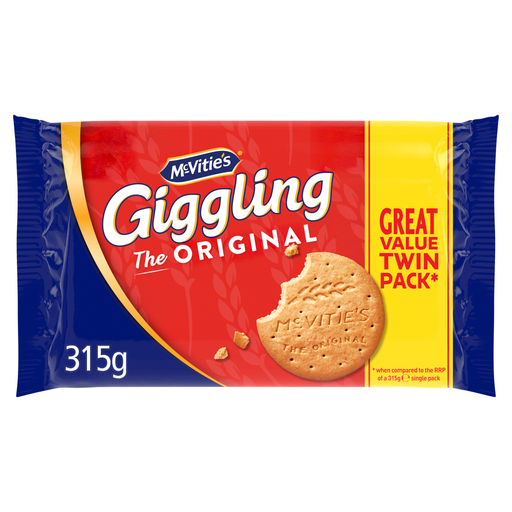
This plain McVitie's twin pack represents the smaller 2 x 315g format for households considering a cupboard snack before training. Check its label against your timing, portion and allergen needs.
 No image available
McVitie's Digestives the Original 2 x 315g
The plain twin-pack format suits repeated household use when you want biscuits available ahead of a training session.
Sainsbury's lists 42 biscuits for this 2 x 315g format; McVitie's lists 71kcal, 9.3g carbohydrate, 3.1g fat and about 1g protein per Original biscuit. It contains wheat. Check the current pack before eating, especially if other allergens matter to you.
View on Joybuy
Questions about choosing and using them
What if I have only 15 to 30 minutes before exercise?
Consider a faster-acting carbohydrate rather than assuming a digestive suits that short window. University College London Hospitals NHS Foundation Trust distinguishes snacks eaten 15–30 minutes before exercise from those eaten 60–90 minutes beforehand; McVitie's lists 3.1g fat per plain Original biscuit.
How do the two McVitie's Original twin-pack sizes differ?
Tesco lists the 2 x 360g pack at 720g and 48 biscuits; Sainsbury's lists the 2 x 315g pack at 630g and 42 biscuits. Choose by how much you expect to use and check the current label of the size you select.
Does a plain digestive's name tell me whether it meets my dietary requirements?
No. Tesco lists its McVitie's 2 x 360g Original twin pack as suitable for vegans, but identifies wheat and says it may contain milk. Its own-label plain digestives have a different warning concerning peanuts and nuts. Read the current declaration for the exact product.
Do retail HFSS rules decide whether these biscuits can be used in school meals throughout the UK?
No single UK-wide school-meal conclusion follows from retail promotion guidance. Department of Health and Social Care guidance concerns promotions of certain foods, while Department for Education school-food guidance concerns food provided in state-funded schools in England. Check the rules for the relevant school setting and the exact product rather than assuming a retail rule determines its use.


