Families and shared-household tea-break planners
Think about how many people reach for the biscuit tin and how quickly an opened pack will be used. A twin pack lets you keep one inner pack sealed while the other is open.


Choose a plain 400g pack for a smaller group that will use it soon after opening. A twin pack makes sense for frequent shared breaks when keeping a second inner pack sealed is useful. If chocolate flavour matters more, compare that variant’s ingredients and per-100g nutrition separately rather than treating it as interchangeable with plain digestives.
Think about how many people reach for the biscuit tin and how quickly an opened pack will be used. A twin pack lets you keep one inner pack sealed while the other is open.
Read the exact pack for allergens, precautionary statements and dietary suitability. Compare nutrition per 100g across variants, then use per-biscuit information when deciding how many to put out.
Start with the amount your group will use, then compare the exact variant’s storage instructions, ingredients and nutrition label.
| Priority | What to check | Your needs |
|---|---|---|
| Pack format | Check the total weight and number of inner packs. A 400g single pack and a 2 x 400g twin pack provide different amounts. | For a small group, I would rather open one pack I expect to use soon. For frequent shared breaks, keeping a second pack sealed could be useful. |
| Opened-pack storage | Read the pack’s storage directions. Sainsbury’s advises keeping its opened 400g digestives in an airtight container for quality. | Biscuits may be left in the tin between tea breaks, so I need a way to store the opened pack. |
| Nutrition | Compare sugars, saturated fat and salt per 100g on the exact variant. The NHS explains that per-100g figures and any front-of-pack traffic-light labels provide different ways to read nutrition information. | I want to compare plain and chocolate biscuits on the same per-100g basis, rather than assume their labels are alike. |
| Allergens and dietary labels | Check highlighted ingredients, any “may contain” statement and the dietary wording on the current pack. Tesco’s plain digestives state possible peanuts and nuts; Asda’s plain digestives state possible milk. | When sharing biscuits, I need to check the particular brand and flavour against everyone’s requirements, not rely on the word “digestive”. |
Tesco Groceries lists 23.1g sugars per 100g for its chocolate-chip digestives, while Marks & Spencer lists 31.7g per 100g for its milk-chocolate digestives. Those figures describe different products, not plain digestives as a category.
Choose the flavour you want, but compare the exact variants’ per-100g labels and ingredients before putting them side by side.
Plain products can have different precautionary allergen statements. Tesco’s plain digestives may contain peanuts and nuts, while the Asda plain pack and the McVitie’s Original 2 x 400g pack listed by Asda may contain milk.
Read the physical label of the exact pack and flavour before sharing it with someone who has an allergy or other dietary requirement.
Opened biscuits need suitable storage to maintain quality; Sainsbury’s advises an airtight container for its 400g pack.
Match the format to the group’s likely use and keep opened biscuits as the pack directs.
These examples describe particular products and pack formats; check the label of the variant you are considering.
Asda lists a McVitie’s Original Digestives twin pack containing 2 x 400g, a format for a group that can use one inner pack while keeping the other sealed.
Tesco lists both a plain 400g digestive and a separate 400g chocolate-chip variant.
Sainsbury’s lists a plain 400g wheatmeal digestive for a shared biscuit tin.
Asda lists its own-label plain digestives in a 400g pack, as well as the separate McVitie’s Original 2 x 400g twin pack.
Marks & Spencer lists a plain 400g digestive and a separate 300g milk-chocolate digestive.
Iceland Foods identifies Crawford’s Digestives as a 400g plain-biscuit option containing wholemeal wheat flour.
These options cover a plain 400g pack, an original twin pack and a dark-chocolate twin pack for different shared tea-break preferences. Check each pack’s label rather than transferring details between variants.
 No image available
A 400g original-digestive pack for a shared tea break where a single pack suits the group’s pace. Check the current ingredients, allergen statements and nutrition label before sharing.
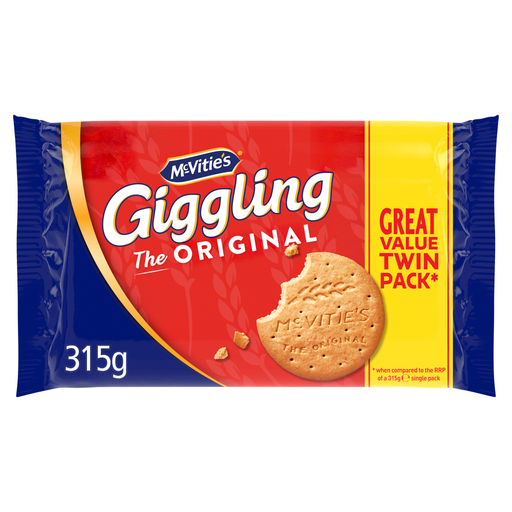 No image available
The two 315g packs offer a second pack to keep sealed during frequent shared tea breaks. This is a different size from the McVitie’s 2 x 400g pack described above; check its own label for ingredients and nutrition.
 No image available
A dark-chocolate digestive option in two 266g packs for a group that prefers chocolate flavour. Check this variant’s ingredients and per-100g nutrition separately from plain digestives.
Choose a 400g pack if the group is likely to use it soon after opening; choose a twin pack if breaks are frequent and keeping a second inner pack sealed helps. Follow the selected product’s storage directions once a pack is open.
No. Tesco, Sainsbury’s and Asda label the specific plain products discussed here as suitable for vegans, as does the McVitie’s Original 2 x 400g pack listed by Asda. That does not establish the status of other sizes or flavours: check the current pack, particularly for chocolate variants containing milk.
Compare the figures per 100g on each product’s label first, then look at any per-biscuit figures for the amount you plan to put out. The NHS identifies more than 5g saturated fat or 22.5g sugars per 100g as high on food labels; pack weight alone does not show those differences.
Read the highlighted ingredients and any “may contain” wording on the exact physical pack. The listed plain products contain wheat, but precautionary statements differ: Tesco’s plain digestives may contain peanuts and nuts, while Asda’s plain digestives may contain milk.
Use the nutrition information on the back to compare products per 100g. GOV.UK explains that front-of-pack traffic-light information may be displayed in addition to the required nutrition information on the back.