Households sharing across several snack breaks
Compare net weight and the stated biscuit count, where available, with the number of sittings you have in mind. Check the storage instructions if the pack will remain open.


For a snack shared over several sittings, compare a 400g plain pack with a 2 × 315g twin pack by how much your group will use; the larger pack is not automatically the better fit. Check the exact pack’s allergens and nutrition panel before sharing, especially if you are considering a chocolate-coated or gluten-free alternative.
Compare net weight and the stated biscuit count, where available, with the number of sittings you have in mind. Check the storage instructions if the pack will remain open.
A plain biscuit may suit a group that does not want a chocolate coating. Compare ingredients and nutrition for the exact pack rather than treating all plain digestives as identical.
Check each pack’s allergen declaration before serving it. The plain McVitie’s, Tesco and M&S products described here contain wheat; an explicitly gluten-free alternative has a different pack size and allergen profile.
Start with how many sittings the pack needs to cover, then check dietary suitability and the label for the biscuits people will actually eat.
| Priority | What to check | Your needs |
|---|---|---|
| Pack size | Compare total net weight, not just the number of packets. Check the typical biscuit count if stated and follow the pack’s storage instructions after opening. | I’m putting biscuits out more than once, so I want enough for those sittings without leaving an opened pack unused for too long. |
| Allergens | Read the exact pack’s ingredients, allergen declaration and any may-contain statement. Look for an explicit gluten-free label if gluten must be avoided. | Someone sharing may need to avoid wheat or another ingredient. A biscuit labelled gluten free still needs its other allergens checked. |
| Nutrition | Use figures per 100g to compare different biscuit sizes, then look at per-biscuit figures for the serving you intend to put out. Keep plain and chocolate-coated variants distinct. | I want to compare the sugar and saturates listed for the actual products, rather than assume that the word “digestive” or a particular coating tells me enough. |
| Biscuit style | Check whether the pack contains plain or chocolate-coated biscuits and whether its weight suits the group. A gluten-free chocolate digestive is not a like-for-like substitute for a larger plain pack. | For this gathering, people’s preference for plain or chocolate biscuits matters alongside how many biscuits we need. |
The product name does not tell you its nutritional composition or establish a digestive-health benefit.
Use the ingredients and nutrition panel for the exact biscuit instead of drawing a conclusion from its name.
Plain digestives can contain wheat, while other ingredients and may-contain statements vary. Tesco’s 400g plain digestives, for example, state that they may contain peanuts and nuts.
Read the current pack label before serving biscuits to people with different dietary requirements.
Per-biscuit values can reflect different biscuit sizes. Tesco’s gluten-free chocolate digestives and M&S plain digestives also have different listed sugar and saturates values per 100g.
Compare per 100g for a like-for-like quantity, then use the per-biscuit figure when deciding how many to serve.
England’s School Food Regulations address food provided in the school settings they cover; they do not establish one rule for every household snack or every UK nation. England’s retail HFSS promotion rules address a different activity.
If biscuits are being provided at a school, check which nation’s rules apply and whether the food is part of a school lunch. Do not assume a named digestive has a particular HFSS classification without checking that product.
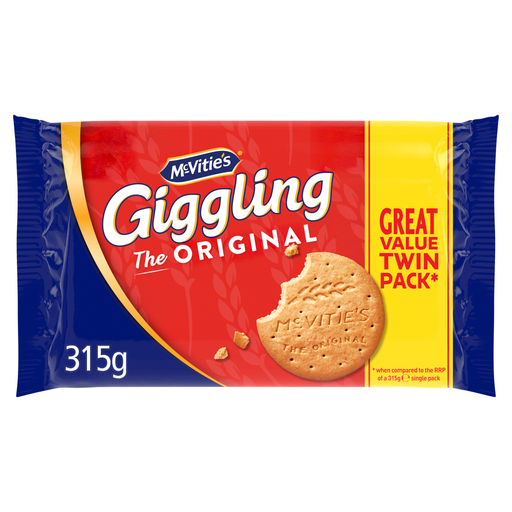
The Original is a plain digestive available in a 2 × 315g twin pack, a format to consider for more than one sharing occasion.
Tesco lists a 400g plain digestive and a separate 166g gluten-free chocolate digestive. They serve different pack-size and dietary needs.
M&S describes its 400g plain digestives as made with demerara sugar for a crisper texture.
These options cover a 400g sugar-free digestive, a plain twin pack and a dark-chocolate twin pack for shared afternoon snacks. Check the pack label for everyone who will be eating them.
 No image available
The 400g pack is a sharing-size option for people seeking this sugar-free variant. It contains wheat and may contain milk and soya; the product information warns that excessive consumption may have a laxative effect.
 No image available
The two plain packs provide 630g in total for repeated sharing; ASDA Groceries states a typical 42 biscuits per twin pack. The Original contains wheat and may contain milk.
 No image available
This 532g twin pack is the dark-chocolate option for a group that prefers coated biscuits. It contains wheat, milk and soya; use its own nutrition panel rather than the figures for plain digestives.
No. Compare the net weight with the number of people and snack sittings you expect, and check how the biscuits should be stored once opened. A twin pack offers more biscuits, but that only helps if your group will use them.
Do not assume so: the McVitie’s, Tesco and M&S plain digestives described here contain wheat. Look for an explicitly gluten-free product and check its other allergens; Tesco’s 166g Free From Chocolate Digestives contain milk and soya.
For the England school provision covered by the Requirements for School Food Regulations 2014, biscuits must not be provided as food outside a school lunch. Check the school setting and which UK nation’s rules apply; this England rule does not itself decide what a parent may put in a packed lunch.
No. The Department of Health and Social Care’s guidance concerns promotion and placement restrictions for certain products sold by businesses operating in and selling to England. Those retail rules are separate from England’s school-food rules and do not, by themselves, establish the classification of every digestive biscuit.
Follow the instructions on the pack. Tesco and M&S instruct shoppers to keep their plain digestives in a cool, dry place and use an airtight container after opening.