What matters when choosing a pack?
Decide whether the biscuits are for cupboard snacking or for eating during a run, then compare pack quantity, portions and ingredients for the exact recipe.
| Priority |
What to check |
Your needs |
| Pack quantity |
Read both the number of packets and their individual weights. ASDA Groceries lists a McVitie's Original 2 × 400 g twin pack; Joybuy UK lists a differently sized 2 × 315 g pack. |
I want enough biscuits to share across training sessions without choosing more than we expect to use. |
| Portions |
Use the carbohydrate figure for one biscuit on the exact label, alongside its stated serving size. ASDA Groceries lists 9.3 g per biscuit for its McVitie's Original twin pack and 11 g for ASDA Digestives 400 g; Sainsbury's lists 9.9 g for its Digestives 400 g. |
If I am planning portions, I need to know what one biscuit in the pack I choose contributes, rather than treating different biscuits as identical. |
| Ingredients |
Check the current ingredients and allergen statements for each recipe. ASDA Groceries declares wheat and a may-contain-milk statement for its plain 400 g pack; its McVitie's Dark Chocolate 400 g listing declares milk, wheat and soya. |
Everyone sharing the biscuits needs to be able to check the exact pack against their own ingredient requirements. |
| Eating during a run |
Consider carrying, opening, portioning and eating the food while moving. The Australian Institute of Sport describes sports bars as a compact option when athletes carry their own food, and a typical sports-gel sachet as providing 20–30 g carbohydrate. |
If I need something to carry on a long run, the food’s format matters as well as its carbohydrate content. |
| Opened-pack storage |
Read the instructions on the pack you buy. The ASDA and Sainsbury's plain digestive listings advise storing biscuits in an airtight container after opening. |
Our household may eat the biscuits over several sessions, so I need a workable way to store an opened packet. |
Brand and recipe references
The pack and recipe matter more than the brand name alone: these retailer listings describe different quantities, portions and ingredients, and do not establish which products are available on Joybuy.
McVitie's
ASDA Groceries lists an Original plain twin pack and a separate dark-chocolate 400 g pack.
- The listed Original twin pack contains 2 × 400 g and gives nutrition per biscuit.
- The dark-chocolate pack has a different recipe and allergen declaration; do not apply its figures to the plain pack or to another pack size.
ASDA
Its own-brand plain Digestives come in a single 400 g pack.
- ASDA Groceries lists carbohydrate and fat per biscuit and advises airtight storage after opening.
- The listing declares wheat and says the biscuits may contain milk; check the current pack when sharing.
Sainsbury's
Its plain Digestives are listed in a 400 g pack with approximately 27 servings.
- The Sainsbury's listing gives nutrition per biscuit and recommends airtight storage after opening.
- Sainsbury's advises checking the physical label because product details can change.
M&S
M&S lists a plain 400 g digestive biscuit pack made with demerara sugar.
- Its published nutrition includes values per 100 g, allowing a comparison on that stated basis.
- For a biscuit-sized portion, use serving information from the exact pack rather than treating a per-100 g figure as a per-biscuit value.
Tesco
Tesco's listing describes a plain 400 g digestive pack.
- The listing gives nutrition per biscuit and an ingredients declaration.
- It lists dried skimmed milk and says the biscuits may contain peanuts and nuts. Check the current label and stock before relying on this option.
Joybuy digestive biscuit options
These Joybuy options are plain and chocolate-coated McVitie's digestives in single packs and twin packs for sharing as cupboard snacks around training. Check the exact pack if you are planning biscuit-sized portions or sharing with someone who has an allergy.
 No image available
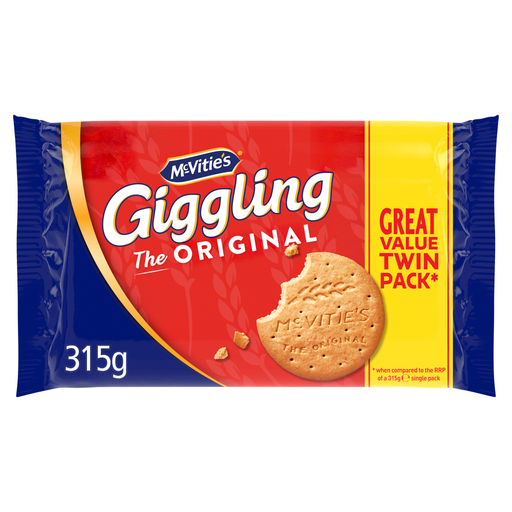
McVitie's Digestives the Original 2 × 315 g
For a household sharing biscuits over several training sessions, the two packets let you leave one unopened. Joybuy UK lists 42 biscuits across this pack; its 2 × 315 g quantity differs from the 2 × 400 g McVitie's Original pack listed by ASDA Groceries.
View on Joybuy
 No image available
McVitie's Digestives Milk Chocolate 400 g
This single 400 g pack is a chocolate-coated option for a shared cupboard snack. Check its own ingredients label before sharing, and use nutrition figures for this milk-chocolate recipe if you are planning portions.
View on Joybuy
 No image available
McVitie's Digestives Dark Chocolate 2 × 266 g
For sharing dark-chocolate biscuits over several sessions, this twin-pack format lets you leave one packet unopened. Check the exact pack’s ingredients and serving information if allergens or biscuit-sized portions affect your choice.
View on Joybuy
 No image available
McVitie's Digestives Dark Chocolate 400 g
If your group wants dark-chocolate digestives as a cupboard snack, this is a single 400 g pack rather than a twin pack. Check its current ingredients and serving details before sharing or planning portions.
View on Joybuy
Questions about sharing and training
Are digestives suitable to eat during every long run?
Do not assume so from carbohydrate content alone. The plain biscuit listings from ASDA Groceries and Sainsbury's give 9.3–11 g carbohydrate per biscuit for the specific packs described above, but carrying and eating biscuits while running is a separate consideration. Try any food you intend to eat on a run during training.
How should I store a sharing pack after opening it?
Follow the instructions on the pack. The ASDA and Sainsbury's plain digestive listings advise keeping opened biscuits in an airtight container.
How can I compare two digestive twin packs?
Check the number of packets and the weight of each one, then compare serving and ingredient information for the exact recipes. For example, Joybuy UK lists McVitie's Original as 2 × 315 g, while ASDA Groceries lists an Original twin pack as 2 × 400 g.
What should I check before sharing biscuits with someone who has an allergy?
Read the ingredients and any relevant precautionary statements on the exact physical pack. UK government food-labelling guidance says prepacked-food labels must include ingredients, including allergens; recipes and online product details can change.
Does a best-before date mean biscuits become unsafe the next day?
Not necessarily. UK government guidance distinguishes a best-before date, which concerns quality, from a use-by date, which concerns safety. Follow the date and storage instructions on the actual pack and check the biscuits for deterioration.


