People sharing biscuits during a game
A bowl for several players calls for a choice between a plain wheaty biscuit and a vanilla-filled one. Check dietary requirements before setting out a shared pack.


Choose a plain digestive if lower listed sugars per 100g matter more than a vanilla filling: McVitie's Original Digestives list 15.1g sugars and 3.7g fibre per 100g, compared with 26.5g sugars and 3.0g fibre for Sainsbury's Custard Creams. Choose a custard cream if the group wants a filled biscuit, but check the exact pack for allergens and nutrition values; neither biscuit name establishes dietary suitability.
A bowl for several players calls for a choice between a plain wheaty biscuit and a vanilla-filled one. Check dietary requirements before setting out a shared pack.
If listed sugars or fibre matter to your choice, compare the exact biscuits per 100g rather than relying on the word “digestive”. Saturated fat and salt remain worth checking too.
Standard custard creams in the reviewed Tesco and Sainsbury's ranges contain wheat and milk-derived ingredients. A guest needing a gluten-free or milk-free biscuit needs the relevant claim on the exact pack.
Start with any guest's dietary requirements, then compare the biscuit format and the figures on the packs you would put out.
| Priority | What to check | Your needs |
|---|---|---|
| Dietary suitability | Read the current ingredient and allergen information. Confirm any gluten-free or milk-free claim on the particular pack. | If a guest avoids gluten or milk, I need a biscuit with the appropriate label claim, not an assumption based on how a standard biscuit looks. |
| Sugars and fibre | Compare values per 100g on like-for-like packs. McVitie's lists 15.1g sugars and 3.7g fibre for Original Digestives; Sainsbury's lists 26.5g sugars and 3.0g fibre for its standard Custard Creams. | I'd choose between these two reviewed products by their listed values, rather than assume every digestive has the same recipe. |
| Saturated fat and salt | Check both figures as well as sugars. McVitie's lists 10.1g saturates and 1.3g salt per 100g for Original Digestives. | Lower listed sugars are only one part of my comparison; I want to see the rest of the nutrition panel too. |
| Biscuit and serving size | Decide whether the group wants a plain digestive or a filled custard cream. Use the pack's per-biscuit information when deciding how many to set out. | For a long session, I'd rather put out a chosen amount and keep the rest of the pack for later. |
McVitie's Original Digestives have lower listed sugars per 100g than the reviewed standard custard creams, but McVitie's also lists 10.1g saturates and 1.3g salt per 100g.
Compare sugars, fibre, saturated fat and salt on the exact packs. Check per-biscuit figures separately when deciding how much to serve.
The reviewed standard Tesco and Sainsbury's custard creams contain wheat and milk-derived ingredients; Tesco also lists possible sesame. McVitie's Original Digestives contain wheat and may contain milk.
Ask guests about requirements before buying, and read the current pack. If gluten-free or milk-free suitability is required, look for that explicit claim on the chosen product.
Sainsbury's Free From Custard Creams are labelled gluten free and milk free, while their panel lists 24.9g sugars and 13.0g saturates per 100g. Dietary suitability and nutrition values answer different questions.
Confirm the required free-from claim first, then compare nutrition panels among biscuits that meet the requirement.
These label examples help distinguish biscuit types; a brand name alone does not establish the ingredients or values of every product it makes.
Original Digestives provide a plain-biscuit reference for the comparison.
Its reviewed range includes standard Custard Creams and a separately labelled Free From version.
The reviewed standard Custard Creams come in a 400g pack.
The reviewed 300g Custard Creams are another standard filled-biscuit example.
Extra Cream Custard Creams are a filled-biscuit option that M&S describes as having more vanilla cream and real custard powder.
These options include plain and flavoured digestives alongside gluten-free biscuit variants. Compare each exact pack against the needs of your gaming group; the chocolate-coated digestive is not the plain biscuit used in the opening label comparison.
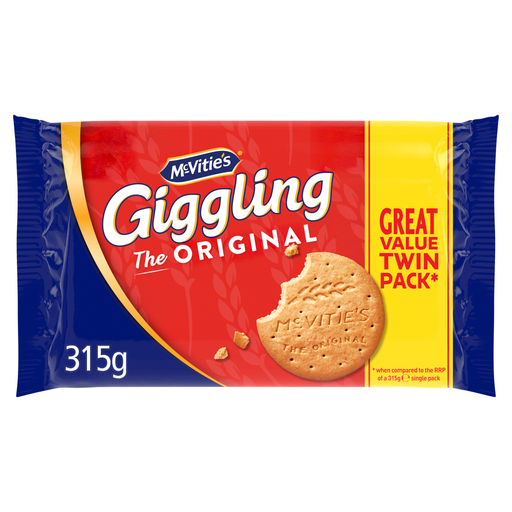 No image available
A plain digestive to consider when comparing listed sugars with standard custard creams. Joybuy's product information gives 15.1g sugars, 3.7g fibre, 10.1g saturates and 1.3g salt per 100g. Check the pack for wheat and possible milk before sharing.
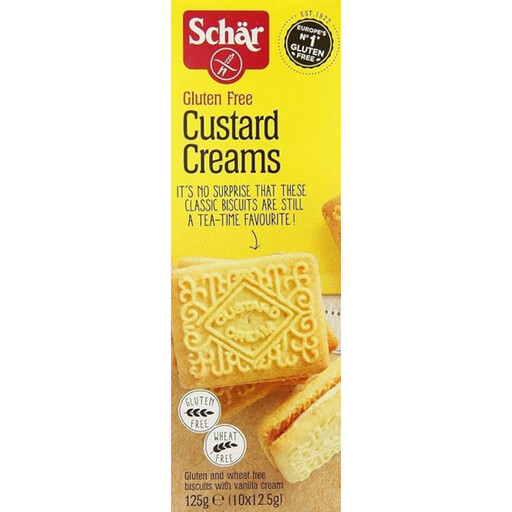 No image available
A custard-cream option labelled gluten free. If a guest also needs a milk-free biscuit, check the exact pack's ingredients and milk-free claims separately; gluten-free and lactose-free wording do not establish the same requirement.
 No image available
A differently labelled digestive for anyone comparing sugars across packs. Read its current nutrition panel, ingredients, sweetener information and any consumption advice rather than applying the figures for McVitie's Original Digestives to this product.
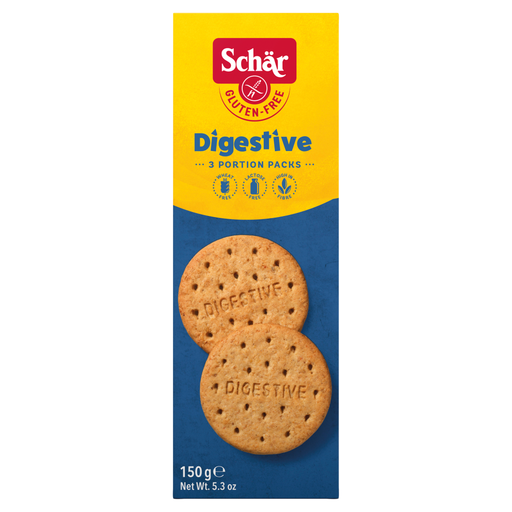 No image available
A digestive-style option labelled gluten free. Check the current pack for the full allergen information, including soya and possible lupin, before offering it to someone with additional requirements.
 No image available
A chocolate-coated digestive for a group choosing that format rather than a plain biscuit. Compare its own nutrition and allergen label with the custard creams under consideration; do not use the values for McVitie's Original Digestives as a substitute.
No biscuit name establishes that for every recipe. McVitie's Original Digestives list 15.1g sugars per 100g, compared with 26.5g for Sainsbury's standard Custard Creams and 28.3g for Tesco's reviewed pack; compare the exact products you plan to buy.
Check the current pack for the particular requirement. The reviewed Tesco and Sainsbury's standard custard creams contain wheat and milk-derived ingredients, while McVitie's Original Digestives contain wheat and may contain milk. Sainsbury's separate Free From Custard Creams are labelled gluten free and milk free; do not transfer those claims to another brand's product.
Use it to narrow your choice, then read the label on the pack received. Ingredients and allergen information can change, and a guest's requirement needs to match the current product rather than a similar-looking biscuit.
No: the Department of Health and Social Care's England guidance addresses certain retail promotions and placement, while the Department for Education publishes separate school-food standards. For a school-food decision, use the school guidance applicable at the time and the school's menu requirements; do not infer a ruling for a particular biscuit from its retail label alone.