
24/7 Customer Support

Free returns

Same-day & Next-day Delivery

Quality Guaranteed

Unlock Your Welcome Offers: FREE Delivery | Up to 80% OFF | Free 30-day JoyPlus trial
Download the APP
From achieving the perfect rise on a Victoria sponge to ensuring precise portion control for your weekly meal prep, a reliable digital kitchen scale is an indispensable tool in the modern British kitchen. Guesswork with measuring cups can lead to inconsistent results, but the accuracy of an electronic kitchen scale brings precision and repeatability to all your culinary projects.
However, with so many options available, choosing the right one can feel overwhelming. Should you opt for a sleek glass design or a durable stainless steel model? Is a 5kg capacity enough, or do you need more? This guide is designed to cut through the clutter, offering practical advice to help you find a food weighing scale that fits your needs, your kitchen and your cooking style.
Before we explore our recommendations, let's cover a few key features to consider. Focusing on these will help you make a more informed decision.
The two most important specifications of any kitchen scale are its maximum capacity and its graduation—the smallest increment it can measure.
Your weighing scales for kitchen use will likely see frequent action, so the material affects both its longevity and how easy it is to maintain.
Beyond basic weighing, several features enhance a scale's usability:
As the Joybuy Product Recommendation Officer, I've filtered through various models to highlight a few that stand out for their features, design and practicality.

Why It Stands Out: This scale integrates modern technology with high-capacity weighing. Its standout feature is the Bluetooth connectivity, which pairs with a companion app for detailed dietary tracking. Combined with a generous 10kg capacity and a sleek tempered glass surface, it’s a powerful tool for those serious about precision.
Pros:
Who is it for?: Health-conscious individuals who want to precisely track their nutritional intake, as well as home cooks who need a higher weight capacity for ambitious kitchen projects.
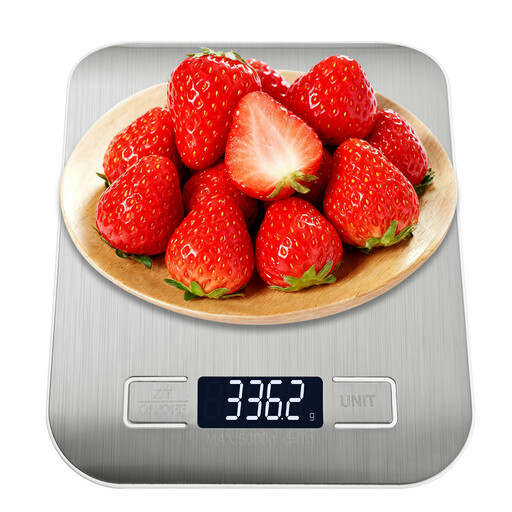
Why It Stands Out: The Vivreal scale combines functionality with a remarkably slim profile. At just 1.5cm thick, this slim food scale is easy to store in a drawer. Its brushed stainless steel platform is treated with an anti-fingerprint finish, ensuring it remains looking sharp on your worktop. It’s a practical and stylish workhorse for daily use.
Pros:
Who is it for?: The everyday home cook and baker who values a balance of style, accuracy and a space-saving design. It’s an excellent all-rounder for a wide range of kitchen tasks.
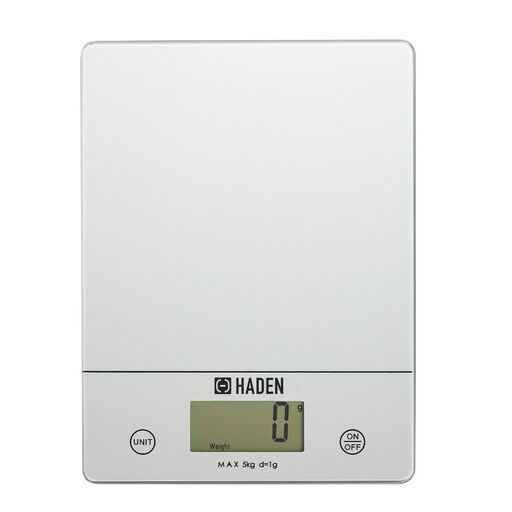
Why It Stands Out: The Haden scale focuses on simplicity and practicality. Its tempered safety glass surface and intuitive touch-button interface make it incredibly user-friendly. A particularly useful feature is its ability to measure the volume of water and milk, which is a great help for bakers who need liquid precision.
Pros:
Who is it for?: Home bakers and cooks who appreciate straightforward functionality and a clean, modern aesthetic. The dedicated liquid measurement function makes it a great choice for those who bake frequently.
While these three models cover a range of common needs, the ideal scale is a personal choice. If you're looking for different materials, capacities or features, there are many other excellent tools available.
Explore our full collection of professional kitchen accessories to find the perfect match for your culinary needs.
Yes, modern digital food scales are generally very accurate, most often measuring in 1-gram increments. To ensure accuracy, always place your scale on a flat, stable surface, wait for it to calibrate to zero before adding ingredients and avoid exceeding its maximum weight capacity.
Using a food weighing scale in grams is simple and effective for scales for meal prep. Place your empty plate or container on the scale and press the 'tare' or 'zero' button. The display will reset to 0. Then, add your food until you reach your desired portion weight. You can repeat this process for multiple food items in the same container by pressing 'tare' after adding each one.
The terms are often used interchangeably. Any accurate digital kitchen scale can be used for baking. However, a dedicated baking scale must have at least 1g precision and a reliable tare function, as baking recipes require exact measurements of ingredients like flour, sugar and leavening agents to achieve consistent results. All the scales recommended in this article are well-suited for baking.